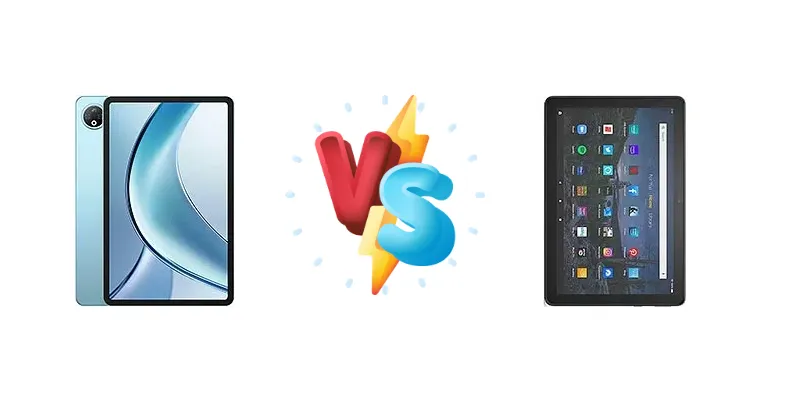
The tablet market offers a wide range of options, but finding the right balance between performance, battery life, and price can be challenging. We pit the Doogee V Pad, a newer entrant focused on endurance and processing power, against the established Amazon Fire HD 10 Plus (2021), known for its affordability and ecosystem integration, to determine which tablet best suits your needs.
🏆 Quick Verdict
For users prioritizing sustained performance and longevity, the Doogee V Pad emerges as the winner. Its newer Mediatek MT8791 chipset, built on a 6nm process, offers a significant architectural advantage over the Fire HD 10 Plus’s older 12nm Helio P60T. While the Fire HD 10 Plus boasts wireless charging, the V Pad’s exceptional 92-hour endurance makes it the better choice for power users.
| Network |
|---|
| 2G bands | GSM 850 / 900 / 1800 / 1900 | N/A |
| 3G bands | HSDPA 850 / 900 / 1900 / 2100 | - |
| 4G bands | 1, 3, 5, 7, 8, 20, 28, B34, 38, 39, 40, 41 | - |
| 5G bands | 1, 3, 7, 8, 28, 38, 41, 77, 78 SA/NSA | - |
| EDGE | - | No |
| GPRS | - | No |
| Speed | HSPA, LTE, 5G | - |
| Technology | GSM / HSPA / LTE / 5G | No cellular connectivity |
| Launch |
|---|
| Announced | 2025, June | 2021, April 27. Released 2021, May 26 |
| Status | Available. Released 2025, June | Discontinued |
| Body |
|---|
| Dimensions | 279.5 x 175 x 8 mm (11.00 x 6.89 x 0.31 in) | 247 x 166 x 9.2 mm (9.72 x 6.54 x 0.36 in) |
| SIM | Nano-SIM + Nano-SIM | No |
| Weight | 572 g (1.26 lb) | 468 g (1.03 lb) |
| Display |
|---|
| Protection | Mohs level 5 | Aluminosilicate glass |
| Resolution | 1200 x 2000 pixels, 5:3 ratio (~194 ppi density) | 1920 x 1200 pixels, 16:10 ratio (~224 ppi density) |
| Size | 12.0 inches, 409.9 cm2 (~83.8% screen-to-body ratio) | 10.1 inches, 295.8 cm2 (~72.1% screen-to-body ratio) |
| Type | IPS LCD | IPS LCD |
| Platform |
|---|
| CPU | Octa-core (2x2.6 GHz Cortex-A78 & 6x2.0 GHz Cortex-A55) | Octa-core (4x2.0 GHz Cortex-A73 & 4x2.0 GHz Cortex-A53) |
| Chipset | Mediatek MT8791 (6 nm) | Mediatek MT8183 Helio P60T (12 nm) |
| GPU | Mali-G68 MC4 | Mali-G72 MP3 |
| OS | Android 15 | Android 9.0 (Pie), Fire OS 7 |
| Memory |
|---|
| Card slot | microSDXC (uses shared SIM slot) | microSDXC (dedicated slot) |
| Internal | 256GB 8GB RAM | 32GB 4GB RAM, 64GB 4GB RAM |
| | - | eMMC 5.1 |
| Main Camera |
|---|
| Features | LED flash | - |
| Single | 13 MP | 5 MP |
| Video | 1080p@30fps | 720p |
| Selfie camera |
|---|
| Single | 8 MP | 2 MP |
| Video | Yes | 720p |
| Sound |
|---|
| 3.5mm jack | - | Yes |
| 35mm jack | No | Yes |
| Loudspeaker | Yes, with stereo speakers (4 speakers) | Yes, with stereo speakers |
| Comms |
|---|
| Bluetooth | 5.2, A2DP, LE | 5.0, A2DP, LE |
| NFC | No | No |
| Positioning | GPS, GALILEO, GLONASS, BDS | No |
| Radio | No | No |
| USB | USB Type-C | USB Type-C 2.0, OTG |
| WLAN | Wi-Fi 802.11 a/b/g/n/ac/6, dual-band | Wi-Fi 802.11 a/b/g/n/ac, dual-band |
| Features |
|---|
| Sensors | - | Accelerometer |
| | - | Text-to-Speech English-language content reader |
| Battery |
|---|
| Charging | 10W wired | Wireless |
| Type | 8800 mAh | Li-Ion |
| Misc |
|---|
| Colors | Black, Blue | Slate |
| Models | - | T76N2P |
| Price | About 350 EUR | About 150 EUR |
| EU LABEL |
|---|
| Battery | 92:32h endurance, 800 cycles | - |
| Energy | Class E | - |
| Free fall | Class C (104 falls) | - |
| Repairability | Class B | - |
Doogee V Pad
- Superior processor performance with the MT8791 chipset.
- Exceptional battery life (92 hours endurance).
- Longer battery lifespan with 800 charge cycles.
- Slow 10W wired charging.
- Display specifications are unknown.
Amazon Fire HD 10 Plus (2021)
- Affordable price point.
- Wireless charging convenience.
- Integration with Amazon’s ecosystem.
- Older and less efficient chipset (MT8183).
- Significantly shorter battery life compared to the Doogee V Pad.
Display Comparison
Neither device’s display specifications are provided, so a direct comparison is limited. However, given the Fire HD 10 Plus’s market positioning, it likely utilizes an IPS LCD panel. The Doogee V Pad, being a newer device, *may* incorporate a more advanced panel technology, but this is speculative. The key differentiator will likely be color accuracy and peak brightness, areas where newer tablets generally excel. Bezels are also a factor; a more modern design on the V Pad is probable.
Camera Comparison
Camera specifications are not provided for either device. Given the price point of the Fire HD 10 Plus, its camera system is likely basic, focused on video calls rather than photography. The Doogee V Pad, while not positioned as a camera-centric device, may offer a slightly more capable camera system due to its newer design and potential for larger sensors. Without specific details, it’s difficult to make a definitive assessment.
Performance
The Doogee V Pad’s Mediatek MT8791 chipset, fabricated on a 6nm process, represents a substantial leap forward compared to the Amazon Fire HD 10 Plus’s 12nm Mediatek MT8183 Helio P60T. The 6nm node allows for greater transistor density and improved power efficiency. Architecturally, the V Pad’s octa-core CPU (2x2.6 GHz Cortex-A78 & 6x2.0 GHz Cortex-A55) is superior to the Fire HD 10 Plus’s (4x2.0 GHz Cortex-A73 & 4x2.0 GHz Cortex-A53). The Cortex-A78 cores in the V Pad offer significantly higher single-core performance, crucial for responsive UI and app loading. This translates to a smoother experience, especially for multitasking and demanding applications.
Battery Life
The Doogee V Pad’s 92:32h endurance is a standout feature, indicating exceptional battery life. This is likely a result of the efficient 6nm chipset and optimized power management. While the Fire HD 10 Plus offers the convenience of wireless charging, it lacks the sheer longevity of the V Pad. The V Pad’s 800 charge cycles also suggest a longer lifespan before battery degradation becomes noticeable. The Fire HD 10 Plus’s charging speed is not specified, but the V Pad’s 10W wired charging is relatively slow, though less critical given its extended runtime.
Buying Guide
Buy the Doogee V Pad if you need a tablet capable of handling demanding tasks, extended use without frequent charging, and a more modern processor architecture. This is ideal for professionals on the go or users who consume a lot of media. Buy the Amazon Fire HD 10 Plus (2021) if you prioritize affordability, seamless integration with Amazon’s ecosystem, and wireless charging convenience, making it a great choice for casual users and families.
Frequently Asked Questions
❓ Will the Doogee V Pad handle demanding games like Genshin Impact or Call of Duty Mobile?
The Doogee V Pad’s Mediatek MT8791 chipset, with its Cortex-A78 cores, offers a significant performance boost over the Fire HD 10 Plus. While it won’t match flagship smartphone performance, it should be capable of running many popular games at medium settings. However, sustained performance will depend on thermal management, which is not specified.
❓ Is the Amazon Fire HD 10 Plus a good choice for reading ebooks and browsing the web?
The Amazon Fire HD 10 Plus excels at basic tasks like ebook reading and web browsing. Its integration with Amazon’s Kindle ecosystem and affordable price make it a compelling option for these use cases. However, the older chipset may result in slightly slower page loading times compared to the Doogee V Pad.
❓ How does the 6nm process of the MT8791 impact the Doogee V Pad’s battery life?
The 6nm fabrication process of the MT8791 chipset is significantly more power-efficient than the 12nm process used in the Fire HD 10 Plus’s MT8183. This means the MT8791 consumes less power for the same level of performance, directly contributing to the Doogee V Pad’s impressive 92-hour endurance.