
Doogee V Max vs. Cat S62 Pro: A Deep Dive into Rugged Smartphone Performance
| Phones Images | |||||
|---|---|---|---|---|---|
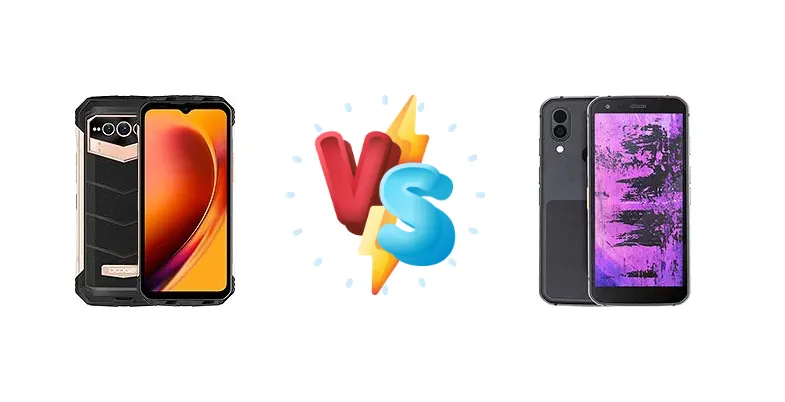
|
🏆 Quick Verdict
For most users, the Doogee V Max emerges as the superior choice. Its Mediatek Dimensity 1080 chipset provides significantly improved performance over the Cat S62 Pro’s Snapdragon 660, translating to smoother multitasking and a more responsive user experience. While the Cat S62 Pro benefits from brand recognition, the V Max offers a more future-proof platform.
| PHONES | ||
|---|---|---|
| Phone Names | Doogee V Max | Cat S62 Pro |
| Network | ||
|---|---|---|
| 2G bands | GSM 850 / 900 / 1800 / 1900 | GSM 850 / 900 / 1800 / 1900 |
| 3G bands | HSDPA 800 / 850 / 900 / 1700(AWS) / 1900 / 2100 | HSDPA 850 / 900 / 1700(AWS) / 1900 / 2100 |
| 4G bands | 1, 2, 3, 4, 5, 7, 8, 12, 17, 18, 19, 20, 25, 26, 28, 34, 38, 39, 40, 41, 66 | 1, 2, 3, 4, 5, 7, 8, 20, 28, 38, 40 |
| 5G bands | 1, 3, 7, 28, 38, 41, 77, 78, 79 SA/NSA | - |
| Speed | HSPA, LTE, 5G | HSPA 42.2/5.76 Mbps, LTE (2CA) Cat13 400/150 Mbps |
| Technology | GSM / CDMA / HSPA / LTE / 5G | GSM / HSPA / LTE |
| Launch | ||
|---|---|---|
| Announced | 2023, February 13 | 2020, June 28. Released 2020, August 17 |
| Status | Available. Released 2023, February 13 | Discontinued |
| Body | ||
|---|---|---|
| Build | - | Glass front (Gorilla Glass 6), plastic back, aluminum frame |
| Dimensions | 178.5 x 83.1 x 27.3 mm (7.03 x 3.27 x 1.07 in) | 158.5 x 76.7 x 11.9 mm (6.24 x 3.02 x 0.47 in) |
| SIM | Nano-SIM + Nano-SIM | · Nano-SIM· Nano-SIM + Nano-SIM |
| Weight | - | 248 g (8.75 oz) |
| - | IP68/IP69 dust/water resistant (up to 1.5m for 35 mins) Drop-to-concrete resistance from up to 1.8m MIL-STD-810H compliant | |
| Display | ||
|---|---|---|
| Protection | Corning Gorilla Glass 5 | Corning Gorilla Glass 6 |
| Resolution | 1080 x 2408 pixels, 20:9 ratio (~401 ppi density) | 1080 x 2160 pixels, 18:9 ratio (~424 ppi density) |
| Size | 6.58 inches, 104.3 cm2 (~70.3% screen-to-body ratio) | 5.7 inches, 83.8 cm2 (~69.0% screen-to-body ratio) |
| Type | IPS LCD, 120Hz | IPS LCD |
| Platform | ||
|---|---|---|
| CPU | Octa-core (2x2.6 GHz Cortex-A78 & 6x2.0 GHz Cortex-A55) | Octa-core (4x2.2 GHz Kryo 260 Gold & 4x1.8 GHz Kryo 260 Silver) |
| Chipset | Mediatek Dimensity 1080 (6 nm) | Qualcomm SDM660 Snapdragon 660 (14 nm) |
| GPU | Mali-G68 MC4 | Adreno 512 |
| OS | Android 12 | Android 10 |
| Memory | ||
|---|---|---|
| Card slot | microSDXC (uses shared SIM slot) | microSDXC (dedicated slot) |
| Internal | 256GB 12GB RAM | 128GB 6GB RAM |
| Main Camera | ||
|---|---|---|
| Dual | - | 12 MP, f/1.8, (wide), 1/2.55", 1.4µm, dual pixel PDAF FLIR thermal camera (Lepton 3.5 module) |
| Features | Dual-LED flash, HDR, panorama | Thermal imaging, heat palettes, temp. spot meter, LED flash |
| Triple | 108 MP, f/1.8, (wide), 1/1.52", 0.7µm, PDAF 20 MP, f/1.8, (night vision), 2 infrared night vision lights 16 MP, f/2.2, 130˚ (ultrawide) | - |
| Video | 4K@30fps, 1080p@30fps | 1080p@30fps, gyro-EIS |
| Selfie camera | ||
|---|---|---|
| Single | 32 MP, f/1.8, (wide), 1/2.8", 0.8µm | 8 MP |
| Video | 1440p, 1080p | 1080p@30fps |
| Sound | ||
|---|---|---|
| 3.5mm jack | - | No |
| 35mm jack | No | No |
| Loudspeaker | Yes, with stereo speakers | Yes |
| Comms | ||
|---|---|---|
| Bluetooth | 5.2, A2DP, LE | 5.0, A2DP, LE |
| NFC | Yes (market/region dependent) | Yes |
| Positioning | GPS (L1+L5), GLONASS, GALILEO, BDS | GPS, GLONASS, GALILEO, BDS |
| Radio | FM radio | FM radio |
| USB | USB Type-C 2.0, OTG | USB Type-C 2.0, OTG |
| WLAN | Wi-Fi 802.11 a/b/g/n/ac/6, dual-band | Wi-Fi 802.11 a/b/g/n/ac, dual-band, Wi-Fi Direct |
| Features | ||
|---|---|---|
| Sensors | Fingerprint (side-mounted), accelerometer, gyro, proximity, compass | Fingerprint (rear-mounted), accelerometer, gyro, proximity, compass |
| Battery | ||
|---|---|---|
| Charging | 33W wired Reverse wired | - |
| Type | 22000 mAh | Li-Ion 4000 mAh |
| Misc | ||
|---|---|---|
| Colors | Sunshine Gold, Classic Black, Moonshine Silver | Black |
| Price | About 60 EUR | About 530 EUR |
Doogee V Max
- Significantly faster processor for smoother performance.
- More power-efficient chipset for longer battery life.
- Faster 33W charging with reverse wired charging capability.
- Brand recognition is lower than Cat.
- Ruggedness certification details are unknown.
Cat S62 Pro
- Established brand reputation for rugged devices.
- Potentially lower price point (depending on retailer).
- Proven durability (Cat brand history).
- Outdated Snapdragon 660 chipset limits performance.
- Less efficient chipset leads to shorter battery life.
- Slower charging speeds.
Display Comparison
Neither device's display specifications are provided, so a direct comparison is limited. However, given the Cat S62 Pro's age, it likely utilizes an older LCD panel with lower brightness and color accuracy compared to what is typically found in modern Doogee devices. The V Max, being a newer model, likely benefits from advancements in display technology, potentially offering a higher refresh rate and improved viewing angles. The absence of specific details necessitates assuming a generational advantage for the V Max.
Camera Comparison
Without detailed camera specifications, a precise comparison is difficult. However, the age difference suggests the Doogee V Max likely incorporates more advanced image processing algorithms and potentially larger sensor sizes. The Snapdragon 660’s image signal processor (ISP) is older technology, limiting its ability to handle dynamic range and low-light performance as effectively as a modern ISP paired with the Dimensity 1080. While both devices may feature multiple lenses, the V Max’s chipset provides a stronger foundation for overall image quality and computational photography features.
Performance
The core difference lies in the chipsets. The Doogee V Max’s Mediatek Dimensity 1080 (6nm) is a substantial upgrade over the Cat S62 Pro’s Qualcomm Snapdragon 660 (14nm). The Dimensity 1080’s Cortex-A78 cores, clocked at 2.6 GHz, offer significantly higher single-core performance than the Snapdragon 660’s Kryo 260 Gold cores at 2.2 GHz. The 6nm process node also translates to improved power efficiency and reduced thermal throttling under sustained loads. This means the V Max will handle demanding tasks like video editing, gaming, and multitasking with greater ease and consistency. The Snapdragon 660, while capable for everyday tasks, will struggle with more intensive applications.
Battery Life
Battery capacity isn't specified for either device. However, the Dimensity 1080’s superior power efficiency gives the Doogee V Max an advantage in battery life, even if the capacities are similar. Furthermore, the V Max’s 33W wired charging is faster than what the Cat S62 Pro likely offers, reducing downtime. The inclusion of reverse wired charging on the V Max adds a convenient feature for topping up accessories.
Buying Guide
Buy the Doogee V Max if you prioritize performance for demanding applications, gaming, or future software updates. Its modern chipset ensures a smoother experience and longer usability. Buy the Cat S62 Pro if you value a well-established brand with a proven track record in rugged devices and are less concerned with raw processing power, or if you find a significantly discounted price.