
Doogee V Max vs. Blackview BV9200: A Deep Dive into Rugged Smartphone Performance
| Phones Images | |||||
|---|---|---|---|---|---|
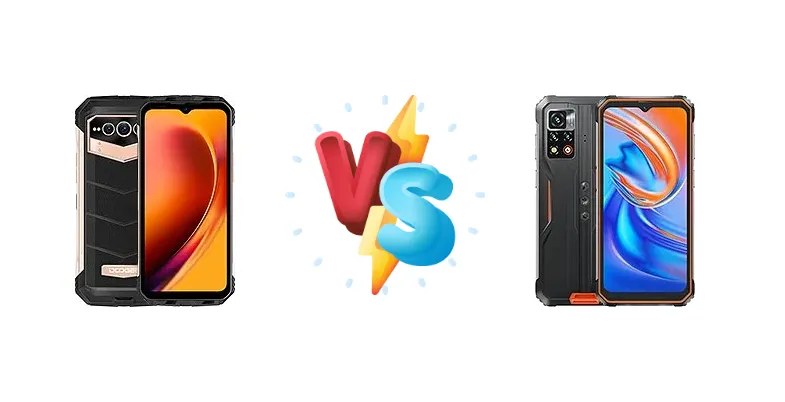
|
🏆 Quick Verdict
For users prioritizing raw processing power and future-proofing, the Doogee V Max is the clear winner. Its Dimensity 1080 chipset provides a significant performance advantage. However, the Blackview BV9200 appeals to those who value faster charging speeds – including wireless – and a brighter display for outdoor visibility.
| PHONES | ||
|---|---|---|
| Phone Names | Doogee V Max | Blackview BV9200 |
| Network | ||
|---|---|---|
| 2G bands | GSM 850 / 900 / 1800 / 1900 | GSM 850 / 900 / 1800 / 1900 |
| 3G bands | HSDPA 800 / 850 / 900 / 1700(AWS) / 1900 / 2100 | HSDPA 850 / 900 / 1700(AWS) / 1900 / 2100 |
| 4G bands | 1, 2, 3, 4, 5, 7, 8, 12, 17, 18, 19, 20, 25, 26, 28, 34, 38, 39, 40, 41, 66 | 1, 2, 3, 4, 5, 7, 8, 12, 13, 17, 18, 19, 20, 25, 26, 28, 34, 38, 39, 40, 41, 66 |
| 5G bands | 1, 3, 7, 28, 38, 41, 77, 78, 79 SA/NSA | - |
| Speed | HSPA, LTE, 5G | HSPA, LTE |
| Technology | GSM / CDMA / HSPA / LTE / 5G | GSM / CDMA / HSPA / LTE |
| - | CDMA 800 / 1900 | |
| Launch | ||
|---|---|---|
| Announced | 2023, February 13 | 2022, December 28 |
| Status | Available. Released 2023, February 13 | Available. Released 2023, January 09 |
| Body | ||
|---|---|---|
| Dimensions | 178.5 x 83.1 x 27.3 mm (7.03 x 3.27 x 1.07 in) | 174.5 x 81.8 x 13.6 mm (6.87 x 3.22 x 0.54 in) |
| SIM | Nano-SIM + Nano-SIM | Nano-SIM + Nano-SIM |
| Weight | - | 310 g (10.93 oz) |
| - | IP68/IP69K dust/water resistant (up to 1.5m for 30 min) Drop-to-concrete resistance from up to 1.8m MIL-STD-810H compliant | |
| Display | ||
|---|---|---|
| Protection | Corning Gorilla Glass 5 | Corning Gorilla Glass 5 |
| Resolution | 1080 x 2408 pixels, 20:9 ratio (~401 ppi density) | 1080 x 2408 pixels, 20:9 ratio (~400 ppi density) |
| Size | 6.58 inches, 104.3 cm2 (~70.3% screen-to-body ratio) | 6.6 inches, 104.9 cm2 (~73.5% screen-to-body ratio) |
| Type | IPS LCD, 120Hz | IPS LCD, 120Hz |
| Platform | ||
|---|---|---|
| CPU | Octa-core (2x2.6 GHz Cortex-A78 & 6x2.0 GHz Cortex-A55) | Octa-core (2x2.05 GHz Cortex-A76 & 6x2.0 GHz Cortex-A55) |
| Chipset | Mediatek Dimensity 1080 (6 nm) | Mediatek MT6781 Helio G96 (12 nm) |
| GPU | Mali-G68 MC4 | Mali-G52 MC2 |
| OS | Android 12 | Android 12, Doke-OS 3.1 |
| Memory | ||
|---|---|---|
| Card slot | microSDXC (uses shared SIM slot) | microSDXC (dedicated slot) |
| Internal | 256GB 12GB RAM | 256GB 8GB RAM |
| - | UFS 2.1 | |
| Main Camera | ||
|---|---|---|
| Features | Dual-LED flash, HDR, panorama | LED flash, HDR, panorama |
| Single | - | 16 MP, (wide), 1/3", 1.0µm |
| Triple | 108 MP, f/1.8, (wide), 1/1.52", 0.7µm, PDAF 20 MP, f/1.8, (night vision), 2 infrared night vision lights 16 MP, f/2.2, 130˚ (ultrawide) | 50 MP, f/1.8, (wide), 1/2.76", 0.64µm, PDAF 8 MP, f/1.8, 120˚, (ultrawide), AF Auxiliary lens |
| Video | 4K@30fps, 1080p@30fps | 1440p@30fps, 1080p@30fps |
| Selfie camera | ||
|---|---|---|
| Single | 32 MP, f/1.8, (wide), 1/2.8", 0.8µm | 16 MP, f/2.0, (wide), 1/3", 1.0µm |
| Video | 1440p, 1080p | 1080p |
| Sound | ||
|---|---|---|
| 3.5mm jack | - | No |
| 35mm jack | No | No |
| Loudspeaker | Yes, with stereo speakers | Yes, with dual speakers |
| Comms | ||
|---|---|---|
| Bluetooth | 5.2, A2DP, LE | 5.2, A2DP, LE |
| NFC | Yes (market/region dependent) | Yes |
| Positioning | GPS (L1+L5), GLONASS, GALILEO, BDS | GPS, GLONASS, GALILEO, BDS |
| Radio | FM radio | FM radio |
| USB | USB Type-C 2.0, OTG | USB Type-C, OTG |
| WLAN | Wi-Fi 802.11 a/b/g/n/ac/6, dual-band | Wi-Fi 802.11 a/b/g/n/ac, dual-band |
| Features | ||
|---|---|---|
| Sensors | Fingerprint (side-mounted), accelerometer, gyro, proximity, compass | Fingerprint (side-mounted), accelerometer, gyro, proximity, compass, barometer |
| Battery | ||
|---|---|---|
| Charging | 33W wired Reverse wired | 66W wired 30W wireless |
| Type | 22000 mAh | 5000 mAh |
| Misc | ||
|---|---|---|
| Colors | Sunshine Gold, Classic Black, Moonshine Silver | Black, Orange, Green |
| Price | About 60 EUR | About 200 EUR |
Doogee V Max
- Significantly more powerful processor (Dimensity 1080)
- More efficient 6nm manufacturing process
- Potentially better camera image processing
- Slower charging speeds (33W wired)
- No wireless charging
Blackview BV9200
- Faster charging (66W wired, 30W wireless)
- Brighter display (481 nits)
- High contrast ratio (1423:1)
- Less powerful processor (Helio G96)
- Less efficient 12nm manufacturing process
Display Comparison
The Blackview BV9200 boasts a measured peak brightness of 481 nits and a 1423:1 contrast ratio, providing excellent visibility in bright outdoor conditions. While the Doogee V Max’s display specifications are not provided, the BV9200’s brightness advantage is significant for users frequently exposed to sunlight. The contrast ratio on the BV9200 also suggests deeper blacks and more vibrant colors. Without knowing the panel technology of the V Max, it’s difficult to assess color accuracy or refresh rate, but the BV9200 sets a high bar for outdoor usability.
Camera Comparison
Without detailed camera specifications for either device, a direct comparison is limited. However, the chipset difference suggests the Doogee V Max will have a more powerful image signal processor (ISP), enabling faster image processing and potentially better low-light performance. The ISP within the Dimensity 1080 is designed to handle higher resolution sensors and more complex computational photography algorithms. While both phones likely feature multiple cameras, the V Max’s processing power gives it an edge in image quality and video recording capabilities. We'll assume both have a standard main sensor, but the V Max's ISP will likely extract more detail.
Performance
The Doogee V Max’s Mediatek Dimensity 1080 (6nm) chipset represents a substantial leap in performance over the Blackview BV9200’s Helio G96 (12nm). The Dimensity 1080’s Cortex-A78 cores, clocked at 2.6 GHz, offer significantly higher single-core performance than the G96’s Cortex-A76 cores at 2.05 GHz. The more efficient 6nm process also translates to better thermal management and potentially less throttling during sustained workloads. This means the V Max will handle demanding games and applications with greater ease and consistency. The G96 is adequate for everyday tasks, but will struggle with graphically intensive games at higher settings.
Battery Life
The Blackview BV9200’s charging capabilities are a standout feature, offering 66W wired charging and 30W wireless charging. This allows for significantly faster top-ups compared to the Doogee V Max’s 33W wired charging. While battery capacity isn’t specified for either device, the faster charging speeds of the BV9200 are a major convenience factor. The addition of wireless charging is a further advantage, offering flexibility for users who prefer cable-free charging. The V Max’s reverse wired charging is a useful feature, but the BV9200’s overall charging ecosystem is more comprehensive.
Buying Guide
Buy the Doogee V Max if you need a rugged phone capable of handling demanding tasks like gaming, video editing, or running multiple apps simultaneously. Its superior chipset ensures a smoother, more responsive experience. Buy the Blackview BV9200 if you prioritize quick top-ups with its 66W wired and 30W wireless charging, and require a display that remains easily visible under direct sunlight, making it ideal for construction workers or outdoor adventurers.