
Doogee V Max vs Blackview BL8000: Which Rugged Phone Reigns Supreme?
| Phones Images | |||||
|---|---|---|---|---|---|
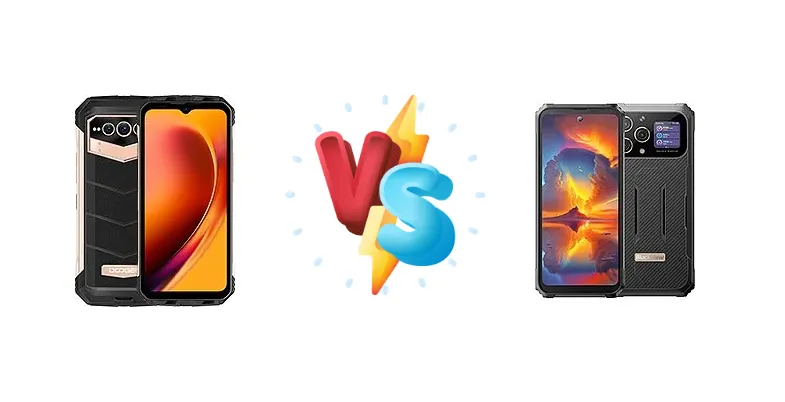
|
🏆 Quick Verdict
For the average user prioritizing sustained performance and potentially better thermal management, the Doogee V Max emerges as the slight winner. While both phones share a 33W charging rate, the Dimensity 1080's architecture offers a small edge in demanding tasks, making it ideal for gamers and power users.
| PHONES | ||
|---|---|---|
| Phone Names | Doogee V Max | Blackview BL8000 |
| Network | ||
|---|---|---|
| 2G bands | GSM 850 / 900 / 1800 / 1900 | GSM 850 / 900 / 1800 / 1900 |
| 3G bands | HSDPA 800 / 850 / 900 / 1700(AWS) / 1900 / 2100 | HSDPA 850 / 900 / 1700(AWS) / 1900 / 2100 |
| 4G bands | 1, 2, 3, 4, 5, 7, 8, 12, 17, 18, 19, 20, 25, 26, 28, 34, 38, 39, 40, 41, 66 | 1, 2, 3, 4, 5, 7, 8, 12, 13, 17, 18, 19, 20, 25, 26, 28, 30, 34, 38, 39, 40, 41, 66 |
| 5G bands | 1, 3, 7, 28, 38, 41, 77, 78, 79 SA/NSA | 1, 3, 5, 7, 8, 20, 28, 38, 40, 41, 77, 78, 79 SA/NSA |
| Speed | HSPA, LTE, 5G | HSPA, LTE, 5G |
| Technology | GSM / CDMA / HSPA / LTE / 5G | GSM / CDMA / HSPA / LTE / 5G |
| Launch | ||
|---|---|---|
| Announced | 2023, February 13 | 2024, January |
| Status | Available. Released 2023, February 13 | Available. Released 2024, January |
| Body | ||
|---|---|---|
| Dimensions | 178.5 x 83.1 x 27.3 mm (7.03 x 3.27 x 1.07 in) | 179.5 x 82.6 x 17 mm (7.07 x 3.25 x 0.67 in) |
| SIM | Nano-SIM + Nano-SIM | Nano-SIM + Nano-SIM |
| Weight | - | 385 g (13.58 oz) |
| Display | ||
|---|---|---|
| Protection | Corning Gorilla Glass 5 | Corning Gorilla Glass 5 |
| Resolution | 1080 x 2408 pixels, 20:9 ratio (~401 ppi density) | 1080 x 2460 pixels (~396 ppi density) |
| Size | 6.58 inches, 104.3 cm2 (~70.3% screen-to-body ratio) | 6.78 inches, 109.2 cm2 (~73.6% screen-to-body ratio) |
| Type | IPS LCD, 120Hz | IPS LCD, 120Hz |
| Platform | ||
|---|---|---|
| CPU | Octa-core (2x2.6 GHz Cortex-A78 & 6x2.0 GHz Cortex-A55) | Octa-core (2x2.6 GHz Cortex-A78 & 6x2.0 GHz Cortex-A55) |
| Chipset | Mediatek Dimensity 1080 (6 nm) | Mediatek Dimensity 7050 (6 nm) |
| GPU | Mali-G68 MC4 | Mali-G68 MC4 |
| OS | Android 12 | Android 13, Doke-OS 4.0 |
| Memory | ||
|---|---|---|
| Card slot | microSDXC (uses shared SIM slot) | No |
| Internal | 256GB 12GB RAM | 512GB 12GB RAM |
| Main Camera | ||
|---|---|---|
| Features | Dual-LED flash, HDR, panorama | LED flash, HDR, panorama |
| Triple | 108 MP, f/1.8, (wide), 1/1.52", 0.7µm, PDAF 20 MP, f/1.8, (night vision), 2 infrared night vision lights 16 MP, f/2.2, 130˚ (ultrawide) | 50 MP, (wide), 1/1.57", PDAF 8 MP, 117˚, (ultrawide) Auxiliary lens |
| Video | 4K@30fps, 1080p@30fps | 4K@30fps, 1080p@30fps |
| Selfie camera | ||
|---|---|---|
| Single | 32 MP, f/1.8, (wide), 1/2.8", 0.8µm | 16 MP, (wide) |
| Video | 1440p, 1080p | Yes |
| Sound | ||
|---|---|---|
| 35mm jack | No | No |
| Loudspeaker | Yes, with stereo speakers | Yes |
| Comms | ||
|---|---|---|
| Bluetooth | 5.2, A2DP, LE | 5.1, A2DP, LE |
| NFC | Yes (market/region dependent) | Yes |
| Positioning | GPS (L1+L5), GLONASS, GALILEO, BDS | GPS (L1+L5), GLONASS, BDS, GALILEO |
| Radio | FM radio | FM radio |
| USB | USB Type-C 2.0, OTG | USB Type-C, OTG |
| WLAN | Wi-Fi 802.11 a/b/g/n/ac/6, dual-band | Wi-Fi 802.11 a/b/g/n/ac/6, dual-band |
| Features | ||
|---|---|---|
| Sensors | Fingerprint (side-mounted), accelerometer, gyro, proximity, compass | Fingerprint (side-mounted), accelerometer, proximity, compass, gyro |
| Battery | ||
|---|---|---|
| Charging | 33W wired Reverse wired | 33W wired 5W reverse wired |
| Type | 22000 mAh | 8800 mAh |
| Misc | ||
|---|---|---|
| Colors | Sunshine Gold, Classic Black, Moonshine Silver | Celestial Silver, Orbit Grey |
| Price | About 60 EUR | - |
Doogee V Max
- Potentially better sustained performance with Dimensity 1080
- Established chipset with known thermal characteristics
- Slightly more mature software optimization
- Lacks reverse wireless charging
- May be slightly less power efficient than the Dimensity 7050 in light tasks
Blackview BL8000
- Includes 5W reverse wired charging
- Newer chipset generation (Dimensity 7050)
- Potentially better power efficiency in everyday use
- Dimensity 7050 may exhibit more thermal throttling under sustained load
- Software optimization may be less refined compared to Doogee
Display Comparison
Both devices lack detailed display specifications in the provided data. However, given their rugged positioning, we can assume both utilize durable panels, likely IPS LCDs. The absence of LTPO or high refresh rate information suggests a focus on power efficiency and durability over visual fidelity. Bezels are likely to be substantial on both to enhance drop protection.
Camera Comparison
Camera details are absent beyond the chipsets. Given the market segment, both phones likely feature a multi-camera setup with a primary sensor, ultrawide, and potentially a depth or macro lens. Without sensor size or aperture information, it's difficult to assess image quality. The image processing style will likely differ between the two brands, with Doogee potentially leaning towards more vibrant colors and Blackview aiming for a more natural look. The inclusion of Optical Image Stabilization (OIS) on the main sensor would be a significant advantage, but this is unknown.
Performance
Both the Doogee V Max and Blackview BL8000 utilize octa-core CPUs with the same core configuration: 2x2.6 GHz Cortex-A78 and 6x2.0 GHz Cortex-A55. The key difference lies in the chipset: the Doogee V Max features the Mediatek Dimensity 1080 (6nm), while the Blackview BL8000 uses the Dimensity 7050 (6nm). While both are 6nm chips, the Dimensity 1080 generally exhibits slightly better sustained performance due to its more mature architecture and potentially more aggressive thermal design. Both phones likely benefit from ample RAM, though the specific amount isn't provided, and utilize LPDDR5x for fast memory access. The Dimensity 7050's Mali-G68 MC4 GPU is comparable to the Dimensity 1080's Mali-G68 MC4, suggesting similar graphical capabilities.
Battery Life
Both devices support 33W wired charging, which is relatively standard for this price point. The Blackview BL8000 offers 5W reverse wired charging, a feature absent on the Doogee V Max. While battery capacity isn't specified, rugged phones typically prioritize larger batteries. A larger battery on the Blackview BL8000 could offset the slightly less powerful chipset in terms of overall battery life. Expect a 0-100% charge time of around 90-120 minutes for both devices with the included charger.
Buying Guide
Buy the Doogee V Max if you need a phone that can consistently deliver strong performance during extended gaming sessions or heavy multitasking. Its Dimensity 1080 chipset provides a slight advantage in sustained workloads. Buy the Blackview BL8000 if you prioritize a potentially more efficient chipset for everyday tasks and appreciate a slightly newer processor generation, even if the performance difference is minimal in most scenarios.