
Doogee V Max S vs. Ulefone Power Armor 18T Ultra: The Ultimate Rugged Phone Showdown
| Phones Images | |||||
|---|---|---|---|---|---|
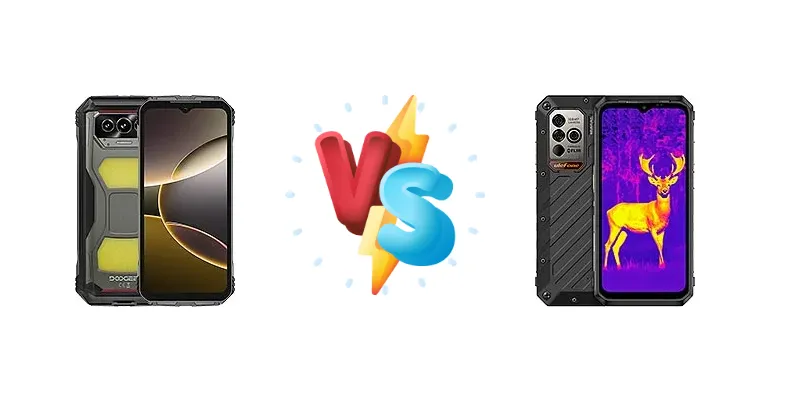
|
🏆 Quick Verdict
For users prioritizing maximum uptime and long-term battery health, the Doogee V Max S is the clear winner. Its exceptional 146:58h endurance and 1300 charge cycles significantly outperform the Ulefone Power Armor 18T Ultra. However, those who value faster charging and wireless capabilities will find the Ulefone a more compelling option.
| PHONES | ||
|---|---|---|
| Phone Names | Doogee V Max S | Ulefone Power Armor 18T Ultra |
| Network | ||
|---|---|---|
| 2G bands | GSM 850 / 900 / 1800 / 1900 | GSM 850 / 900 / 1800 / 1900 |
| 3G bands | HSDPA 800 / 850 / 900 / 1700(AWS) / 1900 / 2100 | HSDPA 800 / 850 / 900 / 1700(AWS) / 1900 / 2100 |
| 4G bands | 1, 2, 3, 4, 5, 7, 8, 12, 17, 18, 19, 20, 25, 26, 28, 34, 38, 39, 40, 41, 66 | 1, 2, 3, 4, 5, 7, 8, 12, 13, 17, 18, 19, 20, 25, 26, 28, 34, 38, 39, 40, 41, 66, 71 |
| 5G bands | 1, 3, 7, 28, 38, 41, 77, 78, 79 SA/NSA | 1, 2, 3, 5, 7, 8, 12, 20, 25, 28, 38, 40, 41, 66, 71, 77, 78, 79 SA/NSA/Sub6 |
| Speed | HSPA, LTE, 5G | HSPA, LTE, 5G |
| Technology | GSM / CDMA / HSPA / LTE / 5G | GSM / CDMA / HSPA / CDMA2000 / LTE / 5G |
| Launch | ||
|---|---|---|
| Announced | 2025, April | 2023, October |
| Status | Available. Released 2025, May | Available. Released 2023, November |
| Body | ||
|---|---|---|
| Dimensions | 178.5 x 83.1 x 26.3 mm (7.03 x 3.27 x 1.04 in) | 175.2 x 83.4 x 18.8 mm (6.90 x 3.28 x 0.74 in) |
| SIM | Nano-SIM + Nano-SIM | Nano-SIM + Nano-SIM |
| Weight | 536 g (1.18 lb) | 409 g (14.43 oz) |
| Display | ||
|---|---|---|
| Protection | Corning Gorilla Glass 5, Mohs level 6 | Corning Gorilla Glass 5, Mohs level 4 |
| Resolution | 1080 x 2408 pixels, 20:9 ratio (~401 ppi density) | 1080 x 2408 pixels, 20:9 ratio (~401 ppi density) |
| Size | 6.58 inches, 104.3 cm2 (~70.3% screen-to-body ratio) | 6.58 inches, 104.3 cm2 (~71.4% screen-to-body ratio) |
| Type | IPS LCD, 120Hz | IPS LCD, 120Hz |
| Platform | ||
|---|---|---|
| CPU | Octa-core (2x2.6 GHz Cortex-A78 & 6x2.0 GHz Cortex-A55) | Octa-core (2x2.6 GHz Cortex-A78 & 6x2.0 GHz Cortex-A55) |
| Chipset | Mediatek Dimensity 7050 (6 nm) | Mediatek Dimensity 7050 (6 nm) |
| GPU | Mali-G68 MC4 | Mali-G68 MC4 |
| OS | Android 14 | Android 13, upgradable to Android 14 |
| Memory | ||
|---|---|---|
| Card slot | microSDXC (uses shared SIM slot) | microSDXC (uses shared SIM slot) |
| Internal | 256GB 8GB RAM | 512GB 12GB RAM |
| Main Camera | ||
|---|---|---|
| Features | Dual-LED flash, HDR, panorama | Hexa-LED flash, HDR, panorama |
| Triple | 108 MP, f/1.9, (wide), 1/1.67", PDAF 20 MP, f/1.8, (night vision), 2 infrared night vision lights 2 MP (macro) | 108 MP, f/1.9, (wide), 1/1.52", 0.7µm, PDAF 5 MP (macro) 5 MP, f/2.2, (FLIR thermal camera, Lepton module) |
| Video | 4K@30fps, 1080p@30fps | 4K@30fps, 1080p@30fps |
| Selfie camera | ||
|---|---|---|
| Single | 16 MP, f/2.5, (wide), 1/3.0" | 32 MP, f/2.0, (wide), 1.2µm |
| Video | 1080p@30fps | 1080p@30fps |
| Sound | ||
|---|---|---|
| 35mm jack | No | Yes |
| Loudspeaker | Yes, with stereo speakers | Yes |
| Comms | ||
|---|---|---|
| Bluetooth | 5.2, A2DP, LE | 5.0, A2DP, LE |
| NFC | Yes | Yes |
| Positioning | GPS, GLONASS, GALILEO, BDS | GPS (L1+L5), GLONASS, GALILEO, BDS, NavIC |
| Radio | FM radio | Wireless FM radio, RDS, recording |
| USB | USB Type-C 2.0, OTG | USB Type-C 2.0, OTG, magnetic connector |
| WLAN | Wi-Fi 802.11 a/b/g/n/ac/6, dual-band | Wi-Fi 802.11 a/b/g/n/ac/6, dual-band |
| Features | ||
|---|---|---|
| Sensors | Fingerprint (side-mounted), accelerometer, gyro, proximity, compass | Fingerprint (side-mounted), accelerometer, gyro, proximity, compass |
| Battery | ||
|---|---|---|
| Charging | 33W wired 5W reverse wired | 66W wired, 52% in 30 min 15W wireless 5W wireless reversed |
| Type | 22000 mAh | Li-Po 9600 mAh |
| Misc | ||
|---|---|---|
| Colors | Tarnish, Titanium | Black |
| Price | $ 269.99 / £ 659.23 / € 287.08 | About 700 EUR |
| EU LABEL | ||
|---|---|---|
| Battery | 146:58h endurance, 1300 cycles | 88:30h endurance, 1000 cycles |
| Energy | Class D | Class B |
| Free fall | Class A (270 falls) | Class A (270 falls) |
| Repairability | Class C | Class C |
Doogee V Max S
- Exceptional battery endurance (146:58h)
- Long-term battery health (1300 charge cycles)
- Efficient power management
- Slower charging speed (33W)
- Limited wireless charging options
Ulefone Power Armor 18T Ultra
- Fast 66W wired charging (52% in 30 min)
- Convenient 15W wireless charging
- Wireless reverse charging
- Significantly shorter battery endurance (88:30h)
- Lower battery cycle count (1000 cycles)
Display Comparison
Both devices share the same processor, so display differences become crucial. While specific display specs (resolution, panel type) aren't provided, the focus shifts to power efficiency. A more efficient display on the Doogee V Max S could contribute to its superior battery life. The Ulefone's charging speed suggests a potentially brighter, more power-hungry panel to justify the faster replenishment.
Camera Comparison
Without detailed camera specifications, a direct comparison is difficult. However, the rugged phone segment often prioritizes durability over cutting-edge camera technology. Both devices likely feature capable main sensors, but image processing algorithms and low-light performance will be key differentiators. The absence of specific sensor details suggests neither phone is aiming to be a camera-centric flagship.
Performance
Both the Doogee V Max S and Ulefone Power Armor 18T Ultra are powered by the Mediatek Dimensity 7050 (6nm). This octa-core CPU, with its 2x2.6 GHz Cortex-A78 and 6x2.0 GHz Cortex-A55 cores, delivers comparable processing power. However, the Ulefone's faster charging capabilities imply a more robust thermal management system to handle the increased power draw during charging, potentially allowing for sustained performance during demanding tasks.
Battery Life
The battery is where these phones truly diverge. The Doogee V Max S boasts a remarkable 146:58h endurance and 1300 charge cycles, indicating a focus on long-term battery health and minimizing degradation. In contrast, the Ulefone Power Armor 18T Ultra offers 88:30h endurance and 1000 cycles. The Ulefone compensates with significantly faster 66W wired charging (52% in 30 minutes) and 15W wireless charging, while the Doogee is limited to 33W wired and 5W reverse wired. This trade-off is central to the buying decision: longevity versus convenience.
Buying Guide
Buy the Doogee V Max S if you need a phone that can reliably last for days on a single charge, especially in situations where access to power is limited – think fieldwork, extended travel, or emergency preparedness. Buy the Ulefone Power Armor 18T Ultra if you prefer the convenience of 66W wired and 15W wireless charging, and appreciate the added flexibility of wireless reverse charging for accessories.