
Doogee V Max S vs Oukitel WP210: A Deep Dive into Rugged Smartphone Performance
| Phones Images | |||||
|---|---|---|---|---|---|
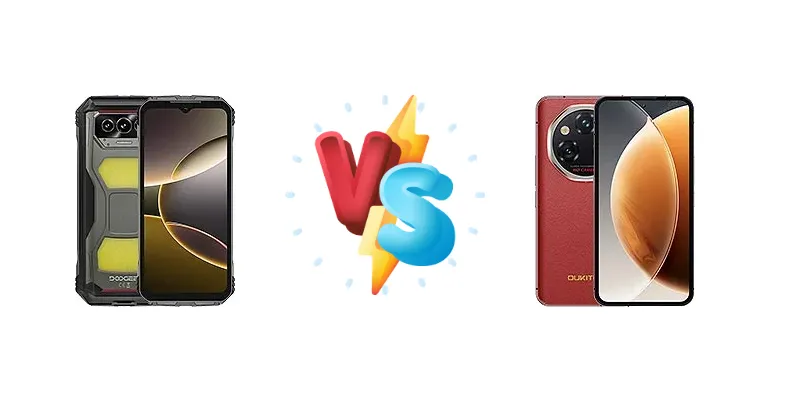
|
🏆 Quick Verdict
For users prioritizing longevity and all-day (and multi-day) use, the Doogee V Max S is the clear winner thanks to its significantly superior 146:58h battery endurance. However, the Oukitel WP210 appeals to those who demand faster performance and quicker charging times, making it ideal for power users.
| PHONES | ||
|---|---|---|
| Phone Names | Doogee V Max S | Oukitel WP210 |
| Network | ||
|---|---|---|
| 2G bands | GSM 850 / 900 / 1800 / 1900 | GSM 850 / 900 / 1800 / 1900 |
| 3G bands | HSDPA 800 / 850 / 900 / 1700(AWS) / 1900 / 2100 | HSDPA 800 / 850 / 900 / 1700(AWS) / 1900 / 2100 |
| 4G bands | 1, 2, 3, 4, 5, 7, 8, 12, 17, 18, 19, 20, 25, 26, 28, 34, 38, 39, 40, 41, 66 | 1, 2, 3, 4, 5, 7, 8, 12, 13, 17, 18, 19, 20, 25, 26, 28, 34, 38, 39, 40, 41, 66, 71 |
| 5G bands | 1, 3, 7, 28, 38, 41, 77, 78, 79 SA/NSA | 1, 2, 3, 5, 7, 8, 12, 20, 25, 28, 34, 38, 39, 40, 41, 48, 66, 71, 77, 78 SA/NSA |
| Speed | HSPA, LTE, 5G | HSPA, LTE, 5G |
| Technology | GSM / CDMA / HSPA / LTE / 5G | GSM / HSPA / LTE / 5G |
| Launch | ||
|---|---|---|
| Announced | 2025, April | 2025, July |
| Status | Available. Released 2025, May | Available. Released 2025, July 15 |
| Body | ||
|---|---|---|
| Dimensions | 178.5 x 83.1 x 26.3 mm (7.03 x 3.27 x 1.04 in) | 163.6 x 77.9 x 13.7 mm (6.44 x 3.07 x 0.54 in) |
| SIM | Nano-SIM + Nano-SIM | Nano-SIM + Nano-SIM |
| Weight | 536 g (1.18 lb) | 311 g (10.97 oz) |
| Display | ||
|---|---|---|
| Protection | Corning Gorilla Glass 5, Mohs level 6 | Corning Gorilla Glass 5, Mohs level 5 |
| Resolution | 1080 x 2408 pixels, 20:9 ratio (~401 ppi density) | 1080 x 2408 pixels, 20:9 ratio (~394 ppi density) |
| Size | 6.58 inches, 104.3 cm2 (~70.3% screen-to-body ratio) | 6.7 inches, 108.1 cm2 (~84.9% screen-to-body ratio) |
| Type | IPS LCD, 120Hz | IPS LCD, 120Hz, 500 nits |
| Platform | ||
|---|---|---|
| CPU | Octa-core (2x2.6 GHz Cortex-A78 & 6x2.0 GHz Cortex-A55) | Octa-core (1x3.1 GHz Cortex-A78 & 3x3.0 GHz Cortex-A78 & 4x2.0 GHz Cortex-A55) |
| Chipset | Mediatek Dimensity 7050 (6 nm) | Mediatek Dimensity 8200 (4 nm) |
| GPU | Mali-G68 MC4 | Mali-G610 MC6 |
| OS | Android 14 | Android 15 |
| Memory | ||
|---|---|---|
| Card slot | microSDXC (uses shared SIM slot) | microSDXC (uses shared SIM slot) |
| Internal | 256GB 8GB RAM | 512GB 12GB RAM |
| Main Camera | ||
|---|---|---|
| Features | Dual-LED flash, HDR, panorama | LED flash, HDR, panorama |
| Triple | 108 MP, f/1.9, (wide), 1/1.67", PDAF 20 MP, f/1.8, (night vision), 2 infrared night vision lights 2 MP (macro) | 108 MP, f/1.9, (wide), 1/1.8", PDAF 2 MP (macro) Auxiliary lens |
| Video | 4K@30fps, 1080p@30fps | 4K@30fps |
| Selfie camera | ||
|---|---|---|
| Single | 16 MP, f/2.5, (wide), 1/3.0" | 32 MP, f/2.2, (wide), 1/2.74" |
| Video | 1080p@30fps | 1080p@30fps |
| Sound | ||
|---|---|---|
| 35mm jack | No | No |
| Loudspeaker | Yes, with stereo speakers | Yes |
| Comms | ||
|---|---|---|
| Bluetooth | 5.2, A2DP, LE | 5.3, A2DP, LE |
| NFC | Yes | Yes |
| Positioning | GPS, GLONASS, GALILEO, BDS | GPS (L1+L5), GLONASS, GALILEO, BDS |
| Radio | FM radio | FM radio |
| USB | USB Type-C 2.0, OTG | USB Type-C 2.0 |
| WLAN | Wi-Fi 802.11 a/b/g/n/ac/6, dual-band | Wi-Fi 802.11 a/b/g/n/ac/6, dual-band |
| Features | ||
|---|---|---|
| Sensors | Fingerprint (side-mounted), accelerometer, gyro, proximity, compass | Fingerprint (side-mounted), accelerometer, gyro, proximity, compass |
| Battery | ||
|---|---|---|
| Charging | 33W wired 5W reverse wired | 45W wired |
| Type | 22000 mAh | Li-Po 8800 mAh |
| Misc | ||
|---|---|---|
| Colors | Tarnish, Titanium | Gray, Black, Red |
| Price | $ 269.99 / £ 659.23 / € 287.08 | - |
| EU LABEL | ||
|---|---|---|
| Battery | 146:58h endurance, 1300 cycles | 86:17h endurance, 1000 cycles |
| Energy | Class D | Class B |
| Free fall | Class A (270 falls) | Class A (270 falls) |
| Repairability | Class C | Class C |
Doogee V Max S
- Exceptional battery life (146:58h endurance)
- Long-lasting battery health (1300 charge cycles)
- Efficient Dimensity 7050 chipset
- Less powerful processor compared to the WP210
- Slower charging speed (33W)
Oukitel WP210
- Powerful Dimensity 8200 chipset (4nm)
- Faster charging (45W)
- Superior processing power for demanding tasks
- Significantly shorter battery life (86:17h endurance)
- Fewer battery charge cycles (1000)
Display Comparison
While display specifications aren't provided, both phones likely utilize IPS LCD panels common in the rugged segment. The focus here isn't on bleeding-edge display tech. However, the chipset differences suggest the WP210 may be capable of driving a higher refresh rate display if equipped, offering smoother scrolling and animations. The V Max S's endurance suggests a potentially more conservative display power draw.
Camera Comparison
Without detailed camera specs, it’s difficult to make a definitive judgment. However, the chipset advantage of the Oukitel WP210 suggests superior image signal processing (ISP) capabilities, potentially leading to better image quality, especially in low-light conditions. The Dimensity 8200’s ISP is more advanced, offering features like improved noise reduction and dynamic range. Both phones likely feature a primary sensor, but the WP210’s processing power could extract more detail and clarity from it.
Performance
The Oukitel WP210’s Mediatek Dimensity 8200 (4nm) holds a clear advantage over the Doogee V Max S’s Dimensity 7050 (6nm). The 4nm process node translates to improved power efficiency and thermal performance, allowing the WP210 to sustain peak performance for longer periods. The WP210’s CPU configuration – featuring a 3.1 GHz Cortex-A78 prime core and three additional Cortex-A78 cores – provides a substantial boost in single-core and multi-core performance compared to the V Max S’s dual 2.6 GHz Cortex-A78 setup. This difference will be most noticeable in demanding applications and games.
Battery Life
The Doogee V Max S dominates in battery endurance with a remarkable 146:58h rating, significantly exceeding the Oukitel WP210’s 86:17h. This translates to days of typical use on a single charge for the V Max S. While the WP210 compensates with 45W wired charging, offering faster top-ups, the V Max S’s longevity is a major draw. The V Max S also boasts 1300 charge cycles, indicating a longer lifespan before significant battery degradation compared to the WP210’s 1000 cycles.
Buying Guide
Buy the Doogee V Max S if you need a phone that can reliably last for days on a single charge, are frequently away from power outlets, or prioritize long-term battery health with its 1300 charge cycles. Buy the Oukitel WP210 if you prefer a snappier user experience, frequently engage in demanding tasks like gaming or video editing, and value the convenience of 45W fast charging.