
Doogee V Max S vs. S100 Pro: Which Rugged Phone Reigns Supreme?
| Phones Images | |||||
|---|---|---|---|---|---|
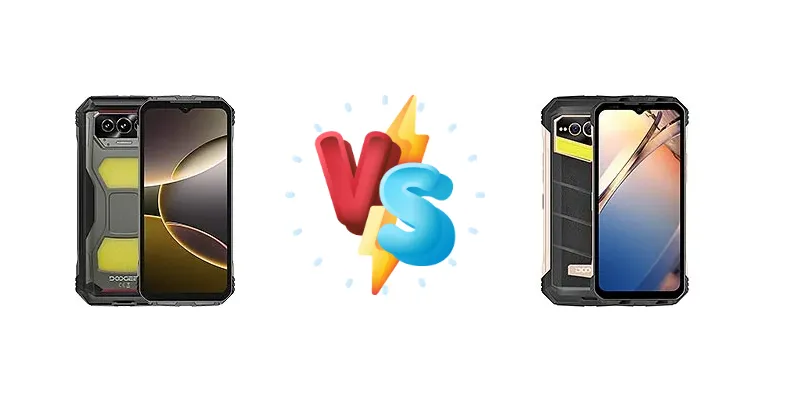
|
🏆 Quick Verdict
For users prioritizing demanding tasks like gaming or video editing, the Doogee V Max S is the clear winner thanks to its significantly more powerful Dimensity 7050 chipset. However, the S100 Pro offers a compelling value proposition for everyday use, providing solid performance and ruggedness at a potentially lower price point.
| PHONES | ||
|---|---|---|
| Phone Names | Doogee V Max S | Doogee S100 Pro |
| Network | ||
|---|---|---|
| 2G bands | GSM 850 / 900 / 1800 / 1900 | GSM 850 / 900 / 1800 / 1900 |
| 3G bands | HSDPA 800 / 850 / 900 / 1700(AWS) / 1900 / 2100 | HSDPA 800 / 850 / 900 / 1700(AWS) / 1900 / 2100 |
| 4G bands | 1, 2, 3, 4, 5, 7, 8, 12, 17, 18, 19, 20, 25, 26, 28, 34, 38, 39, 40, 41, 66 | 1, 2, 3, 4, 5, 7, 8, 12, 13, 17, 18, 19, 20, 25, 26, 28, 34, 38, 39, 40, 41, 66, 71 |
| 5G bands | 1, 3, 7, 28, 38, 41, 77, 78, 79 SA/NSA | - |
| Speed | HSPA, LTE, 5G | HSPA, LTE |
| Technology | GSM / CDMA / HSPA / LTE / 5G | GSM / CDMA / HSPA / LTE |
| Launch | ||
|---|---|---|
| Announced | 2025, April | 2023, May 28 |
| Status | Available. Released 2025, May | Available. Released 2023, June 01 |
| Body | ||
|---|---|---|
| Dimensions | 178.5 x 83.1 x 26.3 mm (7.03 x 3.27 x 1.04 in) | 178.5 x 83.1 x 27.3 mm (7.03 x 3.27 x 1.07 in) |
| SIM | Nano-SIM + Nano-SIM | Nano-SIM + Nano-SIM |
| Weight | 536 g (1.18 lb) | - |
| Display | ||
|---|---|---|
| Protection | Corning Gorilla Glass 5, Mohs level 6 | Corning Gorilla Glass 5 |
| Resolution | 1080 x 2408 pixels, 20:9 ratio (~401 ppi density) | 1080 x 2408 pixels, 20:9 ratio (~401 ppi density) |
| Size | 6.58 inches, 104.3 cm2 (~70.3% screen-to-body ratio) | 6.58 inches, 104.3 cm2 (~70.3% screen-to-body ratio) |
| Type | IPS LCD, 120Hz | IPS LCD |
| Platform | ||
|---|---|---|
| CPU | Octa-core (2x2.6 GHz Cortex-A78 & 6x2.0 GHz Cortex-A55) | Octa-core (2x2.2 GHz Cortex-A76 & 6x2.0 GHz Cortex-A55) |
| Chipset | Mediatek Dimensity 7050 (6 nm) | Mediatek Helio G99 (6 nm) |
| GPU | Mali-G68 MC4 | Mali-G57 MC2 |
| OS | Android 14 | Android 12 |
| Memory | ||
|---|---|---|
| Card slot | microSDXC (uses shared SIM slot) | microSDXC (uses shared SIM slot) |
| Internal | 256GB 8GB RAM | 256GB 12GB RAM |
| Main Camera | ||
|---|---|---|
| Features | Dual-LED flash, HDR, panorama | Dual-LED flash, HDR, panorama |
| Triple | 108 MP, f/1.9, (wide), 1/1.67", PDAF 20 MP, f/1.8, (night vision), 2 infrared night vision lights 2 MP (macro) | 108 MP, f/1.8, (wide), 1/1.52", 0.7µm, PDAF 20 MP, f/1.8, (night vision), 2 infrared night vision lights 16 MP, f/2.2, 130˚ (ultrawide) |
| Video | 4K@30fps, 1080p@30fps | 1440p, 1080p |
| Selfie camera | ||
|---|---|---|
| Single | 16 MP, f/2.5, (wide), 1/3.0" | 32 MP, f/2.0, (wide), 1/2.8", 0.8µm |
| Video | 1080p@30fps | 1440p, 1080p |
| Sound | ||
|---|---|---|
| 35mm jack | No | No |
| Loudspeaker | Yes, with stereo speakers | Yes, with stereo speakers |
| Comms | ||
|---|---|---|
| Bluetooth | 5.2, A2DP, LE | 5.0, A2DP, LE |
| NFC | Yes | Yes (market/region dependent) |
| Positioning | GPS, GLONASS, GALILEO, BDS | GPS (L1+L5), GLONASS, BDS, GALILEO |
| Radio | FM radio | FM radio |
| USB | USB Type-C 2.0, OTG | USB Type-C 2.0, OTG |
| WLAN | Wi-Fi 802.11 a/b/g/n/ac/6, dual-band | Wi-Fi 802.11 a/b/g/n/ac, dual-band |
| Features | ||
|---|---|---|
| Sensors | Fingerprint (side-mounted), accelerometer, gyro, proximity, compass | Fingerprint (side-mounted), accelerometer, gyro, proximity, compass |
| Battery | ||
|---|---|---|
| Charging | 33W wired 5W reverse wired | 33W wired |
| Type | 22000 mAh | 22000 mAh |
| Misc | ||
|---|---|---|
| Colors | Tarnish, Titanium | Black, Black/Silver, Black/Gold |
| Price | $ 269.99 / £ 659.23 / € 287.08 | About 300 EUR |
| EU LABEL | ||
|---|---|---|
| Battery | 146:58h endurance, 1300 cycles | - |
| Energy | Class D | - |
| Free fall | Class A (270 falls) | - |
| Repairability | Class C | - |
Doogee V Max S
- Significantly more powerful processor (Dimensity 7050)
- Exceptional battery endurance (146:58h)
- 5W Reverse Wired Charging
- Potentially higher price point
- May generate more heat under sustained load
Doogee S100 Pro
- More affordable price (likely)
- Efficient Helio G99 chipset for everyday tasks
- Rugged design and build quality
- Lower processing power compared to V Max S
- Shorter battery life
Display Comparison
Both devices utilize 6nm chipsets, suggesting similar power efficiency considerations impacting display capabilities. While specific display specs are missing, the focus on ruggedness typically means prioritizing durability over cutting-edge display tech. Expect both to feature robust glass protection. The V Max S's more powerful processor *could* support higher refresh rates if implemented, but this isn't confirmed. Color accuracy is likely similar, geared towards practical visibility in outdoor conditions rather than color-critical work.
Camera Comparison
Without detailed camera specifications, a direct comparison is limited. However, Doogee’s marketing often focuses on megapixel count rather than sensor size or lens quality. Assuming similar sensor sizes, the image signal processor (ISP) within the Dimensity 7050 of the V Max S will likely offer more advanced image processing capabilities, resulting in better dynamic range and low-light performance. The S100 Pro’s Helio G99 ISP is capable, but will be outmatched by the V Max S. We can expect both to offer acceptable image quality for social media sharing, but the V Max S should excel in more challenging conditions.
Performance
The core difference lies in the chipsets. The Doogee V Max S’s Mediatek Dimensity 7050, built on a 6nm process, features a more modern CPU architecture – Cortex-A78 cores clocked at 2.6 GHz – compared to the S100 Pro’s Helio G99 with its 2.2 GHz Cortex-A76 cores. This translates to a substantial performance advantage for the V Max S in CPU-intensive tasks. The Dimensity 7050’s superior architecture will result in faster app loading times, smoother multitasking, and a more responsive user experience. While both use 6nm fabrication, the A78 cores are demonstrably more efficient and powerful than the A76 cores. The GPU within the Dimensity 7050 will also provide a significantly better gaming experience.
Battery Life
The Doogee V Max S boasts an impressive 146:58h endurance rating, a testament to the efficiency of the Dimensity 7050 and likely a larger battery capacity (though not specified). Both phones support 33W wired charging, offering reasonable recharge speeds. The V Max S also includes 5W reverse wired charging, a useful feature for topping up accessories. The combination of superior endurance and reverse charging gives the V Max S a clear advantage in battery-related features. The 1300 charge cycles also suggest a longer lifespan for the V Max S's battery.
Buying Guide
Buy the Doogee V Max S if you need a rugged phone capable of handling intensive applications, extended gaming sessions, and benefit from its exceptional 146:58h battery endurance. Buy the Doogee S100 Pro if you prefer a more budget-friendly rugged device for everyday tasks, reliable performance, and don't require the absolute highest processing power.