
Doogee V Max S vs. Cat S75: A Head-to-Head Rugged Smartphone Showdown
| Phones Images | |||||
|---|---|---|---|---|---|
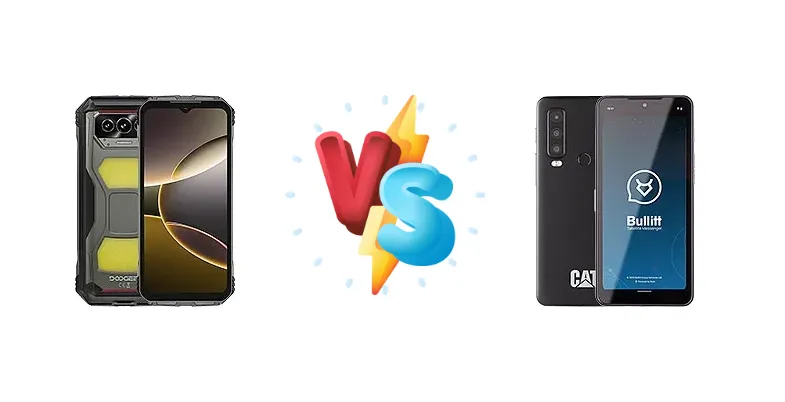
|
🏆 Quick Verdict
For most users prioritizing longevity and sustained use, the Doogee V Max S emerges as the winner. Its significantly superior battery endurance (146:58h) and impressive 1300 charge cycles outweigh the Cat S75’s slightly faster processor. However, those who value wireless charging and a marginally quicker CPU will find the Cat S75 a compelling alternative.
| PHONES | ||
|---|---|---|
| Phone Names | Doogee V Max S | Cat S75 |
| Network | ||
|---|---|---|
| 2G bands | GSM 850 / 900 / 1800 / 1900 | GSM 850 / 900 / 1800 / 1900 |
| 3G bands | HSDPA 800 / 850 / 900 / 1700(AWS) / 1900 / 2100 | HSDPA 850 / 900 / 1700(AWS) / 1900 / 2100 |
| 4G bands | 1, 2, 3, 4, 5, 7, 8, 12, 17, 18, 19, 20, 25, 26, 28, 34, 38, 39, 40, 41, 66 | 1, 2, 3, 4, 5, 7, 8, 20, 28, 32, 38, 39, 40, 41 |
| 5G bands | 1, 3, 7, 28, 38, 41, 77, 78, 79 SA/NSA | 1, 2, 3, 5, 7, 8, 20, 23, 28, 38, 40, 41, 75, 77, 78, 255, 256 SA/NSA/Sub6/mmWave |
| Speed | HSPA, LTE, 5G | HSPA, LTE, 5G |
| Technology | GSM / CDMA / HSPA / LTE / 5G | GSM / HSPA / LTE / 5G |
| Launch | ||
|---|---|---|
| Announced | 2025, April | 2023, February 24 |
| Status | Available. Released 2025, May | Available. Released 2023, July |
| Body | ||
|---|---|---|
| Build | - | Glass front (Gorilla Glass Victus), plastic back, aluminum frame |
| Dimensions | 178.5 x 83.1 x 26.3 mm (7.03 x 3.27 x 1.04 in) | 171 x 80 x 11.9 mm (6.73 x 3.15 x 0.47 in) |
| SIM | Nano-SIM + Nano-SIM | Nano-SIM + Nano-SIM |
| Weight | 536 g (1.18 lb) | 268 g (9.45 oz) |
| - | IP68/IP69 dust/water resistant (up to 5m for 35 min) Drop-to-concrete resistance from up to 1.8m MIL-STD-810H compliant | |
| Display | ||
|---|---|---|
| Protection | Corning Gorilla Glass 5, Mohs level 6 | Corning Gorilla Glass Victus |
| Resolution | 1080 x 2408 pixels, 20:9 ratio (~401 ppi density) | 1080 x 2408 pixels, 20:9 ratio (~400 ppi density) |
| Size | 6.58 inches, 104.3 cm2 (~70.3% screen-to-body ratio) | 6.6 inches, 104.9 cm2 (~76.7% screen-to-body ratio) |
| Type | IPS LCD, 120Hz | IPS LCD, 120Hz |
| Platform | ||
|---|---|---|
| CPU | Octa-core (2x2.6 GHz Cortex-A78 & 6x2.0 GHz Cortex-A55) | Octa-core (2x2.2 GHz Cortex-A78 & 6x2.0 GHz Cortex-A55) |
| Chipset | Mediatek Dimensity 7050 (6 nm) | Mediatek Dimensity 930 (6 nm) |
| GPU | Mali-G68 MC4 | IMG BXM-8-256 |
| OS | Android 14 | Android 12 |
| Memory | ||
|---|---|---|
| Card slot | microSDXC (uses shared SIM slot) | microSDXC (uses shared SIM slot) |
| Internal | 256GB 8GB RAM | 128GB 6GB RAM |
| Main Camera | ||
|---|---|---|
| Features | Dual-LED flash, HDR, panorama | Dual-LED flash, HDR, panorama |
| Single | - | 8 MP, f/2.0, (wide) |
| Triple | 108 MP, f/1.9, (wide), 1/1.67", PDAF 20 MP, f/1.8, (night vision), 2 infrared night vision lights 2 MP (macro) | 50 MP, f/1.8, (wide), PDAF 8 MP, f/2.2, (ultrawide) 2 MP (macro) |
| Video | 4K@30fps, 1080p@30fps | 1080p@30fps |
| Selfie camera | ||
|---|---|---|
| Single | 16 MP, f/2.5, (wide), 1/3.0" | 8 MP, f/2.0, (wide) |
| Video | 1080p@30fps | 1080p@30fps |
| Sound | ||
|---|---|---|
| 3.5mm jack | - | No |
| 35mm jack | No | No |
| Loudspeaker | Yes, with stereo speakers | Yes |
| Comms | ||
|---|---|---|
| Bluetooth | 5.2, A2DP, LE | 5.1, A2DP, LE |
| NFC | Yes | Yes |
| Positioning | GPS, GLONASS, GALILEO, BDS | GPS (L1+L5), GALILEO, GLONASS, BDS |
| Radio | FM radio | Unspecified |
| USB | USB Type-C 2.0, OTG | USB Type-C 2.0, OTG |
| WLAN | Wi-Fi 802.11 a/b/g/n/ac/6, dual-band | Wi-Fi 802.11 a/b/g/n/ac, dual-band |
| Features | ||
|---|---|---|
| Sensors | Fingerprint (side-mounted), accelerometer, gyro, proximity, compass | Fingerprint (rear-mounted), accelerometer, gyro, proximity, compass |
| - | Emergency SOS via satellite (Bullitt Satellite Connect service) | |
| Battery | ||
|---|---|---|
| Charging | 33W wired 5W reverse wired | 15W wireless |
| Type | 22000 mAh | Li-Po 5000 mAh |
| Misc | ||
|---|---|---|
| Colors | Tarnish, Titanium | Black |
| Models | - | BM1S1B |
| Price | $ 269.99 / £ 659.23 / € 287.08 | About 600 EUR |
| EU LABEL | ||
|---|---|---|
| Battery | 146:58h endurance, 1300 cycles | - |
| Energy | Class D | - |
| Free fall | Class A (270 falls) | - |
| Repairability | Class C | - |
Doogee V Max S
- Exceptional battery life (146:58h endurance)
- High charge cycle count (1300 cycles)
- Faster 33W wired charging
- Potentially slightly slower CPU performance
- No wireless charging
Cat S75
- More powerful Dimensity 930 chipset
- Convenient 15W wireless charging
- Slightly more responsive for demanding apps
- Significantly lower battery endurance (data unavailable)
- Slower charging speeds overall
Display Comparison
Neither device provides display specifications, but given their rugged focus, expect durable, though likely not cutting-edge, panels. The absence of LTPO technology suggests neither phone will dynamically adjust refresh rates for power saving. Bezels are likely to be substantial on both to protect the screen. Color accuracy is likely secondary to visibility in direct sunlight, a key requirement for outdoor use.
Camera Comparison
Without detailed camera specs, a direct comparison is difficult. However, rugged phones often prioritize practicality over photographic excellence. Expect both to feature capable main sensors for outdoor photography, but image processing will likely focus on clarity and dynamic range rather than artistic effects. The absence of information regarding OIS (Optical Image Stabilization) suggests it may not be present on either device, potentially leading to less stable video recording. The usefulness of a 2MP macro camera, commonly found on phones in this segment, is questionable due to its limited resolution and image quality.
Performance
The Cat S75 boasts the Mediatek Dimensity 930, featuring a 2x2.2 GHz Cortex-A78 core configuration, while the Doogee V Max S utilizes the Dimensity 7050 with 2x2.6 GHz Cortex-A78 cores. While the 930 is a capable chip, the 7050’s higher clock speeds suggest a performance edge in CPU-bound tasks. Both chipsets are fabricated on a 6nm process, indicating similar efficiency. However, the V Max S’s larger battery capacity will likely mitigate any performance-related power draw. The impact of RAM speed (LPDDR5x is likely on both) is less significant than the chipset choice in everyday use.
Battery Life
The Doogee V Max S truly shines with its exceptional battery endurance of 146:58 hours, coupled with an impressive 1300 charge cycles, indicating long-term battery health. The Cat S75 lacks this endurance data, but its 15W wireless charging capability offers a convenient alternative to wired charging. The V Max S’s 33W wired charging is faster, but the Cat S75’s wireless option provides flexibility. The V Max S’s 5W reverse wired charging is a useful feature for topping up accessories, a capability absent on the Cat S75.
Buying Guide
Buy the Doogee V Max S if you need a phone that will reliably last for days on a single charge, especially if you work or recreate in areas without frequent access to power. It’s ideal for construction workers, outdoor enthusiasts, and anyone who demands maximum uptime. Buy the Cat S75 if you prefer the convenience of wireless charging and prioritize a slightly more responsive experience for demanding tasks, even if it means sacrificing some battery life. This phone is better suited for professionals who need quick access to applications and don't mind charging more frequently.