
Doogee V Max S vs Blackview BV9300: A Deep Dive into Rugged Smartphone Performance
| Phones Images | |||||
|---|---|---|---|---|---|
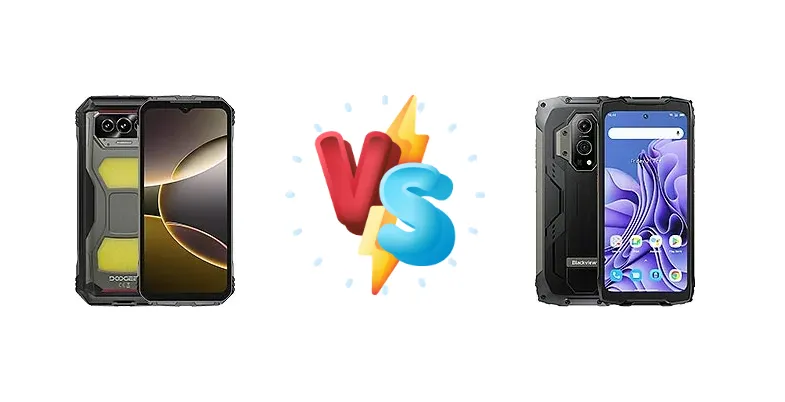
|
🏆 Quick Verdict
For most users, the Doogee V Max S is the superior choice. Its Mediatek Dimensity 7050 chipset provides a noticeable performance advantage over the Blackview BV9300’s Helio G99, translating to smoother multitasking and gaming. While both offer similar charging speeds, the V Max S’s endurance rating suggests better overall battery management.
| PHONES | ||
|---|---|---|
| Phone Names | Doogee V Max S | Blackview BV9300 |
| Network | ||
|---|---|---|
| 2G bands | GSM 850 / 900 / 1800 / 1900 | GSM 850 / 900 / 1800 / 1900 |
| 3G bands | HSDPA 800 / 850 / 900 / 1700(AWS) / 1900 / 2100 | HSDPA 850 / 900 / 1700(AWS) / 1900 / 2100 |
| 4G bands | 1, 2, 3, 4, 5, 7, 8, 12, 17, 18, 19, 20, 25, 26, 28, 34, 38, 39, 40, 41, 66 | 1, 2, 3, 4, 5, 7, 8, 12, 13, 17, 18, 19, 20, 25, 26, 28, 30, 34, 38, 39, 40, 41, 66 |
| 5G bands | 1, 3, 7, 28, 38, 41, 77, 78, 79 SA/NSA | - |
| Speed | HSPA, LTE, 5G | HSPA, LTE |
| Technology | GSM / CDMA / HSPA / LTE / 5G | GSM / CDMA / HSPA / LTE |
| - | CDMA 800 / 1900 | |
| Launch | ||
|---|---|---|
| Announced | 2025, April | 2023, May 10 |
| Status | Available. Released 2025, May | Available. Released 2023, May 10 |
| Body | ||
|---|---|---|
| Dimensions | 178.5 x 83.1 x 26.3 mm (7.03 x 3.27 x 1.04 in) | 184.6 x 85.6 x 22.8 mm (7.27 x 3.37 x 0.90 in) |
| SIM | Nano-SIM + Nano-SIM | Nano-SIM + Nano-SIM |
| Weight | 536 g (1.18 lb) | 520 g (1.15 lb) |
| - | IP68/IP69K dust/water resistant (up to 1.5m for 30 min) Drop-to-concrete resistance from up to 1.8m MIL-STD-810H compliant Laser rangefinder (up to 40m) Dedicated flashlight (100 lumens) | |
| Display | ||
|---|---|---|
| Protection | Corning Gorilla Glass 5, Mohs level 6 | Corning Gorilla Glass 5 |
| Resolution | 1080 x 2408 pixels, 20:9 ratio (~401 ppi density) | 1080 x 2388 pixels (~391 ppi density) |
| Size | 6.58 inches, 104.3 cm2 (~70.3% screen-to-body ratio) | 6.7 inches, 108.7 cm2 (~68.8% screen-to-body ratio) |
| Type | IPS LCD, 120Hz | IPS LCD, 120Hz |
| Platform | ||
|---|---|---|
| CPU | Octa-core (2x2.6 GHz Cortex-A78 & 6x2.0 GHz Cortex-A55) | Octa-core (2x2.2 GHz Cortex-A76 & 6x2.0 GHz Cortex-A55) |
| Chipset | Mediatek Dimensity 7050 (6 nm) | Mediatek Helio G99 (6 nm) |
| GPU | Mali-G68 MC4 | Mali-G57 MC2 |
| OS | Android 14 | Android 12, Doke-OS 3.1 |
| Memory | ||
|---|---|---|
| Card slot | microSDXC (uses shared SIM slot) | microSDXC (uses shared SIM slot) |
| Internal | 256GB 8GB RAM | 256GB 12GB RAM |
| - | UFS 2.1 | |
| Main Camera | ||
|---|---|---|
| Features | Dual-LED flash, HDR, panorama | LED flash, HDR, panorama |
| Triple | 108 MP, f/1.9, (wide), 1/1.67", PDAF 20 MP, f/1.8, (night vision), 2 infrared night vision lights 2 MP (macro) | 50 MP, (wide), 1/2.76", 0.64µm, PDAF 8 MP, 120˚, (ultrawide), AF Auxiliary lens |
| Video | 4K@30fps, 1080p@30fps | 1440p@30fps, 1080p@30fps |
| Selfie camera | ||
|---|---|---|
| Single | 16 MP, f/2.5, (wide), 1/3.0" | 32 MP, (wide) |
| Video | 1080p@30fps | 1080p |
| Sound | ||
|---|---|---|
| 3.5mm jack | - | No |
| 35mm jack | No | No |
| Loudspeaker | Yes, with stereo speakers | Yes |
| Comms | ||
|---|---|---|
| Bluetooth | 5.2, A2DP, LE | 5.2, A2DP, LE |
| NFC | Yes | Yes |
| Positioning | GPS, GLONASS, GALILEO, BDS | GPS, GLONASS, GALILEO, BDS |
| Radio | FM radio | FM radio |
| USB | USB Type-C 2.0, OTG | USB Type-C, OTG |
| WLAN | Wi-Fi 802.11 a/b/g/n/ac/6, dual-band | Wi-Fi 802.11 a/b/g/n/ac, dual-band |
| Features | ||
|---|---|---|
| Sensors | Fingerprint (side-mounted), accelerometer, gyro, proximity, compass | Fingerprint (side-mounted), accelerometer, proximity, compass |
| Battery | ||
|---|---|---|
| Charging | 33W wired 5W reverse wired | 33W wired 5W reverse wired |
| Type | 22000 mAh | 15080 mAh |
| Misc | ||
|---|---|---|
| Colors | Tarnish, Titanium | Black, Orange, Green |
| Price | $ 269.99 / £ 659.23 / € 287.08 | About 390 EUR |
| EU LABEL | ||
|---|---|---|
| Battery | 146:58h endurance, 1300 cycles | - |
| Energy | Class D | - |
| Free fall | Class A (270 falls) | - |
| Repairability | Class C | - |
Doogee V Max S
- Superior chipset performance with the Dimensity 7050
- Exceptional battery endurance (146:58h)
- Longer battery lifespan (1300 charge cycles)
- Potentially higher price point
- Limited information on display quality
Blackview BV9300
- Potentially more affordable price
- Solid rugged build quality
- Acceptable performance for basic tasks
- Inferior chipset performance (Helio G99)
- Lower battery endurance compared to V Max S
Display Comparison
Display specifications are not provided, so a direct comparison is limited. However, given the price points, both likely utilize IPS LCD panels. The focus here is on durability – both will prioritize scratch resistance and impact protection over color accuracy or high refresh rates. Expect both to feature relatively thick bezels to enhance structural integrity.
Camera Comparison
Camera details are absent, but we can infer that both phones will prioritize practicality over photographic excellence. Rugged phones often feature larger sensors for better low-light performance, but image processing is typically geared towards capturing clear, usable images rather than artistic flair. The absence of high-resolution sensors suggests a focus on durability and cost-effectiveness. Expect both to offer basic camera functionality suitable for documenting outdoor adventures.
Performance
The core difference lies in the chipsets. The Doogee V Max S boasts the Mediatek Dimensity 7050 (6nm), featuring a 2x2.6 GHz Cortex-A78 and 6x2.0 GHz Cortex-A55 configuration. This is a significant step up from the Blackview BV9300’s Helio G99 (6nm) with its 2x2.2 GHz Cortex-A76 and 6x2.0 GHz Cortex-A55 cores. The A78 cores in the Dimensity 7050 offer superior single-core performance, crucial for responsive app launches and smoother UI navigation. While both are 6nm chips, the architectural improvements in the Dimensity 7050 translate to a more powerful and efficient experience. This difference will be most noticeable in graphically intensive applications and multitasking scenarios.
Battery Life
The Doogee V Max S claims an impressive 146:58h endurance rating and 1300 charge cycles, indicating superior battery optimization and longevity. While both devices offer 33W wired charging and 5W reverse wired charging, the V Max S’s endurance suggests it can extract more usage from its battery capacity. The 1300 charge cycles also promise a longer lifespan, reducing the need for battery replacement over time. This is a key advantage for users who rely on their phones for extended periods without access to power.
Buying Guide
Buy the Doogee V Max S if you prioritize performance for demanding tasks like gaming or video editing, and require a phone that can handle sustained workloads without throttling. Buy the Blackview BV9300 if you’re on a tighter budget and primarily need a durable device for basic communication, navigation, and light usage. The BV9300 offers a solid rugged experience at a potentially lower price point, but sacrifices processing power.