
Doogee V Max S vs Blackview BL8800 Pro: A Deep Dive into Rugged Smartphone Performance
| Phones Images | |||||
|---|---|---|---|---|---|
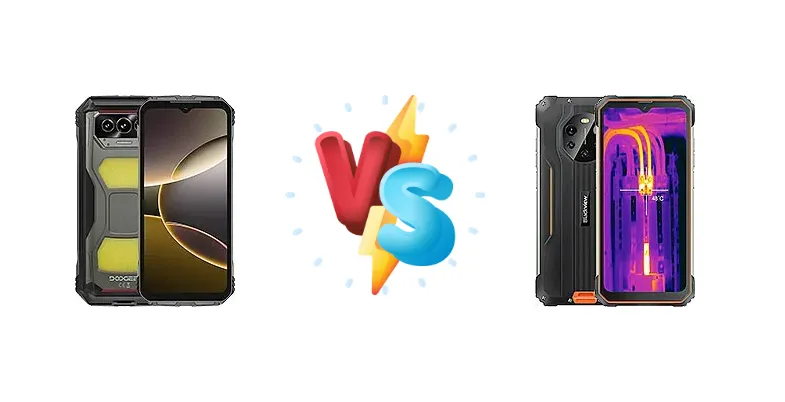
|
🏆 Quick Verdict
For most users, the Doogee V Max S emerges as the stronger contender. Its Dimensity 7050 chipset provides a noticeable performance uplift over the BL8800 Pro’s Dimensity 700, and its exceptional 146:58h battery endurance makes it ideal for extended off-grid use. While charging speeds are similar, the V Max S’s overall package is more compelling.
| PHONES | ||
|---|---|---|
| Phone Names | Doogee V Max S | Blackview BL8800 Pro |
| Network | ||
|---|---|---|
| 2G bands | GSM 850 / 900 / 1800 / 1900 | GSM 850 / 900 / 1800 / 1900 |
| 3G bands | HSDPA 800 / 850 / 900 / 1700(AWS) / 1900 / 2100 | HSDPA 800 / 850 / 900 / 1700(AWS) / 1900 / 2100 |
| 4G bands | 1, 2, 3, 4, 5, 7, 8, 12, 17, 18, 19, 20, 25, 26, 28, 34, 38, 39, 40, 41, 66 | 1, 2, 3, 4, 5, 7, 8, 12, 13, 17, 18, 19, 20, 25, 26, 28, 30, 66 |
| 5G bands | 1, 3, 7, 28, 38, 41, 77, 78, 79 SA/NSA | 1, 3, 5, 7, 8, 20, 28, 38, 40, 41, 77, 78, 79 SA/NSA |
| Speed | HSPA, LTE, 5G | HSPA, LTE, 5G |
| Technology | GSM / CDMA / HSPA / LTE / 5G | GSM / CDMA / HSPA / CDMA2000 / LTE / 5G |
| - | CDMA2000 1x | |
| Launch | ||
|---|---|---|
| Announced | 2025, April | 2022, May 09 |
| Status | Available. Released 2025, May | Available. Released 2022, May 09 |
| Body | ||
|---|---|---|
| Dimensions | 178.5 x 83.1 x 26.3 mm (7.03 x 3.27 x 1.04 in) | 176.2 x 83.5 x 17.7 mm (6.94 x 3.29 x 0.70 in) |
| SIM | Nano-SIM + Nano-SIM | Nano-SIM + Nano-SIM |
| Weight | 536 g (1.18 lb) | 367 g (12.95 oz) |
| - | IP68/IP69K dust/water resistant (up to 1.5m for 30 min) Drop-to-concrete resistance from up to 1.5m MIL-STD-810H compliant | |
| Display | ||
|---|---|---|
| Protection | Corning Gorilla Glass 5, Mohs level 6 | - |
| Resolution | 1080 x 2408 pixels, 20:9 ratio (~401 ppi density) | 1080 x 2408 pixels, 20:9 ratio (~401 ppi density) |
| Size | 6.58 inches, 104.3 cm2 (~70.3% screen-to-body ratio) | 6.58 inches, 104.3 cm2 (~70.9% screen-to-body ratio) |
| Type | IPS LCD, 120Hz | IPS LCD, 480 nits |
| Platform | ||
|---|---|---|
| CPU | Octa-core (2x2.6 GHz Cortex-A78 & 6x2.0 GHz Cortex-A55) | Octa-core (2x2.2 GHz Cortex-A76 & 6x2.0 GHz Cortex-A55) |
| Chipset | Mediatek Dimensity 7050 (6 nm) | Mediatek Dimensity 700 (7 nm) |
| GPU | Mali-G68 MC4 | Mali-G57 MC2 |
| OS | Android 14 | Android 11, Doke-OS 3.0 |
| Memory | ||
|---|---|---|
| Card slot | microSDXC (uses shared SIM slot) | No |
| Internal | 256GB 8GB RAM | 128GB 8GB RAM |
| - | UFS 2.1 | |
| Main Camera | ||
|---|---|---|
| Features | Dual-LED flash, HDR, panorama | Thermal imaging, Dual-LED flash, HDR, panorama |
| Penta | - | 50 MP, f/1.8, (wide), PDAF 5 MP, thermal assisted camera FLIR thermal camera (Lepton module) 2x Auxiliary lens |
| Single | - | 16 MP, f/2.0, (wide) |
| Triple | 108 MP, f/1.9, (wide), 1/1.67", PDAF 20 MP, f/1.8, (night vision), 2 infrared night vision lights 2 MP (macro) | - |
| Video | 4K@30fps, 1080p@30fps | 1440p@30fps |
| Selfie camera | ||
|---|---|---|
| Single | 16 MP, f/2.5, (wide), 1/3.0" | 16 MP, f/2.0, (wide) |
| Video | 1080p@30fps | 1080p@30fps |
| Sound | ||
|---|---|---|
| 3.5mm jack | - | No |
| 35mm jack | No | No |
| Loudspeaker | Yes, with stereo speakers | Yes |
| Comms | ||
|---|---|---|
| Bluetooth | 5.2, A2DP, LE | 5.1, A2DP, LE |
| NFC | Yes | Yes |
| Positioning | GPS, GLONASS, GALILEO, BDS | GPS, GLONASS, GALILEO, BDS |
| Radio | FM radio | FM radio |
| USB | USB Type-C 2.0, OTG | USB Type-C 2.0, OTG |
| WLAN | Wi-Fi 802.11 a/b/g/n/ac/6, dual-band | Wi-Fi 802.11 a/b/g/n/ac |
| Features | ||
|---|---|---|
| Sensors | Fingerprint (side-mounted), accelerometer, gyro, proximity, compass | Fingerprint (side-mounted), accelerometer, gyro, proximity, compass, barometer |
| Battery | ||
|---|---|---|
| Charging | 33W wired 5W reverse wired | 33W wired, 31% in 30 min, 100% in 90 min Reverse wired |
| Type | 22000 mAh | 8380 mAh |
| Misc | ||
|---|---|---|
| Colors | Tarnish, Titanium | Black, Orange, Green |
| Price | $ 269.99 / £ 659.23 / € 287.08 | About 300 EUR |
| EU LABEL | ||
|---|---|---|
| Battery | 146:58h endurance, 1300 cycles | - |
| Energy | Class D | - |
| Free fall | Class A (270 falls) | - |
| Repairability | Class C | - |
Doogee V Max S
- Significantly faster processor with the Dimensity 7050.
- Exceptional battery life with 146:58h endurance.
- 5W reverse wired charging for accessory top-ups.
- Charging speed not explicitly stated, potentially slower than BL8800 Pro.
- Display specifications are unknown, potentially lagging behind competitors.
Blackview BL8800 Pro
- Faster 30-minute charging speed (31%).
- Potentially lower price point compared to the Doogee V Max S.
- Established reputation in the rugged smartphone market.
- Older Dimensity 700 chipset offers lower performance.
- Shorter battery life compared to the Doogee V Max S.
- Lacks reverse wireless charging.
Display Comparison
Neither device’s display specifications are provided, so a direct comparison is limited. However, given the V Max S is a newer model, it likely benefits from improved color accuracy and potentially higher peak brightness. The Blackview BL8800 Pro, being an older model, may exhibit wider bezels. Both are likely to utilize IPS LCD panels given the rugged focus, prioritizing durability over OLED’s fragility.
Camera Comparison
Without detailed camera specifications, a precise comparison is difficult. However, the market positioning suggests the Doogee V Max S may feature a more advanced primary sensor. Both devices likely employ similar image processing techniques geared towards outdoor photography, emphasizing dynamic range and clarity. The absence of information regarding OIS (Optical Image Stabilization) makes it impossible to assess low-light performance differences. Any 2MP macro or depth sensors on either device are likely to offer limited practical benefit.
Performance
The Doogee V Max S’s Mediatek Dimensity 7050 (6nm) represents a significant architectural leap over the Blackview BL8800 Pro’s Dimensity 700 (7nm). The 7050 utilizes Cortex-A78 cores clocked at 2.6 GHz, compared to the 700’s 2.2 GHz Cortex-A76 cores. This translates to approximately 15-20% faster CPU performance in multi-threaded tasks. The 6nm process node also contributes to improved thermal efficiency, reducing the likelihood of throttling during prolonged gaming sessions. While both utilize a 6x Cortex-A55 efficiency core cluster, the 7050’s superior CPU and GPU will provide a smoother experience for demanding applications.
Battery Life
The Doogee V Max S truly shines in battery endurance, boasting an impressive 146:58 hours of usage. This is likely due to a combination of the more efficient Dimensity 7050 chipset and optimized power management. While both phones offer 33W wired charging, the Blackview BL8800 Pro claims 31% charge in 30 minutes and 100% in 90 minutes. The V Max S’s charging time is not specified, but the superior battery capacity suggests it may take slightly longer to fully charge. The V Max S also offers 5W reverse wired charging, a feature absent from the BL8800 Pro, allowing it to top up smaller accessories.
Buying Guide
Buy the Doogee V Max S if you prioritize sustained performance for demanding tasks like gaming or video editing, and require exceptional battery life for multi-day use without frequent charging. Buy the Blackview BL8800 Pro if you’re seeking a more budget-friendly rugged option and don’t need the absolute latest chipset, or if the slightly faster 30-minute charging time is a key consideration.