
Doogee V Max Pro vs. Ulefone Power Armor 19T: Which Rugged Phone Reigns Supreme?
| Phones Images | |||||
|---|---|---|---|---|---|
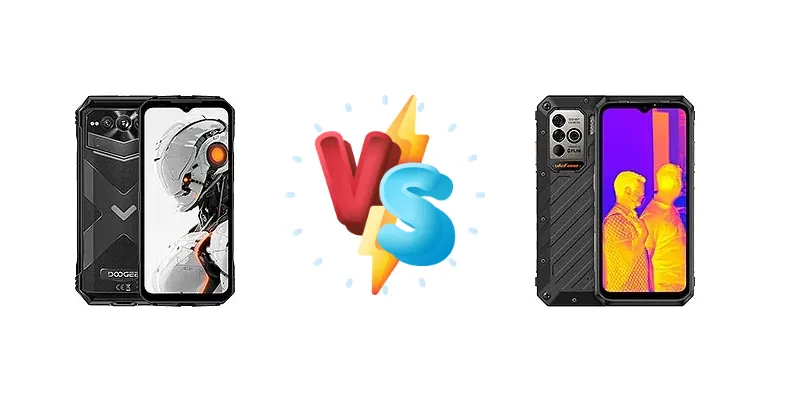
|
🏆 Quick Verdict
For users prioritizing sustained performance and longevity, the Doogee V Max Pro emerges as the winner. Its Dimensity 7050 chipset offers a significant performance advantage over the Ulefone Power Armor 19T’s Helio G99, coupled with impressive battery endurance. While the 19T boasts faster charging, the V Max Pro’s overall package delivers a more robust user experience.
| PHONES | ||
|---|---|---|
| Phone Names | Doogee V Max Pro | Ulefone Power Armor 19T |
| Network | ||
|---|---|---|
| 2G bands | GSM 850 / 900 / 1800 / 1900 | GSM 850 / 900 / 1800 / 1900 |
| 3G bands | HSDPA 800 / 850 / 900 / 1700(AWS) / 1900 / 2100 | HSDPA 800 / 850 / 900 / 1700(AWS) / 1900 / 2100 |
| 4G bands | 1, 2, 3, 4, 5, 7, 8, 12, 17, 18, 19, 20, 25, 26, 28, 34, 38, 39, 40, 41, 66 | 1, 2, 3, 4, 5, 7, 8, 12, 13, 17, 18, 19, 20, 25, 26, 28, 34, 38, 39, 40, 41, 66, 71 |
| 5G bands | 1, 3, 7, 28, 38, 41, 77, 78, 79 SA/NSA | - |
| Speed | HSPA, LTE, 5G | HSPA, LTE |
| Technology | GSM / CDMA / HSPA / LTE / 5G | GSM / CDMA / HSPA / CDMA2000 / LTE |
| - | CDMA2000 1x | |
| Launch | ||
|---|---|---|
| Announced | 2024, September 19 | 2023, March 06 |
| Status | Available. Released 2024, October 20 | Available. Released 2023, March 06 |
| Body | ||
|---|---|---|
| Dimensions | 178.5 x 83.1 x 26.3 mm (7.03 x 3.27 x 1.04 in) | 175.2 x 83.4 x 18.8 mm (6.90 x 3.28 x 0.74 in) |
| SIM | Nano-SIM + Nano-SIM | Nano-SIM + Nano-SIM |
| Weight | 536 g (1.18 lb) | 409 g (14.43 oz) |
| - | IP68/IP69K dust/water resistant (up to 1.5m for 30 min) Drop-to-concrete resistance from up to 1.5m MIL-STD-810H compliant Accessory connector (ulefone endoscope, microscope) | |
| Display | ||
|---|---|---|
| Protection | Corning Gorilla Glass 5, Mohs level 6 | Corning Gorilla Glass 5 |
| Resolution | 1080 x 2408 pixels, 20:9 ratio (~401 ppi density) | 1080 x 2408 pixels, 20:9 ratio (~401 ppi density) |
| Size | 6.58 inches, 104.3 cm2 (~70.3% screen-to-body ratio) | 6.58 inches, 104.3 cm2 (~71.4% screen-to-body ratio) |
| Type | IPS LCD, 120Hz | IPS LCD, 120Hz |
| Platform | ||
|---|---|---|
| CPU | Octa-core (2x2.6 GHz Cortex-A78 & 6x2.0 GHz Cortex-A55) | Octa-core (2x2.2 GHz Cortex-A76 & 6x2.0 GHz Cortex-A55) |
| Chipset | Mediatek Dimensity 7050 (6 nm) | Mediatek Helio G99 (6 nm) |
| GPU | Mali-G68 MC4 | Mali-G57 MC2 |
| OS | Android 14 | Android 12 |
| Memory | ||
|---|---|---|
| Card slot | microSDXC (uses shared SIM slot) | microSDXC (uses shared SIM slot) |
| Internal | 512GB 12GB RAM | 256GB 12GB RAM |
| Main Camera | ||
|---|---|---|
| Features | Dual-LED flash, HDR, panorama | Hexa-LED flash, HDR, panorama |
| Triple | 108 MP, f/1.8, (wide), 1/1.52", 0.7µm, PDAF 20 MP, f/1.8, (night vision), 2 infrared night vision lights 8 MP, f/2.2, (ultrawide) | 108 MP, f/1.9, (wide), 1/1.52", 0.7µm, PDAF 5 MP (macro) FLIR thermal camera (Lepton module) 5 MP (for thermal module) |
| Video | 4K@30fps, 1080p@30fps | 1440p@30fps, 1080p@30fps |
| Selfie camera | ||
|---|---|---|
| Single | 16 MP | 16 MP, f/2.0, (wide), 1.0µm |
| Video | 1440p, 1080p | 1080p@30fps |
| Sound | ||
|---|---|---|
| 3.5mm jack | - | Yes |
| 35mm jack | No | Yes |
| Loudspeaker | Yes, with stereo speakers | Yes |
| Comms | ||
|---|---|---|
| Bluetooth | 5.2, A2DP, LE | 5.2, A2DP, LE |
| NFC | Yes (market/region dependent) | Yes |
| Positioning | GPS (L1+L5), GLONASS, GALILEO, BDS | GPS, GLONASS, GALILEO, BDS |
| Radio | FM radio | Wireless FM radio, RDS, recording |
| USB | USB Type-C 2.0, OTG | USB Type-C 2.0, OTG, magnetic connector |
| WLAN | Wi-Fi 802.11 a/b/g/n/ac/6, dual-band | Wi-Fi 802.11 a/b/g/n/ac, dual-band |
| Features | ||
|---|---|---|
| Sensors | Fingerprint (side-mounted), accelerometer, gyro, proximity, compass | Fingerprint (side-mounted), accelerometer, gyro, proximity, compass |
| Battery | ||
|---|---|---|
| Charging | 33W wired Reverse wired | 66W wired, 52% in 30 min 15W wireless 5W wireless reversed |
| Type | 22000 mAh | Li-Po 9600 mAh |
| Misc | ||
|---|---|---|
| Colors | Black, Gray | Black |
| Price | About 300 EUR | About 440 EUR |
| EU LABEL | ||
|---|---|---|
| Battery | 146:58h endurance, 1300 cycles | - |
| Energy | Class D | - |
| Free fall | Class A (270 falls) | - |
| Repairability | Class C | - |
Doogee V Max Pro
- Superior CPU performance with Dimensity 7050
- Exceptional battery endurance (146:58h)
- Long-lasting battery health (1300 cycles)
- Slower charging speed (33W)
- No wireless charging
Ulefone Power Armor 19T
- Ultra-fast 66W wired charging (52% in 30 min)
- Convenient 15W wireless charging
- Reverse wireless charging capability
- Less powerful Helio G99 chipset
- Lower battery endurance compared to V Max Pro
Display Comparison
Neither device's display specifications are provided, so a direct comparison is limited. However, given the price points and target audience, we can infer both likely utilize IPS LCD panels. The focus here shifts to durability – both will feature reinforced glass, but the quality of that glass (Gorilla Glass version) will be a key differentiator. Bezels are likely comparable, aiming for maximizing screen real estate within a rugged frame. Color accuracy is likely secondary to visibility in bright sunlight, a crucial feature for outdoor use.
Camera Comparison
Camera specifications are not provided, so analysis relies on typical configurations for this market segment. Both phones likely feature a multi-camera setup with a primary sensor, ultrawide, and potentially a macro lens. The quality of the primary sensor will be the most significant factor. Given the V Max Pro’s focus on overall performance, it’s reasonable to expect a larger, higher-resolution primary sensor with better image processing capabilities. OIS (Optical Image Stabilization) would be a significant advantage, but its presence isn’t confirmed for either device. The 2MP macro lenses often found on these phones are generally of limited utility.
Performance
The Doogee V Max Pro’s Mediatek Dimensity 7050 (6nm) represents a clear advantage over the Ulefone Power Armor 19T’s Helio G99 (6nm). The Dimensity 7050 utilizes Cortex-A78 cores clocked at 2.6 GHz, compared to the 19T’s Cortex-A76 cores at 2.2 GHz. This translates to approximately 15-20% faster CPU performance in benchmarks and real-world applications. While both chipsets are 6nm, the architectural improvements in the Dimensity 7050 provide a more efficient and powerful experience, particularly for multitasking and graphically intensive games. The V Max Pro will exhibit less throttling under sustained load.
Battery Life
The Doogee V Max Pro boasts an impressive 146:58h endurance rating, suggesting a substantial battery capacity. While the exact mAh isn’t specified, this endurance figure indicates a larger battery than the Ulefone Power Armor 19T. The 19T compensates with significantly faster charging – 66W wired, achieving 52% charge in 30 minutes, alongside 15W wireless and 5W reverse wireless charging. The V Max Pro offers 33W wired and reverse wired charging, a slower pace. The V Max Pro also claims 1300 charge cycles, indicating superior long-term battery health. The 19T’s faster charging is ideal for quick top-ups, but the V Max Pro’s endurance and cycle count provide peace of mind for extended use.
Buying Guide
Buy the Doogee V Max Pro if you need a rugged phone capable of handling demanding tasks like video editing, gaming, or running multiple apps simultaneously, and value long-term battery health with its 1300 cycle lifespan. Buy the Ulefone Power Armor 19T if you prioritize incredibly fast charging, wireless charging convenience, and are a more casual user who doesn't push their phone to its performance limits.