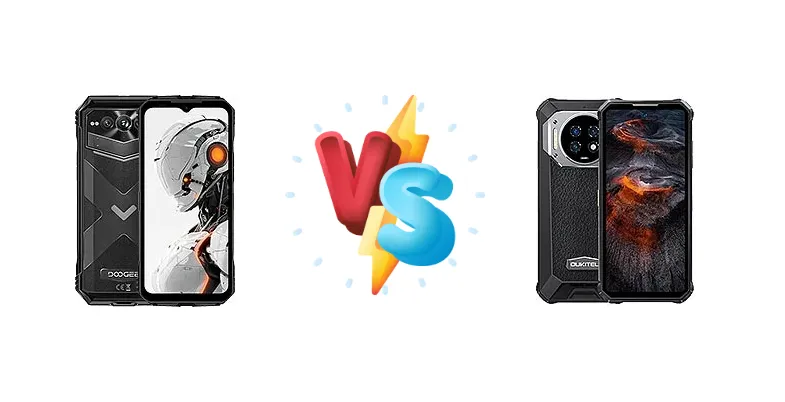
The rugged smartphone market is heating up, with both Doogee and Oukitel offering compelling options. We pit the newer Doogee V Max Pro, boasting a modern Dimensity 7050 chipset, against the established Oukitel WP19, powered by the Helio G95, to determine which device offers the best blend of performance, endurance, and value for users needing a durable device.
🏆 Quick Verdict
For most users, the Doogee V Max Pro emerges as the superior choice. Its Dimensity 7050 chipset provides a significant performance uplift over the Oukitel WP19’s Helio G95, translating to smoother multitasking and gaming. While both offer 33W charging, the V Max Pro’s superior endurance and more efficient processor make it the better all-rounder.
| Network |
|---|
| 2G bands | GSM 850 / 900 / 1800 / 1900 | GSM 850 / 900 / 1800 / 1900 |
| 3G bands | HSDPA 800 / 850 / 900 / 1700(AWS) / 1900 / 2100 | HSDPA 850 / 900 / 1700(AWS) / 1900 / 2100 |
| 4G bands | 1, 2, 3, 4, 5, 7, 8, 12, 17, 18, 19, 20, 25, 26, 28, 34, 38, 39, 40, 41, 66 | LTE |
| 5G bands | 1, 3, 7, 28, 38, 41, 77, 78, 79 SA/NSA | - |
| Speed | HSPA, LTE, 5G | HSPA, LTE |
| Technology | GSM / CDMA / HSPA / LTE / 5G | GSM / HSPA / LTE |
| Launch |
|---|
| Announced | 2024, September 19 | 2022, June |
| Status | Available. Released 2024, October 20 | Available. Released 2022, July |
| Body |
|---|
| Dimensions | 178.5 x 83.1 x 26.3 mm (7.03 x 3.27 x 1.04 in) | - |
| SIM | Nano-SIM + Nano-SIM | Nano-SIM + Nano-SIM |
| Weight | 536 g (1.18 lb) | - |
| Display |
|---|
| Protection | Corning Gorilla Glass 5, Mohs level 6 | - |
| Resolution | 1080 x 2408 pixels, 20:9 ratio (~401 ppi density) | 1080 x 2460 pixels (~396 ppi density) |
| Size | 6.58 inches, 104.3 cm2 (~70.3% screen-to-body ratio) | 6.78 inches, 109.2 cm2 |
| Type | IPS LCD, 120Hz | IPS LCD, 90Hz |
| Platform |
|---|
| CPU | Octa-core (2x2.6 GHz Cortex-A78 & 6x2.0 GHz Cortex-A55) | Octa-core (2x2.05 GHz Cortex-A76 & 6x2.0 GHz Cortex-A55) |
| Chipset | Mediatek Dimensity 7050 (6 nm) | Mediatek MT6785V/CD Helio G95 (12 nm) |
| GPU | Mali-G68 MC4 | Mali-G76 MC4 |
| OS | Android 14 | Android 12 |
| Memory |
|---|
| Card slot | microSDXC (uses shared SIM slot) | microSDXC (dedicated slot) |
| Internal | 512GB 12GB RAM | 256GB 8GB RAM |
| Main Camera |
|---|
| Features | Dual-LED flash, HDR, panorama | LED flash, panorama |
| Triple | 108 MP, f/1.8, (wide), 1/1.52", 0.7µm, PDAF
20 MP, f/1.8, (night vision), 2 infrared night vision lights
8 MP, f/2.2, (ultrawide) | 64 MP, f/1.8, (wide), PDAF
20 MP, f/2.0, (night vision), 4 infrared night vision lights
2 MP (macro) |
| Video | 4K@30fps, 1080p@30fps | 4K@30fps, 1080p@30fps |
| Selfie camera |
|---|
| Single | 16 MP | 16 MP |
| Video | 1440p, 1080p | Yes |
| Sound |
|---|
| 35mm jack | No | Unspecified |
| Loudspeaker | Yes, with stereo speakers | Yes |
| Comms |
|---|
| Bluetooth | 5.2, A2DP, LE | Yes |
| NFC | Yes (market/region dependent) | Yes |
| Positioning | GPS (L1+L5), GLONASS, GALILEO, BDS | GPS, GLONASS, GALILEO, BDS |
| Radio | FM radio | Unspecified |
| USB | USB Type-C 2.0, OTG | USB Type-C 2.0, OTG |
| WLAN | Wi-Fi 802.11 a/b/g/n/ac/6, dual-band | Yes |
| Features |
|---|
| Sensors | Fingerprint (side-mounted), accelerometer, gyro, proximity, compass | Unspecified |
| Battery |
|---|
| Charging | 33W wired
Reverse wired | 33W wired |
| Type | 22000 mAh | Li-Po 21000 mAh |
| Misc |
|---|
| Colors | Black, Gray | Blue, Camo, Camouflage |
| Price | About 300 EUR | About 380 EUR |
| EU LABEL |
|---|
| Battery | 146:58h endurance, 1300 cycles | - |
| Energy | Class D | - |
| Free fall | Class A (270 falls) | - |
| Repairability | Class C | - |
Doogee V Max Pro
- Significantly faster processor (Dimensity 7050)
- Superior battery endurance (146:58h)
- Longer battery lifespan (1300 cycles)
- Likely higher price point
- May not offer significant camera improvements without further specs
Oukitel WP19
- More affordable price
- Rugged design for durability
- Acceptable performance for basic tasks
- Older, less efficient chipset (Helio G95)
- Shorter battery life
- Lower overall performance
Display Comparison
Neither device's display specifications are provided, so a direct comparison is limited. However, given the V Max Pro's positioning as a more premium device, it likely features a higher quality panel with better color accuracy and potentially higher peak brightness. Rugged phones often prioritize durability over display excellence, so expect both to have robust glass protection, but potentially lower peak brightness compared to flagship smartphones.
Camera Comparison
Without detailed camera specifications, a precise comparison is difficult. However, the chipset difference suggests the Doogee V Max Pro will have a more powerful image signal processor (ISP), enabling better image processing and potentially superior low-light performance. The V Max Pro’s more powerful processor can handle more complex computational photography algorithms. Both phones likely feature multiple cameras, but the V Max Pro is expected to offer a more refined camera experience overall.
Performance
The core difference lies in the chipsets. The Doogee V Max Pro’s Mediatek Dimensity 7050 (6nm) is a clear upgrade over the Oukitel WP19’s Helio G95 (12nm). The 6nm process node of the Dimensity 7050 offers significantly improved power efficiency and thermal performance. The Dimensity 7050’s octa-core configuration (2x2.6 GHz Cortex-A78 & 6x2.0 GHz Cortex-A55) provides a substantial CPU performance boost compared to the Helio G95’s (2x2.05 GHz Cortex-A76 & 6x2.0 GHz Cortex-A55). This translates to faster app loading times, smoother multitasking, and a more responsive user experience. The Dimensity 7050 also boasts a more capable GPU, making it the better choice for mobile gaming.
Battery Life
The Doogee V Max Pro boasts an impressive 146:58h endurance rating and a 1300 cycle lifespan, indicating exceptional battery life and longevity. While both phones support 33W wired charging, the Dimensity 7050’s superior power efficiency means the V Max Pro will likely achieve a full charge faster and maintain that charge for a longer period. The 1300 cycle lifespan suggests the V Max Pro’s battery will retain a higher capacity after prolonged use compared to the WP19.
Buying Guide
Buy the Doogee V Max Pro if you prioritize performance for demanding tasks like gaming or video editing, and require exceptional battery life for extended use in the field. Buy the Oukitel WP19 if you are on a tighter budget and primarily need a durable phone for basic communication and light usage, accepting a performance trade-off.
Frequently Asked Questions
❓ Will the Doogee V Max Pro’s Dimensity 7050 handle demanding games like Genshin Impact at high settings?
The Dimensity 7050 is a capable chipset that should handle Genshin Impact at medium to high settings with playable frame rates. While it won't match the performance of flagship Snapdragon chips, it offers a significant improvement over the Helio G95 in the Oukitel WP19, providing a smoother gaming experience.
❓ How does the 33W charging compare between the Doogee V Max Pro and Oukitel WP19, considering the different battery efficiencies?
While both phones support 33W charging, the Doogee V Max Pro will likely charge faster due to the Dimensity 7050’s superior power efficiency. The V Max Pro’s processor consumes less power during charging, allowing more energy to be directed towards the battery itself. Furthermore, the V Max Pro’s longer endurance suggests it will require less frequent charging overall.
❓ Is the Doogee V Max Pro’s battery lifespan of 1300 cycles a realistic claim?
1300 cycles is a very high number, and real-world results will vary based on usage patterns and charging habits. However, the Dimensity 7050’s power efficiency and the V Max Pro’s battery management system likely contribute to a longer battery lifespan compared to the Oukitel WP19.