
Doogee V Max Pro vs Blackview BV8900: A Deep Dive into Rugged Smartphone Performance
| Phones Images | |||||
|---|---|---|---|---|---|
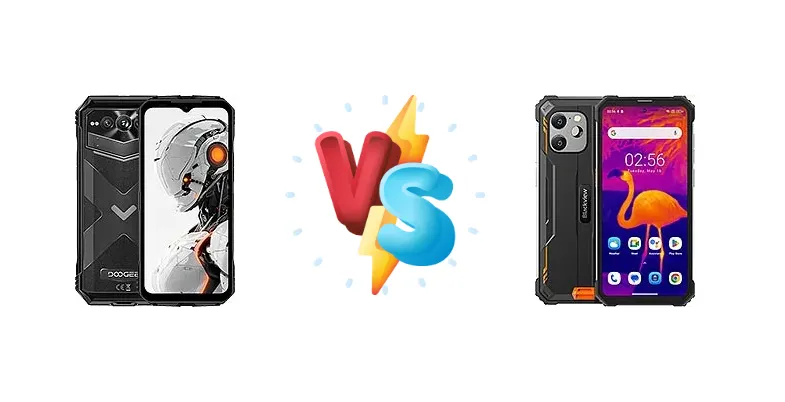
|
🏆 Quick Verdict
For most users prioritizing performance and longevity, the Doogee V Max Pro emerges as the stronger choice. Its Mediatek Dimensity 7050 chipset, built on a 6nm process, delivers significantly improved processing power and efficiency compared to the Blackview BV8900’s older 12nm Helio P90. The V Max Pro’s superior endurance rating further solidifies its position for power users.
| PHONES | ||
|---|---|---|
| Phone Names | Doogee V Max Pro | Blackview BV8900 |
| Network | ||
|---|---|---|
| 2G bands | GSM 850 / 900 / 1800 / 1900 | GSM 850 / 900 / 1800 / 1900 |
| 3G bands | HSDPA 800 / 850 / 900 / 1700(AWS) / 1900 / 2100 | HSDPA 850 / 900 / 1700(AWS) / 1900 / 2100 |
| 4G bands | 1, 2, 3, 4, 5, 7, 8, 12, 17, 18, 19, 20, 25, 26, 28, 34, 38, 39, 40, 41, 66 | 1, 2, 3, 4, 5, 7, 8, 12, 13, 17, 18, 19, 20, 25, 26, 28, 34, 38, 39, 40, 41, 66 |
| 5G bands | 1, 3, 7, 28, 38, 41, 77, 78, 79 SA/NSA | - |
| Speed | HSPA, LTE, 5G | HSPA, LTE |
| Technology | GSM / CDMA / HSPA / LTE / 5G | GSM / CDMA / HSPA / LTE |
| Launch | ||
|---|---|---|
| Announced | 2024, September 19 | 2023, May 28 |
| Status | Available. Released 2024, October 20 | Available. Released 2023, June 12 |
| Body | ||
|---|---|---|
| Dimensions | 178.5 x 83.1 x 26.3 mm (7.03 x 3.27 x 1.04 in) | 172.4 x 82.2 x 19.8 mm (6.79 x 3.24 x 0.78 in) |
| SIM | Nano-SIM + Nano-SIM | Nano-SIM + Nano-SIM |
| Weight | 536 g (1.18 lb) | 398 g (14.04 oz) |
| Display | ||
|---|---|---|
| Protection | Corning Gorilla Glass 5, Mohs level 6 | Corning Gorilla Glass Victus |
| Resolution | 1080 x 2408 pixels, 20:9 ratio (~401 ppi density) | 1080 x 2408 pixels, 20:9 ratio (~406 ppi density) |
| Size | 6.58 inches, 104.3 cm2 (~70.3% screen-to-body ratio) | 6.5 inches, 101.8 cm2 (~71.8% screen-to-body ratio) |
| Type | IPS LCD, 120Hz | IPS LCD |
| Platform | ||
|---|---|---|
| CPU | Octa-core (2x2.6 GHz Cortex-A78 & 6x2.0 GHz Cortex-A55) | Octa-core (2x2.2 GHz Cortex-A75 & 6x2.0 GHz Cortex-A55) |
| Chipset | Mediatek Dimensity 7050 (6 nm) | Mediatek MT6779 Helio P90 (12 nm) |
| GPU | Mali-G68 MC4 | PowerVR GM9446 |
| OS | Android 14 | Android 13, Doke-OS 3.1 |
| Memory | ||
|---|---|---|
| Card slot | microSDXC (uses shared SIM slot) | microSDXC (uses shared SIM slot) |
| Internal | 512GB 12GB RAM | 256GB 8GB RAM |
| Main Camera | ||
|---|---|---|
| Dual | - | 64 MP, f/1.8, (wide), 1/1.97", PDAF, OIS 5 MP, thermal assisted camera FLIR thermal camera (Lepton module) |
| Features | Dual-LED flash, HDR, panorama | Thermal imaging, LED flash |
| Triple | 108 MP, f/1.8, (wide), 1/1.52", 0.7µm, PDAF 20 MP, f/1.8, (night vision), 2 infrared night vision lights 8 MP, f/2.2, (ultrawide) | - |
| Video | 4K@30fps, 1080p@30fps | 4K@30fps, 1080p@30fps |
| Selfie camera | ||
|---|---|---|
| Single | 16 MP | 16 MP, f/2.2, (wide) |
| Video | 1440p, 1080p | 1080p@30fps |
| Sound | ||
|---|---|---|
| 35mm jack | No | No |
| Loudspeaker | Yes, with stereo speakers | Yes |
| Comms | ||
|---|---|---|
| Bluetooth | 5.2, A2DP, LE | 5.0, A2DP, LE |
| NFC | Yes (market/region dependent) | Yes |
| Positioning | GPS (L1+L5), GLONASS, GALILEO, BDS | GPS, GLONASS, GALILEO, BDS |
| Radio | FM radio | FM radio |
| USB | USB Type-C 2.0, OTG | USB Type-C 3.0, OTG |
| WLAN | Wi-Fi 802.11 a/b/g/n/ac/6, dual-band | Wi-Fi 802.11 a/b/g/n/ac, dual-band |
| Features | ||
|---|---|---|
| Sensors | Fingerprint (side-mounted), accelerometer, gyro, proximity, compass | Fingerprint (side-mounted), accelerometer, proximity, compass, gyro, barometer |
| Battery | ||
|---|---|---|
| Charging | 33W wired Reverse wired | 33W wired Reverse wired |
| Type | 22000 mAh | 10380 mAh |
| Misc | ||
|---|---|---|
| Colors | Black, Gray | Black, Orange, Green |
| Price | About 300 EUR | About 290 EUR |
| EU LABEL | ||
|---|---|---|
| Battery | 146:58h endurance, 1300 cycles | - |
| Energy | Class D | - |
| Free fall | Class A (270 falls) | - |
| Repairability | Class C | - |
Doogee V Max Pro
- Significantly faster processor with the Dimensity 7050.
- Superior battery endurance and lifespan (146:58h, 1300 cycles).
- More efficient 6nm chipset for cooler operation.
- Potentially higher price point.
- Limited information on camera specifications.
Blackview BV8900
- More affordable price point (likely).
- Rugged design for durability.
- 33W fast charging with reverse wired charging.
- Older and less powerful Helio P90 chipset.
- Lower battery endurance compared to the V Max Pro.
- Less efficient 12nm process.
Display Comparison
While both devices are rugged, display details are limited in the provided data. However, the chipset difference suggests the V Max Pro likely benefits from a more modern display controller, potentially offering better refresh rates and color accuracy. The BV8900, with its older chipset, may exhibit slightly lower display performance. Given the rugged nature of both phones, expect durable glass or plastic coverings, but specifics like peak brightness and resolution remain unknown.
Camera Comparison
Camera specifications are absent, making a direct comparison impossible. However, given the V Max Pro’s focus on overall performance, it’s reasonable to assume it incorporates a more advanced camera system with larger sensors and improved image processing capabilities. The BV8900 likely features a more basic camera setup geared towards functional photography. Without detailed sensor information, it’s difficult to assess low-light performance or video recording quality.
Performance
The core difference lies in the chipsets. The Doogee V Max Pro’s Mediatek Dimensity 7050 (6nm) is a substantial upgrade over the Blackview BV8900’s Helio P90 (12nm). The 6nm process node allows for greater transistor density and improved power efficiency, translating to better sustained performance and less heat generation. The Dimensity 7050’s Cortex-A78 cores, clocked at 2.6 GHz, outperform the BV8900’s Cortex-A75 cores at 2.2 GHz in both single-core and multi-core tasks. This means faster app loading, smoother multitasking, and a more responsive user experience on the V Max Pro. The BV8900 will handle everyday tasks, but will struggle with demanding applications.
Battery Life
The Doogee V Max Pro boasts an impressive 146:58h endurance rating and a 1300 cycle battery lifespan, indicating exceptional battery life and longevity. While both phones offer 33W wired charging and reverse wired charging, the V Max Pro’s more efficient chipset will likely result in faster overall charging times and reduced power consumption during use. The 1300 cycle lifespan suggests the V Max Pro’s battery will retain a higher capacity over the long term, delaying the need for replacement.
Buying Guide
Buy the Doogee V Max Pro if you need a rugged phone capable of handling demanding tasks like gaming, video editing, or running resource-intensive applications, and value long-term battery health. Buy the Blackview BV8900 if you prioritize a more budget-friendly rugged option for basic communication, navigation, and light usage, and aren't concerned with having the latest processing power.