
Doogee V Max Plus vs. Doogee S99: A Deep Dive into Rugged Smartphone Performance
| Phones Images | |||||
|---|---|---|---|---|---|
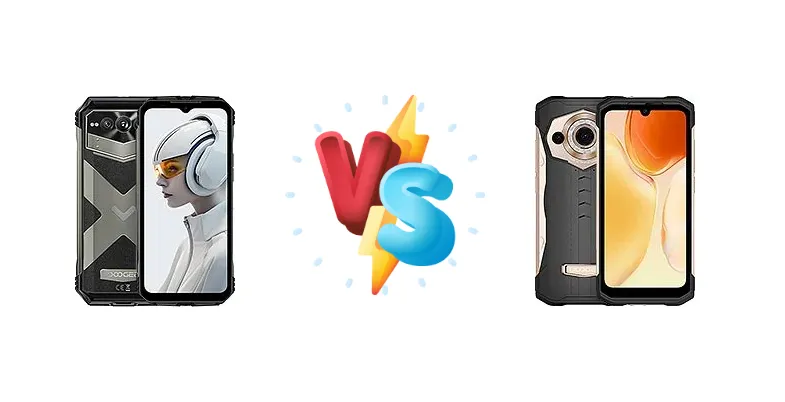
|
🏆 Quick Verdict
For users prioritizing performance and extended battery life, the Doogee V Max Plus is the clear winner. Its Dimensity 7050 chipset delivers a significant performance uplift over the S99’s Helio G96, and its exceptional 146:58h endurance makes it ideal for prolonged off-grid use. However, the S99 offers wireless charging as a convenience feature.
| PHONES | ||
|---|---|---|
| Phone Names | Doogee V Max Plus | Doogee S99 |
| Network | ||
|---|---|---|
| 2G bands | GSM 850 / 900 / 1800 / 1900 | GSM 850 / 900 / 1800 / 1900 |
| 3G bands | HSDPA 800 / 850 / 900 / 1700(AWS) / 1900 / 2100 | HSDPA 800 / 850 / 900 / 1700(AWS) / 1900 / 2100 |
| 4G bands | 1, 2, 3, 4, 5, 7, 8, 12, 17, 18, 19, 20, 25, 26, 28, 34, 38, 39, 40, 41, 66 | 1, 2, 3, 4, 5, 7, 8, 12, 13, 17, 18, 19, 20, 25, 26, 28, 34, 38, 39, 40, 41, 66 |
| 5G bands | 1, 3, 7, 28, 38, 41, 77, 78, 79 SA/NSA | - |
| Speed | HSPA, LTE, 5G | HSPA, LTE |
| Technology | GSM / CDMA / HSPA / LTE / 5G | GSM / CDMA / HSPA / LTE |
| Launch | ||
|---|---|---|
| Announced | 2024, August | 2022, December 05 |
| Status | Available. Released 2024, August | Available. Released 2022, December 05 |
| Body | ||
|---|---|---|
| Dimensions | 178.5 x 83.1 x 26.3 mm (7.03 x 3.27 x 1.04 in) | 172 x 82 x 15.5 mm (6.77 x 3.23 x 0.61 in) |
| SIM | Nano-SIM + Nano-SIM | Nano-SIM + Nano-SIM |
| Weight | - | - |
| Display | ||
|---|---|---|
| Protection | Corning Gorilla Glass 5, Mohs level 6 | Corning Gorilla Glass |
| Resolution | 1080 x 2408 pixels, 20:9 ratio (~401 ppi density) | 1080 x 2340 pixels, 19.5:9 ratio (~409 ppi density) |
| Size | 6.58 inches, 104.3 cm2 (~70.3% screen-to-body ratio) | 6.3 inches, 97.4 cm2 (~69.1% screen-to-body ratio) |
| Type | IPS LCD, 120Hz | IPS LCD |
| Platform | ||
|---|---|---|
| CPU | Octa-core (2x2.6 GHz Cortex-A78 & 6x2.0 GHz Cortex-A55) | Octa-core (2x2.05 GHz Cortex-A76 & 6x2.0 GHz Cortex-A55) |
| Chipset | Mediatek Dimensity 7050 (6 nm) | Mediatek MT6781 Helio G96 (12 nm) |
| GPU | Mali-G68 MC4 | Mali-G57 MC2 |
| OS | Android 14 | Android 12 |
| Memory | ||
|---|---|---|
| Card slot | microSDXC (uses shared SIM slot) | microSDXC (dedicated slot) |
| Internal | 512GB 16GB RAM | 128GB 8GB RAM |
| Main Camera | ||
|---|---|---|
| Features | Dual-LED flash, HDR, panorama | Dual-LED flash, HDR, panorama |
| Triple | 200 MP, f/1.8, (wide), 1/1.4", 0.56µm, PDAF 20 MP, f/1.8, (night vision), 2 infrared night vision lights 8 MP, f/2.2, 125˚ (ultrawide) | 108 MP, f/1.9, (wide), 1/1.52", 0.7µm, PDAF 64 MP, f/1.8, (night vision), 2 infrared night vision lights 16 MP, f/1.8, 130˚ (ultrawide) |
| Video | 4K@30fps, 1080p@30fps | 1440p@30fps, 1080p@30fps |
| Selfie camera | ||
|---|---|---|
| Single | 32 MP, f/1.8, (wide), 1/2.8", 0.8µm | 32 MP, f/2.0, (wide), 1/2.8", 0.8µm |
| Video | 1440p, 1080p | 1080p@30fps |
| Sound | ||
|---|---|---|
| 35mm jack | No | No |
| Loudspeaker | Yes, with stereo speakers | Yes |
| Comms | ||
|---|---|---|
| Bluetooth | 5.2, A2DP, LE | 5.1, A2DP, LE |
| NFC | Yes (market/region dependent) | Yes (market/region dependent) |
| Positioning | GPS (L1+L5), GLONASS, GALILEO, BDS | GPS, GLONASS, GALILEO, BDS |
| Radio | FM radio | FM radio |
| USB | USB Type-C 2.0, OTG | USB Type-C 2.0, OTG |
| WLAN | Wi-Fi 802.11 a/b/g/n/ac/6, dual-band | Wi-Fi 802.11 a/b/g/n/ac, dual-band |
| Features | ||
|---|---|---|
| Sensors | Fingerprint (side-mounted), accelerometer, gyro, proximity, compass | Fingerprint (side-mounted), accelerometer, gyro, proximity, compass |
| Battery | ||
|---|---|---|
| Charging | 33W wired Reverse wired | 33W wired, 45% in 30 min 15W wireless Reverse wired |
| Type | 22000 mAh | 6000 mAh |
| Misc | ||
|---|---|---|
| Colors | Obsidian Black, Pewter Gray | Gold, Black |
| Price | About 500 EUR | About 250 EUR |
| EU LABEL | ||
|---|---|---|
| Battery | 146:58h endurance, 1300 cycles | - |
| Energy | Class D | - |
| Free fall | Class A (270 falls) | - |
| Repairability | Class C | - |
Doogee V Max Plus
- Significantly faster processor (Dimensity 7050)
- Exceptional battery endurance (146:58h)
- Longer battery lifespan (1300 cycles)
- Lacks wireless charging
- Potentially higher price
Doogee S99
- More affordable price point
- Convenient 15W wireless charging
- Faster initial charging (45% in 30 min)
- Less powerful processor (Helio G96)
- Shorter battery life
Display Comparison
Neither device's display specifications are provided, so a direct comparison is limited. However, given the V Max Plus's focus on overall performance, it's reasonable to expect a slightly higher quality panel, potentially with a higher refresh rate. The S99, targeting a more budget-conscious segment, likely utilizes a standard 60Hz panel. Bezels are likely similar given both phones' rugged design constraints, prioritizing protection over minimal aesthetics.
Camera Comparison
Without detailed camera specifications, a precise comparison is difficult. However, the chipset difference suggests the V Max Plus will have a more capable image signal processor (ISP), leading to better image processing and potentially improved low-light performance. The S99's Helio G96 is a capable chipset, but the Dimensity 7050 offers a more modern ISP. It's likely both phones will feature similar primary sensors, but the V Max Plus will benefit from faster processing and potentially more advanced features.
Performance
The core difference lies in the chipsets. The Doogee V Max Plus boasts the Mediatek Dimensity 7050 (6nm), featuring an octa-core configuration with 2x2.6 GHz Cortex-A78 and 6x2.0 GHz Cortex-A55 cores. This is a substantial upgrade over the Doogee S99’s Mediatek Helio G96 (12nm) with its 2x2.05 GHz Cortex-A76 and 6x2.0 GHz Cortex-A55 cores. The 6nm process node of the Dimensity 7050 translates to improved power efficiency and reduced thermal throttling compared to the 12nm Helio G96. This means the V Max Plus will sustain peak performance for longer periods, crucial for gaming or demanding applications. The Dimensity 7050's Cortex-A78 cores also offer a performance advantage over the G96's A76 cores.
Battery Life
The Doogee V Max Plus shines in battery endurance, boasting an impressive 146:58h rating and a 1300 cycle lifespan. While both phones offer 33W wired charging, the V Max Plus’s superior battery capacity and efficiency mean it will likely achieve a longer overall usage time. The S99 adds 15W wireless charging, a convenience feature absent on the V Max Plus, and claims 45% charge in 30 minutes with wired charging. However, the V Max Plus’s significantly longer endurance likely outweighs the convenience of wireless charging for many users.
Buying Guide
Buy the Doogee V Max Plus if you need a rugged phone capable of handling demanding tasks like gaming, video editing, or running resource-intensive apps, and if maximizing battery life is paramount. Buy the Doogee S99 if you prioritize a lower price point, appreciate the convenience of wireless charging, and primarily use your phone for everyday tasks like communication, navigation, and casual photography.