
Doogee V Max Plus vs. S98 Pro: A Deep Dive into Rugged Smartphone Performance
| Phones Images | |||||
|---|---|---|---|---|---|
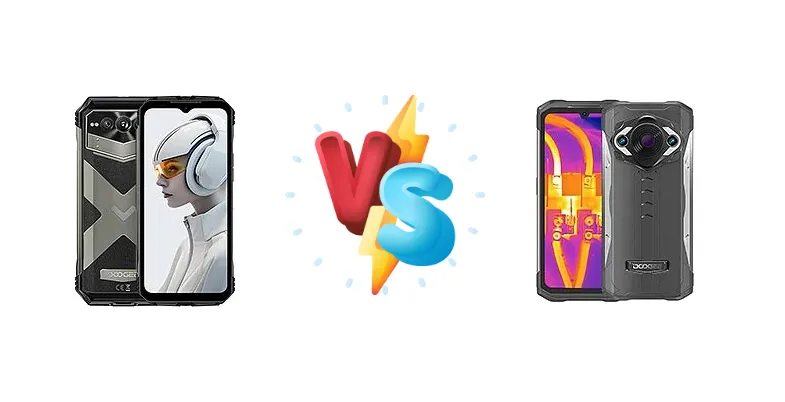
|
🏆 Quick Verdict
For most users, the Doogee V Max Plus emerges as the stronger choice. Its Mediatek Dimensity 7050 chipset, built on a more efficient 6nm process, delivers superior performance and longevity compared to the S98 Pro’s 12nm Helio G96. While both offer 33W charging, the V Max Plus boasts significantly better battery endurance, making it ideal for extended outdoor use.
| PHONES | ||
|---|---|---|
| Phone Names | Doogee V Max Plus | Doogee S98 Pro |
| Network | ||
|---|---|---|
| 2G bands | GSM 850 / 900 / 1800 / 1900 | GSM 850 / 900 / 1800 / 1900 |
| 3G bands | HSDPA 800 / 850 / 900 / 1700(AWS) / 1900 / 2100 | HSDPA 800 / 850 / 900 / 1700(AWS) / 1900 / 2100 |
| 4G bands | 1, 2, 3, 4, 5, 7, 8, 12, 17, 18, 19, 20, 25, 26, 28, 34, 38, 39, 40, 41, 66 | 1, 2, 3, 4, 5, 7, 8, 12, 13, 17, 18, 19, 20, 25, 26, 28, 34, 38, 39, 40, 41, 66 |
| 5G bands | 1, 3, 7, 28, 38, 41, 77, 78, 79 SA/NSA | - |
| Speed | HSPA, LTE, 5G | HSPA, LTE |
| Technology | GSM / CDMA / HSPA / LTE / 5G | GSM / CDMA / HSPA / LTE |
| Launch | ||
|---|---|---|
| Announced | 2024, August | 2022, May 27 |
| Status | Available. Released 2024, August | Available. Released 2022, June 06 |
| Body | ||
|---|---|---|
| Dimensions | 178.5 x 83.1 x 26.3 mm (7.03 x 3.27 x 1.04 in) | 172 x 82 x 15.5 mm (6.77 x 3.23 x 0.61 in) |
| SIM | Nano-SIM + Nano-SIM | Nano-SIM + Nano-SIM |
| Weight | - | 320 g (11.29 oz) |
| Display | ||
|---|---|---|
| Protection | Corning Gorilla Glass 5, Mohs level 6 | Corning Gorilla Glass |
| Resolution | 1080 x 2408 pixels, 20:9 ratio (~401 ppi density) | 1080 x 2340 pixels, 19.5:9 ratio (~409 ppi density) |
| Size | 6.58 inches, 104.3 cm2 (~70.3% screen-to-body ratio) | 6.3 inches, 97.4 cm2 (~69.1% screen-to-body ratio) |
| Type | IPS LCD, 120Hz | IPS LCD, 500 nits (peak) |
| Platform | ||
|---|---|---|
| CPU | Octa-core (2x2.6 GHz Cortex-A78 & 6x2.0 GHz Cortex-A55) | Octa-core (2x2.05 GHz Cortex-A76 & 6x2.0 GHz Cortex-A55) |
| Chipset | Mediatek Dimensity 7050 (6 nm) | Mediatek MT6781 Helio G96 (12 nm) |
| GPU | Mali-G68 MC4 | Mali-G57 MC2 |
| OS | Android 14 | Android 12 |
| Memory | ||
|---|---|---|
| Card slot | microSDXC (uses shared SIM slot) | microSDXC (dedicated slot) |
| Internal | 512GB 16GB RAM | 256GB 8GB RAM |
| Main Camera | ||
|---|---|---|
| Features | Dual-LED flash, HDR, panorama | Dual-LED flash, HDR, panorama |
| Triple | 200 MP, f/1.8, (wide), 1/1.4", 0.56µm, PDAF 20 MP, f/1.8, (night vision), 2 infrared night vision lights 8 MP, f/2.2, 125˚ (ultrawide) | 48 MP, f/1.8, (wide), PDAF 20 MP, f/1.8, (night vision), 2 infrared night vision lights Thermal imaging camera |
| Video | 4K@30fps, 1080p@30fps | 1440p, 1080p |
| Selfie camera | ||
|---|---|---|
| Single | 32 MP, f/1.8, (wide), 1/2.8", 0.8µm | 16 MP, f/2.0, (wide) |
| Video | 1440p, 1080p | 1080p |
| Sound | ||
|---|---|---|
| 35mm jack | No | Unspecified |
| Loudspeaker | Yes, with stereo speakers | Yes |
| Comms | ||
|---|---|---|
| Bluetooth | 5.2, A2DP, LE | 5.1, A2DP, LE |
| NFC | Yes (market/region dependent) | Yes |
| Positioning | GPS (L1+L5), GLONASS, GALILEO, BDS | GPS, GLONASS, BDS, GALILEO |
| Radio | FM radio | FM radio |
| USB | USB Type-C 2.0, OTG | USB Type-C 2.0, OTG |
| WLAN | Wi-Fi 802.11 a/b/g/n/ac/6, dual-band | Wi-Fi 802.11 a/b/g/n/ac, dual-band |
| Features | ||
|---|---|---|
| Sensors | Fingerprint (side-mounted), accelerometer, gyro, proximity, compass | Fingerprint (side-mounted), accelerometer, gyro, proximity, compass |
| Battery | ||
|---|---|---|
| Charging | 33W wired Reverse wired | 33W wired 15W wireless |
| Type | 22000 mAh | 6000 mAh |
| Misc | ||
|---|---|---|
| Colors | Obsidian Black, Pewter Gray | Black |
| Price | About 500 EUR | About 470 EUR |
| EU LABEL | ||
|---|---|---|
| Battery | 146:58h endurance, 1300 cycles | - |
| Energy | Class D | - |
| Free fall | Class A (270 falls) | - |
| Repairability | Class C | - |
Doogee V Max Plus
- Superior chipset performance (Dimensity 7050)
- Exceptional battery endurance (146:58h)
- Longer battery lifespan (1300 cycles)
- Lacks wireless charging
- Potentially higher price point
Doogee S98 Pro
- Convenient 15W wireless charging
- Potentially lower price
- Sufficient performance for everyday tasks
- Older, less efficient chipset (Helio G96)
- Significantly shorter battery endurance
Display Comparison
Neither device's display specifications are provided, so a direct comparison is limited. However, given the V Max Plus's focus on overall performance, it's reasonable to expect a slightly more modern panel with potentially higher peak brightness. The S98 Pro's omission of wireless charging suggests a possible cost-saving measure that *could* translate to a slightly better display, but this is speculative. Both likely target similar resolutions and refresh rates within the rugged phone segment.
Camera Comparison
Without specific camera sensor details, a detailed comparison is challenging. However, the market positioning suggests the V Max Plus may benefit from a more modern image signal processor (ISP) integrated within the Dimensity 7050, potentially leading to better image processing and low-light performance. The S98 Pro’s Helio G96 ISP is capable, but older. Both devices likely feature multiple rear cameras, but the quality of the main sensor and the effectiveness of image stabilization (OIS, if present) will be crucial differentiators. We can assume both will include standard features like portrait mode and night mode.
Performance
The core difference lies in the chipsets. The Doogee V Max Plus utilizes the Mediatek Dimensity 7050 (6nm), featuring an octa-core configuration with 2x2.6 GHz Cortex-A78 and 6x2.0 GHz Cortex-A55 cores. This is a significant upgrade over the S98 Pro’s Mediatek Helio G96 (12nm) with its 2x2.05 GHz Cortex-A76 and 6x2.0 GHz Cortex-A55 cores. The 6nm process of the Dimensity 7050 translates to improved power efficiency and reduced thermal throttling under sustained load, benefiting gamers and power users. The Cortex-A78 cores in the V Max Plus also offer a performance advantage over the A76 cores in the S98 Pro. While both phones likely share similar RAM configurations, the chipset difference is the defining factor.
Battery Life
The Doogee V Max Plus boasts a remarkable 146:58h endurance rating and a 1300 cycle lifespan, indicating exceptional battery longevity. While both phones support 33W wired charging, the V Max Plus’s superior endurance means users will rely on charging less frequently. The S98 Pro compensates with 15W wireless charging, a convenience feature absent on the V Max Plus. However, the slower wireless charging speed doesn’t negate the V Max Plus’s overall battery advantage. The Dimensity 7050’s efficiency further contributes to the V Max Plus’s extended runtime.
Buying Guide
Buy the Doogee V Max Plus if you prioritize long-lasting battery life, demanding applications, and future-proofing with a newer chipset. This phone is ideal for travelers, outdoor enthusiasts, or anyone who frequently finds themselves away from a power outlet. Buy the Doogee S98 Pro if you value the convenience of wireless charging and are primarily focused on everyday tasks and moderate gaming; its Helio G96 is sufficient for less intensive workloads, and the wireless charging adds a layer of usability.