
Doogee V Max Play vs Nokia XR20: A Deep Dive into Rugged Smartphone Choices
| Phones Images | |||||
|---|---|---|---|---|---|
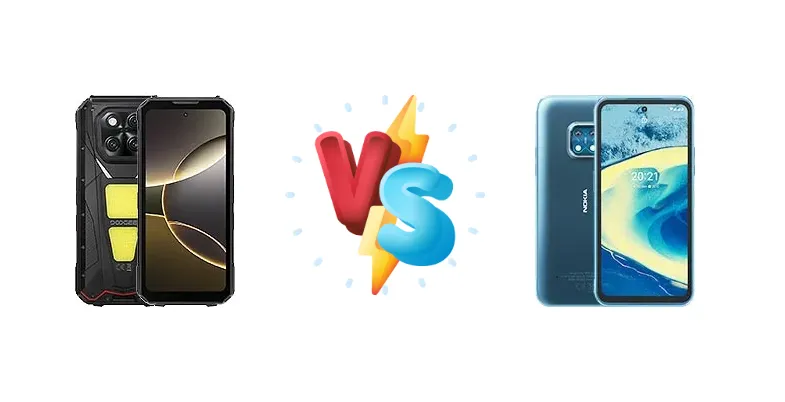
|
🏆 Quick Verdict
For users demanding the best possible performance in a rugged package, the Doogee V Max Play is the clear winner. Its Dimensity 7300 chipset delivers significantly faster processing speeds and improved efficiency compared to the XR20’s Snapdragon 480. However, the Nokia XR20 remains a viable option for those prioritizing software updates and a more refined user experience.
| PHONES | ||
|---|---|---|
| Phone Names | Doogee V Max Play | Nokia XR20 |
| Network | ||
|---|---|---|
| 2G bands | GSM 850 / 900 / 1800 / 1900 | GSM 850 / 900 / 1800 / 1900 |
| 3G bands | HSDPA 800 / 850 / 900 / 1700(AWS) / 1900 / 2100 | HSDPA 850 / 900 / 1700(AWS) / 1900 / 2100 |
| 4G bands | 1, 2, 3, 4, 5, 7, 8, 12, 17, 18, 19, 20, 25, 26, 28, 34, 38, 39, 40, 41, 66 | 1, 2, 3, 4, 5, 7, 8, 12, 13, 14, 20, 25, 26, 28, 30, 38, 40, 41, 48, 66, 71 |
| 5G bands | 1, 3, 7, 28, 38, 41, 77, 78, 79 SA/NSA | 2, 5, 25, 38, 41, 48, 66, 77, 78 SA/NSA |
| Speed | HSPA, LTE, 5G | HSPA, LTE, 5G |
| Technology | GSM / CDMA / HSPA / LTE / 5G | GSM / CDMA / HSPA / EVDO / LTE / 5G |
| - | CDMA2000 1xEV-DO | |
| Launch | ||
|---|---|---|
| Announced | 2025, September | 2021, July 27 |
| Status | Available. Released 2025, September | Available. Released 2021, August 04 |
| Body | ||
|---|---|---|
| Dimensions | 183.5 x 85.4 x 30.5 mm (7.22 x 3.36 x 1.20 in) | 171.6 x 81.5 x 10.6 mm (6.76 x 3.21 x 0.42 in) |
| SIM | Nano-SIM + Nano-SIM | · Nano-SIM· Nano-SIM + Nano-SIM |
| Weight | 683 g (1.51 lb) | 248 g (8.75 oz) |
| - | IP68 dust/water resistant (up to 1.5m for 60 min) Drop-to-concrete resistance from up to 1.8m MIL-STD-810H compliant | |
| Display | ||
|---|---|---|
| Protection | Mohs level 6 | Corning Gorilla Glass Victus |
| Resolution | 1080 x 2460 pixels (~396 ppi density) | 1080 x 2400 pixels, 20:9 ratio (~395 ppi density) |
| Size | 6.78 inches, 109.2 cm2 (~69.7% screen-to-body ratio) | 6.67 inches, 107.4 cm2 (~76.8% screen-to-body ratio) |
| Type | IPS LCD, 120Hz | IPS LCD, 550 nits |
| Platform | ||
|---|---|---|
| CPU | Octa-core (2x2.6 GHz Cortex-A78 & 6x2.0 GHz Cortex-A55) | Octa-core (2x2.0 GHz Kryo 460 & 6x1.8 GHz Kryo 460) |
| Chipset | Mediatek Dimensity 7300 (4 nm) | Qualcomm SM4350 Snapdragon 480 5G (8 nm) |
| GPU | Mali-G615 MC2 | Adreno 619 |
| OS | Android 15 | Android 11, upgradable to Android 13 |
| Memory | ||
|---|---|---|
| Card slot | microSDXC (dedicated slot) | microSDXC (uses shared SIM slot) |
| Internal | 512GB 16GB RAM | 64GB 4GB RAM, 128GB 6GB RAM |
| Main Camera | ||
|---|---|---|
| Dual | - | 48 MP, f/1.8, (wide), 1/2.25", 0.8µm, PDAF 13 MP, f/2.4, 123˚ (ultrawide), 1/3.0", 1.12µm |
| Features | Dual-LED flash, HDR, panorama | Zeiss optics, Dual-LED dual-tone flash, second LED flash, HDR, panorama |
| Single | - | 8 MP, f/2.0 (wide), 1/4.0", 1.12µm |
| Triple | 200 MP, f/2.0, (wide), 1/1.3", PDAF 20 MP, f/1.8, (night vision), 2 infrared night vision lights 8 MP, f/2.2, 119˚ (ultrawide) | - |
| Video | 4K@30fps, 1080p@30fps | 1080p@30fps |
| Selfie camera | ||
|---|---|---|
| Single | 32 MP, f/2.3, (wide) | 8 MP, f/2.0 (wide), 1/4.0", 1.12µm |
| Video | 1080p@30fps | 1080p@30fps |
| Sound | ||
|---|---|---|
| 3.5mm jack | - | Yes |
| 35mm jack | No | Yes |
| Loudspeaker | Yes (130 dB) | Yes, with stereo speakers |
| Comms | ||
|---|---|---|
| Bluetooth | 5.4, A2DP, LE | 5.1, A2DP, LE, aptX Adaptive |
| Infrared port | Yes | - |
| NFC | Yes | Yes |
| Positioning | GPS (L1+L5), GLONASS, GALILEO, BDS | GPS (L1+L5), GLONASS, BDS, GALILEO, QZSS, NavIC |
| Radio | FM radio | Unspecified |
| USB | USB Type-C | USB Type-C 3.0 |
| WLAN | Wi-Fi 802.11 a/b/g/n/ac/6e, dual-band | Wi-Fi 802.11 a/b/g/n/ac/6, dual-band, Wi-Fi Direct |
| Features | ||
|---|---|---|
| Sensors | Fingerprint (side-mounted), accelerometer, gyro, proximity, compass | Fingerprint (side-mounted), accelerometer, gyro, proximity, compass, barometer |
| Battery | ||
|---|---|---|
| Charging | 45W wired 10W reverse wired | 18W wired 15W wireless |
| Type | 20500 mAh | Li-Po 4630 mAh |
| Misc | ||
|---|---|---|
| Colors | Black, Tarnish | Ultra Blue, Granite Gray |
| Models | - | TA-1368, TA-1362 |
| Price | € 649.99 / $ 518.56 / £ 489.99 | About 270 EUR |
| SAR EU | - | 1.13 W/kg (head) 1.43 W/kg (body) |
| EU LABEL | ||
|---|---|---|
| Battery | 192:26h endurance, 1100 cycles | - |
| Energy | Class B | - |
| Free fall | Class A (270 falls) | - |
| Repairability | Class C | - |
Doogee V Max Play
- Significantly faster processor with the Dimensity 7300
- Faster 45W wired charging
- Exceptional battery endurance (192:26h)
- No wireless charging
- Software support may be less consistent than Nokia
Nokia XR20
- Guaranteed software updates from Nokia
- Convenient 15W wireless charging
- Corning Gorilla Glass Victus for enhanced durability
- Slower Snapdragon 480 processor
- Slower 18W wired charging
Display Comparison
Display specifications are not provided, but given the market positioning, we can infer differences. The Doogee V Max Play, targeting a performance-focused user, likely features a higher refresh rate display (potentially 90Hz or 120Hz) to complement its chipset. The Nokia XR20, prioritizing efficiency, likely uses a standard 60Hz panel. Both are expected to have durable glass, but the XR20’s Corning Gorilla Glass Victus offers superior scratch and drop resistance. Bezels are likely comparable, given the rugged design constraints of both devices.
Camera Comparison
Camera details are limited, but the chipset difference hints at processing capabilities. The Dimensity 7300’s integrated ISP (Image Signal Processor) will likely deliver superior image quality and faster processing speeds compared to the Snapdragon 480’s. While sensor size and megapixel count are unknown, the V Max Play’s chipset allows for more advanced computational photography features. The XR20 may focus on simplicity and reliability in its image processing.
Performance
The performance gap between these two devices is substantial. The Doogee V Max Play’s Mediatek Dimensity 7300 (4nm) is a significantly more powerful chipset than the Nokia XR20’s Qualcomm Snapdragon 480 5G (8nm). The Dimensity 7300’s octa-core configuration (2x2.6 GHz Cortex-A78 & 6x2.0 GHz Cortex-A55) provides a noticeable advantage in CPU-intensive tasks compared to the XR20’s (2x2.0 GHz Kryo 460 & 6x1.8 GHz Kryo 460). The 4nm process node of the Dimensity 7300 also translates to better thermal efficiency, reducing the likelihood of performance throttling during extended use. This benefits gamers and power users.
Battery Life
The Doogee V Max Play boasts impressive battery endurance with a reported 192:26h usage time and a 1100 cycle lifespan, suggesting a focus on long-term battery health. Its 45W wired charging is significantly faster than the Nokia XR20’s 18W wired charging, allowing for quicker top-ups. The XR20 compensates with 15W wireless charging, a feature absent on the V Max Play. While the XR20’s battery capacity is unknown, the V Max Play’s endurance suggests a large battery combined with the efficiency of the Dimensity 7300.
Buying Guide
Buy the Doogee V Max Play if you need a rugged phone for demanding tasks like gaming, video editing, or running multiple apps simultaneously. Its superior processing power and faster charging will be invaluable. Buy the Nokia XR20 if you prefer a phone with guaranteed software updates, wireless charging convenience, and a more polished, less aggressive design, even if it means sacrificing some raw performance.