
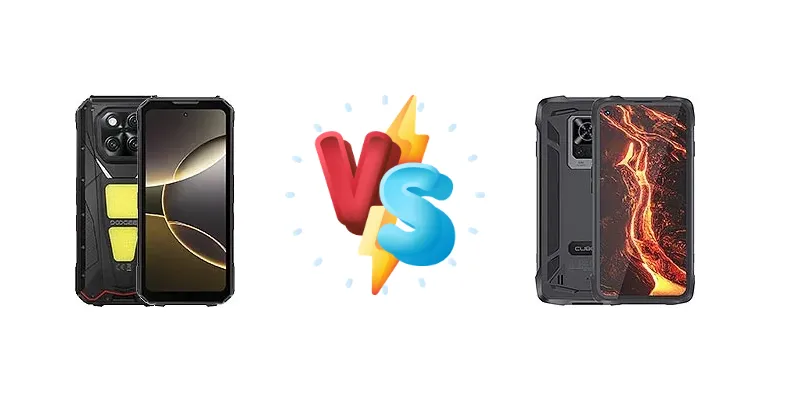
Doogee V Max Play vs Cubot KingKong 7: A Deep Dive into Rugged Smartphone Performance
| Phones Images | |||||
|---|---|---|---|---|---|
|
🏆 Quick Verdict
For the average user prioritizing performance and longevity, the Doogee V Max Play is the clear winner. Its Dimensity 7300 chipset delivers significantly faster processing speeds and improved efficiency compared to the Cubot KingKong 7’s Helio P60, making it better suited for demanding tasks and future-proofing.
| PHONES | ||
|---|---|---|
| Phone Names | Doogee V Max Play | Cubot KingKong 7 |
| Network | ||
|---|---|---|
| 2G bands | GSM 850 / 900 / 1800 / 1900 | GSM 850 / 900 / 1800 / 1900 |
| 3G bands | HSDPA 800 / 850 / 900 / 1700(AWS) / 1900 / 2100 | HSDPA 850 / 900 / 1700(AWS) / 1900 / 2100 |
| 4G bands | 1, 2, 3, 4, 5, 7, 8, 12, 17, 18, 19, 20, 25, 26, 28, 34, 38, 39, 40, 41, 66 | 1, 2, 3, 4, 5, 7, 8, 12, 13, 17, 18, 19, 20, 25, 26, 28, 38, 40, 41, 66 |
| 5G bands | 1, 3, 7, 28, 38, 41, 77, 78, 79 SA/NSA | - |
| Speed | HSPA, LTE, 5G | HSPA, LTE |
| Technology | GSM / CDMA / HSPA / LTE / 5G | GSM / CDMA / HSPA / LTE |
| Launch | ||
|---|---|---|
| Announced | 2025, September | 2022 |
| Status | Available. Released 2025, September | Available. Released 2022 |
| Body | ||
|---|---|---|
| Dimensions | 183.5 x 85.4 x 30.5 mm (7.22 x 3.36 x 1.20 in) | 166.8 x 83.5 x 14 mm (6.57 x 3.29 x 0.55 in) |
| SIM | Nano-SIM + Nano-SIM | Nano-SIM + Nano-SIM |
| Weight | 683 g (1.51 lb) | 267 g (9.42 oz) |
| Display | ||
|---|---|---|
| Protection | Mohs level 6 | - |
| Resolution | 1080 x 2460 pixels (~396 ppi density) | 1080 x 2300 pixels (~400 ppi density) |
| Size | 6.78 inches, 109.2 cm2 (~69.7% screen-to-body ratio) | 6.36 inches, 100.4 cm2 (~72.1% screen-to-body ratio) |
| Type | IPS LCD, 120Hz | IPS LCD |
| Platform | ||
|---|---|---|
| CPU | Octa-core (2x2.6 GHz Cortex-A78 & 6x2.0 GHz Cortex-A55) | Octa-core (4x2.0 GHz Cortex-A73 & 4x2.0 GHz Cortex-A53) |
| Chipset | Mediatek Dimensity 7300 (4 nm) | Mediatek MT6771V/CA Helio P60 (12 nm) |
| GPU | Mali-G615 MC2 | Mali-G72 MP3 |
| OS | Android 15 | Android 11 |
| Memory | ||
|---|---|---|
| Card slot | microSDXC (dedicated slot) | microSDXC (uses shared SIM slot) |
| Internal | 512GB 16GB RAM | 128GB 8GB RAM |
| Main Camera | ||
|---|---|---|
| Features | Dual-LED flash, HDR, panorama | LED flash |
| Triple | 200 MP, f/2.0, (wide), 1/1.3", PDAF 20 MP, f/1.8, (night vision), 2 infrared night vision lights 8 MP, f/2.2, 119˚ (ultrawide) | 64 MP, (wide), AF 16 MP, (ultrawide) 5 MP (macro) |
| Video | 4K@30fps, 1080p@30fps | Yes |
| Selfie camera | ||
|---|---|---|
| Single | 32 MP, f/2.3, (wide) | 32 MP |
| Video | 1080p@30fps | Yes |
| Sound | ||
|---|---|---|
| 35mm jack | No | Unspecified |
| Loudspeaker | Yes (130 dB) | Yes |
| Comms | ||
|---|---|---|
| Bluetooth | 5.4, A2DP, LE | 4.2, A2DP |
| Infrared port | Yes | - |
| NFC | Yes | Yes |
| Positioning | GPS (L1+L5), GLONASS, GALILEO, BDS | GPS, GLONASS, BDS |
| Radio | FM radio | Unspecified |
| USB | USB Type-C | USB Type-C, OTG |
| WLAN | Wi-Fi 802.11 a/b/g/n/ac/6e, dual-band | Wi-Fi 802.11 a/b/g/n |
| Features | ||
|---|---|---|
| Sensors | Fingerprint (side-mounted), accelerometer, gyro, proximity, compass | Fingerprint (rear-mounted), accelerometer, gyro, proximity, compass |
| Battery | ||
|---|---|---|
| Charging | 45W wired 10W reverse wired | - |
| Type | 20500 mAh | 5000 mAh |
| Misc | ||
|---|---|---|
| Colors | Black, Tarnish | Black |
| Price | € 649.99 / $ 518.56 / £ 489.99 | - |
| EU LABEL | ||
|---|---|---|
| Battery | 192:26h endurance, 1100 cycles | - |
| Energy | Class B | - |
| Free fall | Class A (270 falls) | - |
| Repairability | Class C | - |
Doogee V Max Play
- Significantly faster processor (Dimensity 7300)
- Superior power efficiency (4nm process)
- Faster charging (45W)
- Longer battery life (192-26h endurance)
- Likely higher price point
- Rugged design may add bulk
Cubot KingKong 7
- More affordable price
- Rugged design for durability
- Acceptable for basic tasks
- Potentially lighter weight
- Outdated processor (Helio P60)
- Lower performance and efficiency
- Shorter battery life
- Slower charging
Display Comparison
Display specifications are absent from the provided data, but considering the price points, we can infer both devices likely utilize LCD panels. The V Max Play, being a newer device, likely benefits from a higher peak brightness and potentially better color accuracy. The KingKong 7, given its older chipset, may exhibit lower brightness levels and a less refined color profile. Bezels are likely substantial on both, typical of rugged designs prioritizing protection over aesthetics.
Camera Comparison
Camera details are limited, but the chipset difference hints at processing capabilities. The Dimensity 7300 includes a more advanced Image Signal Processor (ISP) than the Helio P60, enabling better noise reduction, dynamic range, and overall image quality. While both phones likely feature multiple cameras, the V Max Play will likely produce superior photos and videos, especially in challenging lighting conditions. The absence of sensor details prevents a deeper analysis, but the chipset advantage is a significant indicator.
Performance
The performance disparity is stark. The Doogee V Max Play’s Mediatek Dimensity 7300 (4nm) is a generational leap ahead of the Cubot KingKong 7’s Helio P60 (12nm). The Dimensity 7300’s Cortex-A78 cores, clocked at 2.6 GHz, offer significantly higher single-core performance than the Helio P60’s Cortex-A73 cores at 2.0 GHz. The 4nm process node of the Dimensity 7300 also translates to superior power efficiency and reduced thermal throttling during sustained workloads. This means the V Max Play will handle multitasking, gaming, and demanding applications with far greater ease. The Helio P60, while adequate for basic tasks, will struggle with modern, resource-intensive apps.
Battery Life
The Doogee V Max Play boasts an impressive 192-26 hour endurance rating and a 1100 cycle battery lifespan, suggesting a large capacity and optimized power management. While the KingKong 7’s battery capacity is unknown, the less efficient Helio P60 chipset will likely result in shorter battery life. The V Max Play’s 45W wired charging is also considerably faster than the KingKong 7’s expected slower charging rate, allowing for quicker top-ups. The 10W reverse wired charging on the V Max Play adds a convenient feature for charging accessories.
Buying Guide
Buy the Doogee V Max Play if you need a rugged phone capable of handling demanding applications, gaming, and extended use without significant performance throttling. Its modern chipset and efficient power management are ideal for power users and those seeking future-proofed performance. Buy the Cubot KingKong 7 if you prioritize affordability and basic rugged functionality, and your usage primarily revolves around calls, texts, and light app usage. It’s a viable option for those on a tight budget who still need a durable device.