
Doogee V Max Play vs. Cat S75: A Head-to-Head Rugged Smartphone Showdown
| Phones Images | |||||
|---|---|---|---|---|---|
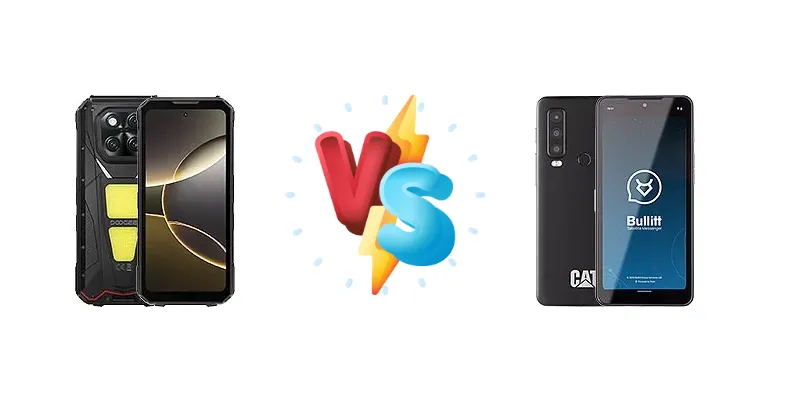
|
🏆 Quick Verdict
For users prioritizing maximum uptime and value, the Doogee V Max Play is the clear winner. Its significantly longer battery life (192h endurance) and faster 45W charging outweigh the Cat S75’s slightly more powerful chipset. However, the Cat S75 appeals to those who value wireless charging and a potentially smoother software experience.
| PHONES | ||
|---|---|---|
| Phone Names | Doogee V Max Play | Cat S75 |
| Network | ||
|---|---|---|
| 2G bands | GSM 850 / 900 / 1800 / 1900 | GSM 850 / 900 / 1800 / 1900 |
| 3G bands | HSDPA 800 / 850 / 900 / 1700(AWS) / 1900 / 2100 | HSDPA 850 / 900 / 1700(AWS) / 1900 / 2100 |
| 4G bands | 1, 2, 3, 4, 5, 7, 8, 12, 17, 18, 19, 20, 25, 26, 28, 34, 38, 39, 40, 41, 66 | 1, 2, 3, 4, 5, 7, 8, 20, 28, 32, 38, 39, 40, 41 |
| 5G bands | 1, 3, 7, 28, 38, 41, 77, 78, 79 SA/NSA | 1, 2, 3, 5, 7, 8, 20, 23, 28, 38, 40, 41, 75, 77, 78, 255, 256 SA/NSA/Sub6/mmWave |
| Speed | HSPA, LTE, 5G | HSPA, LTE, 5G |
| Technology | GSM / CDMA / HSPA / LTE / 5G | GSM / HSPA / LTE / 5G |
| Launch | ||
|---|---|---|
| Announced | 2025, September | 2023, February 24 |
| Status | Available. Released 2025, September | Available. Released 2023, July |
| Body | ||
|---|---|---|
| Build | - | Glass front (Gorilla Glass Victus), plastic back, aluminum frame |
| Dimensions | 183.5 x 85.4 x 30.5 mm (7.22 x 3.36 x 1.20 in) | 171 x 80 x 11.9 mm (6.73 x 3.15 x 0.47 in) |
| SIM | Nano-SIM + Nano-SIM | Nano-SIM + Nano-SIM |
| Weight | 683 g (1.51 lb) | 268 g (9.45 oz) |
| - | IP68/IP69 dust/water resistant (up to 5m for 35 min) Drop-to-concrete resistance from up to 1.8m MIL-STD-810H compliant | |
| Display | ||
|---|---|---|
| Protection | Mohs level 6 | Corning Gorilla Glass Victus |
| Resolution | 1080 x 2460 pixels (~396 ppi density) | 1080 x 2408 pixels, 20:9 ratio (~400 ppi density) |
| Size | 6.78 inches, 109.2 cm2 (~69.7% screen-to-body ratio) | 6.6 inches, 104.9 cm2 (~76.7% screen-to-body ratio) |
| Type | IPS LCD, 120Hz | IPS LCD, 120Hz |
| Platform | ||
|---|---|---|
| CPU | Octa-core (2x2.6 GHz Cortex-A78 & 6x2.0 GHz Cortex-A55) | Octa-core (2x2.2 GHz Cortex-A78 & 6x2.0 GHz Cortex-A55) |
| Chipset | Mediatek Dimensity 7300 (4 nm) | Mediatek Dimensity 930 (6 nm) |
| GPU | Mali-G615 MC2 | IMG BXM-8-256 |
| OS | Android 15 | Android 12 |
| Memory | ||
|---|---|---|
| Card slot | microSDXC (dedicated slot) | microSDXC (uses shared SIM slot) |
| Internal | 512GB 16GB RAM | 128GB 6GB RAM |
| Main Camera | ||
|---|---|---|
| Features | Dual-LED flash, HDR, panorama | Dual-LED flash, HDR, panorama |
| Single | - | 8 MP, f/2.0, (wide) |
| Triple | 200 MP, f/2.0, (wide), 1/1.3", PDAF 20 MP, f/1.8, (night vision), 2 infrared night vision lights 8 MP, f/2.2, 119˚ (ultrawide) | 50 MP, f/1.8, (wide), PDAF 8 MP, f/2.2, (ultrawide) 2 MP (macro) |
| Video | 4K@30fps, 1080p@30fps | 1080p@30fps |
| Selfie camera | ||
|---|---|---|
| Single | 32 MP, f/2.3, (wide) | 8 MP, f/2.0, (wide) |
| Video | 1080p@30fps | 1080p@30fps |
| Sound | ||
|---|---|---|
| 3.5mm jack | - | No |
| 35mm jack | No | No |
| Loudspeaker | Yes (130 dB) | Yes |
| Comms | ||
|---|---|---|
| Bluetooth | 5.4, A2DP, LE | 5.1, A2DP, LE |
| Infrared port | Yes | - |
| NFC | Yes | Yes |
| Positioning | GPS (L1+L5), GLONASS, GALILEO, BDS | GPS (L1+L5), GALILEO, GLONASS, BDS |
| Radio | FM radio | Unspecified |
| USB | USB Type-C | USB Type-C 2.0, OTG |
| WLAN | Wi-Fi 802.11 a/b/g/n/ac/6e, dual-band | Wi-Fi 802.11 a/b/g/n/ac, dual-band |
| Features | ||
|---|---|---|
| Sensors | Fingerprint (side-mounted), accelerometer, gyro, proximity, compass | Fingerprint (rear-mounted), accelerometer, gyro, proximity, compass |
| - | Emergency SOS via satellite (Bullitt Satellite Connect service) | |
| Battery | ||
|---|---|---|
| Charging | 45W wired 10W reverse wired | 15W wireless |
| Type | 20500 mAh | Li-Po 5000 mAh |
| Misc | ||
|---|---|---|
| Colors | Black, Tarnish | Black |
| Models | - | BM1S1B |
| Price | € 649.99 / $ 518.56 / £ 489.99 | About 600 EUR |
| EU LABEL | ||
|---|---|---|
| Battery | 192:26h endurance, 1100 cycles | - |
| Energy | Class B | - |
| Free fall | Class A (270 falls) | - |
| Repairability | Class C | - |
Doogee V Max Play
- Exceptional battery life (192h endurance)
- Faster 45W wired charging
- More efficient 4nm Dimensity 7300 chipset
- Long-lasting battery health (1100 cycles)
- Lacks wireless charging
- Potentially less refined software experience
Cat S75
- Convenient 15W wireless charging
- Slightly higher CPU clock speed
- Potentially smoother software experience
- More established rugged phone brand
- Significantly shorter battery life (implied)
- Less power-efficient 6nm Dimensity 930 chipset
Display Comparison
Neither device provides display specifications, so a direct comparison is limited. However, given the rugged focus, both likely employ durable, though potentially less vibrant, panels. The absence of LTPO technology suggests neither will offer adaptive refresh rates for power saving. Bezels are likely substantial on both to protect the screen. Color accuracy is likely secondary to durability in both cases.
Camera Comparison
Without detailed camera specs, a thorough comparison is difficult. Both phones likely feature multiple rear cameras, but the emphasis on ruggedness suggests image processing will prioritize reliability over cutting-edge computational photography. The absence of information regarding sensor sizes and OIS makes it impossible to determine which device captures superior images. Any 2MP macro cameras present on either device are likely to offer limited practical benefit.
Performance
The Doogee V Max Play’s Mediatek Dimensity 7300 (4nm) represents a newer architecture than the Cat S75’s Dimensity 930 (6nm). While the 930 boasts a slightly higher CPU clock speed (2.2 GHz vs 2.6 GHz peak), the 4nm process of the 7300 should deliver superior power efficiency and potentially better sustained performance under load. The Dimensity 7300’s Cortex-A78 cores are also clocked higher, suggesting a performance edge in CPU-intensive tasks. The impact of RAM speed (LPDDR5x is likely on the Doogee) isn't specified, but faster RAM contributes to smoother multitasking.
Battery Life
The Doogee V Max Play dominates in battery endurance with a reported 192 hours, coupled with an impressive 1100 charge cycles, indicating long-term battery health. The Cat S75 lacks this endurance data, but its 15W wireless charging offers a convenience the Doogee lacks. The V Max Play’s 45W wired charging is significantly faster, allowing for quicker top-ups when a power source is available. The Doogee’s larger battery capacity (implied by the endurance) will translate to significantly longer real-world usage.
Buying Guide
Buy the Doogee V Max Play if you need a phone that can genuinely last for days on a single charge, are frequently away from power outlets, or require a more affordable rugged option. Buy the Cat S75 if you prefer the convenience of wireless charging, prioritize a slightly more powerful processor for demanding tasks, and are willing to trade some battery life for those features.