
Doogee V Max LR vs Ulefone Power Armor 13: A Deep Dive into Rugged Smartphone Performance
| Phones Images | |||||
|---|---|---|---|---|---|
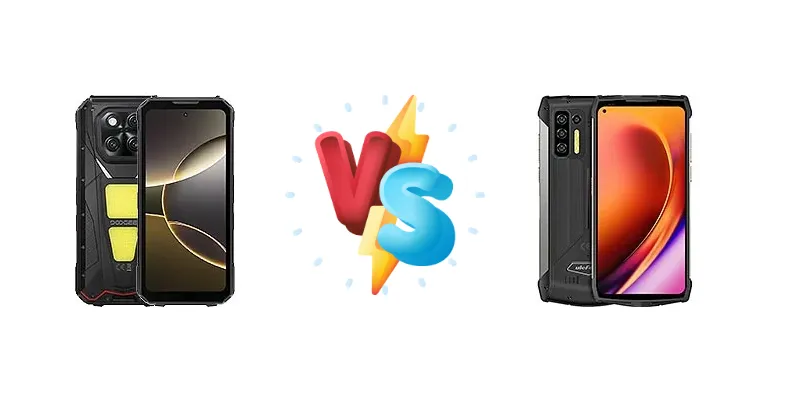
|
🏆 Quick Verdict
For most users, the Doogee V Max LR emerges as the superior choice. Its significantly more powerful Dimensity 7300 chipset, built on a 4nm process, provides a substantial performance advantage over the Ulefone’s Helio G95. While the Ulefone boasts a longer rated battery life, the Doogee’s faster charging and overall efficiency make it the more practical option.
| PHONES | ||
|---|---|---|
| Phone Names | Doogee V Max LR | Ulefone Power Armor 13 |
| Network | ||
|---|---|---|
| 2G bands | GSM 850 / 900 / 1800 / 1900 | GSM 850 / 900 / 1800 / 1900 |
| 3G bands | HSDPA 800 / 850 / 900 / 1700(AWS) / 1900 / 2100 | HSDPA 850 / 900 / 1700(AWS) / 1900 / 2100 |
| 4G bands | 1, 2, 3, 4, 5, 7, 8, 12, 17, 18, 19, 20, 25, 26, 28, 34, 38, 39, 40, 41, 66 | 1, 2, 3, 4, 5, 7, 8, 12, 13, 17, 18, 19, 20, 25, 26, 28, 38, 40, 66 |
| 5G bands | 1, 3, 7, 28, 38, 41, 77, 78, 79 SA/NSA | - |
| Speed | HSPA, LTE, 5G | HSPA 42.2/11.5 Mbps, LTE Cat12 600/150 Mbps |
| Technology | GSM / CDMA / HSPA / LTE / 5G | GSM / HSPA / LTE |
| Launch | ||
|---|---|---|
| Announced | 2025, September | 2021, July 22 |
| Status | Available. Released 2025, October | Available. Released 2021, July 26 |
| Body | ||
|---|---|---|
| Dimensions | 183.5 x 85.4 x 30.5 mm (7.22 x 3.36 x 1.20 in) | 183.7 x 85.4 x 20.8 mm (7.23 x 3.36 x 0.82 in) |
| SIM | Nano-SIM + Nano-SIM | Nano-SIM + Nano-SIM |
| Weight | 630 g (1.39 lb) | 492 g (1.08 lb) |
| - | IP68 dust/water resistant (up to 1.5m for 30 min) Drop-to-concrete resistance from up to 1.2m MIL-STD-810G compliant | |
| Display | ||
|---|---|---|
| Protection | Mohs level 6 | Corning Gorilla Glass 3 |
| Resolution | 1080 x 2460 pixels (~396 ppi density) | 1080 x 2400 pixels, 20:9 ratio (~386 ppi density) |
| Size | 6.78 inches, 109.2 cm2 (~69.7% screen-to-body ratio) | 6.81 inches, 112.0 cm2 (~71.4% screen-to-body ratio) |
| Type | IPS LCD, 120Hz, 500 nits | IPS LCD |
| Platform | ||
|---|---|---|
| CPU | Octa-core (2x2.6 GHz Cortex-A78 & 6x2.0 GHz Cortex-A55) | Octa-core (2x2.05 GHz Cortex-A76 & 6x2.0 GHz Cortex-A55) |
| Chipset | Mediatek Dimensity 7300 (4 nm) | Mediatek MT6785V/CD Helio G95 (12 nm) |
| GPU | Mali-G615 MC2 | Mali-G76 MC4 |
| OS | Android 15 | Android 11 |
| Memory | ||
|---|---|---|
| Card slot | microSDXC (dedicated slot) | microSDXC (uses shared SIM slot) |
| Internal | 512GB 16GB RAM | 256GB 8GB RAM |
| Main Camera | ||
|---|---|---|
| Features | Dual-LED flash, HDR, panorama | Quad-LED flash, HDR, panorama |
| Penta | - | 48 MP, f/1.8, 26mm (wide), 1/2.0", 0.8µm, PDAF 8 MP, f/2.2, (ultrawide) 2 MP (macro) Auxiliary lens |
| Triple | 200 MP, f/2.0, (wide), 1/1.3", PDAF 20 MP, f/1.8, (night vision), 2 infrared night vision lights 8 MP, f/2.2, 119˚ (ultrawide) | - |
| Video | 4K@30fps, 1080p@30fps | 4K@30fps, 1080p@30fps |
| Selfie camera | ||
|---|---|---|
| Features | - | HDR, panorama |
| Single | 32 MP, f/2.3, (wide) | 16 MP, f/2.2 |
| Video | 1080p@30fps | 1080p@30fps |
| Sound | ||
|---|---|---|
| 3.5mm jack | - | Yes |
| 35mm jack | No | Yes |
| Loudspeaker | Yes (130 dB) | Yes |
| Comms | ||
|---|---|---|
| Bluetooth | 5.4, A2DP, LE | 5.0, A2DP, LE |
| Infrared port | Yes | - |
| NFC | Yes | Yes |
| Positioning | GPS (L1+L5), GLONASS, GALILEO, BDS | GPS, GLONASS, GALILEO, BDS |
| Radio | FM radio | FM radio, RDS, recording |
| USB | USB Type-C | - |
| WLAN | Wi-Fi 802.11 a/b/g/n/ac/6e, dual-band | Wi-Fi 802.11 a/b/g/n/ac, dual-band |
| Features | ||
|---|---|---|
| Sensors | Fingerprint (side-mounted), accelerometer, gyro, proximity, compass | Fingerprint (side-mounted), accelerometer, gyro, proximity, compass, baroceptor, coulombmeter |
| - | Infrared distance measure (error range: 1~20m, ±10mm; 20~40m, ±25mm) | |
| Battery | ||
|---|---|---|
| Charging | 45W wired 10W reverse wired | 33W wired 15W wireless 5W reverse wireless |
| Type | 20500 mAh | Li-Po 13200 mAh |
| Misc | ||
|---|---|---|
| Colors | Black, Tarnish | Black |
| Price | About 770 EUR | About 300 EUR |
| Tests | ||
|---|---|---|
| Battery life | - | Endurance rating 296h |
| Camera | - | Photo / Video |
| Display | - | Contrast ratio: 1306:1 (nominal) |
| Loudspeaker | - | -28.3 LUFS (Average) |
| Performance | - | AnTuTu: 294194 (v8), 351678 (v9) GeekBench: 1610 (v5.1) GFXBench: 18fps (ES 3.1 onscreen) |
| EU LABEL | ||
|---|---|---|
| Battery | 192:26h endurance, 1100 cycles | - |
| Energy | Class B | - |
| Free fall | Class A (270 falls) | - |
| Repairability | Class C | - |
Doogee V Max LR
- Significantly faster processor (Dimensity 7300)
- More efficient 4nm process for better battery life and less heat
- Faster 45W wired charging
- Reverse wired charging capability
- Lower rated battery endurance compared to Ulefone
- Rugged design may be less proven than Ulefone's
Ulefone Power Armor 13
- Longer rated battery endurance (296 hours)
- Wireless charging support (15W)
- Established reputation for ruggedness
- Lower price point (likely)
- Outdated and less powerful Helio G95 chipset
- Slower 33W wired charging
- Less efficient 12nm process
- Limited performance for demanding tasks
Display Comparison
Both devices share a contrast ratio of 1306:1, suggesting similar visual depth. However, the Ulefone Power Armor 13 provides a measured peak brightness of 401 nits. While Doogee doesn't specify peak brightness, the lack of LTPO technology on either device suggests neither will excel in direct sunlight compared to flagship phones. The similar contrast ratios mean color reproduction will be comparable, but the Ulefone’s measured brightness gives it a slight edge in outdoor visibility.
Camera Comparison
Both phones list 'Photo / Video' capabilities, but lack specific details. Without sensor size or aperture information, a direct comparison is difficult. However, the market segment suggests the Ulefone likely prioritizes durability over camera quality. The Doogee, positioned slightly higher, may offer a more refined camera experience, but further testing is needed to confirm. The absence of details suggests neither phone will compete with dedicated camera-focused smartphones.
Performance
The Doogee V Max LR’s Mediatek Dimensity 7300 (4nm) represents a significant leap in processing power compared to the Ulefone Power Armor 13’s Helio G95 (12nm). The Dimensity 7300’s Cortex-A78 cores, clocked at 2.6 GHz, outperform the G95’s Cortex-A76 cores at 2.05 GHz. The 4nm fabrication process also translates to improved thermal efficiency, reducing the likelihood of throttling during sustained workloads. This means the Doogee will handle demanding games and applications with greater ease and consistency. The Ulefone, while capable for everyday tasks, will struggle with more intensive operations.
Battery Life
The Ulefone Power Armor 13 boasts an endurance rating of 296 hours, a figure the Doogee V Max LR doesn’t directly match with its 192:26h endurance. However, endurance ratings are based on specific usage patterns. The Doogee compensates with significantly faster 45W wired charging compared to the Ulefone’s 33W. The Doogee also offers 10W reverse wired charging, a feature absent on the Ulefone. Furthermore, the Dimensity 7300’s 4nm process is more power-efficient, potentially mitigating the difference in raw battery capacity over time. The Doogee also claims 1100 battery cycles, suggesting longer lifespan.
Buying Guide
Buy the Doogee V Max LR if you prioritize performance for demanding tasks like gaming or video editing, and value faster charging speeds. Its modern chipset ensures smoother operation and future-proofing. Buy the Ulefone Power Armor 13 if your primary concern is maximizing battery life above all else, and you don't require intensive processing power. It's a solid choice for basic communication and extended use in remote locations where charging isn't readily available.