
Doogee V Max LR vs. Ulefone Armor 17 Pro: A Deep Dive into Rugged Smartphone Performance
| Phones Images | |||||
|---|---|---|---|---|---|
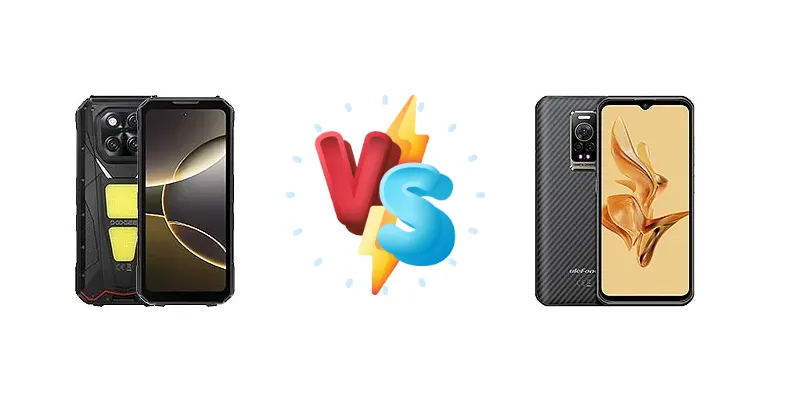
|
🏆 Quick Verdict
For users prioritizing sustained performance and exceptional battery life, the Doogee V Max LR emerges as the winner. Its Dimensity 7300 chipset, built on a 4nm process, offers a significant architectural advantage over the Ulefone Armor 17 Pro’s Helio G99. While the Ulefone boasts faster charging, the Doogee’s longevity and processing power make it the better all-around choice.
| PHONES | ||
|---|---|---|
| Phone Names | Doogee V Max LR | Ulefone Armor 17 Pro |
| Network | ||
|---|---|---|
| 2G bands | GSM 850 / 900 / 1800 / 1900 | GSM 850 / 900 / 1800 / 1900 |
| 3G bands | HSDPA 800 / 850 / 900 / 1700(AWS) / 1900 / 2100 | HSDPA 800 / 850 / 900 / 1700(AWS) / 1900 / 2100 |
| 4G bands | 1, 2, 3, 4, 5, 7, 8, 12, 17, 18, 19, 20, 25, 26, 28, 34, 38, 39, 40, 41, 66 | 1, 2, 3, 4, 5, 7, 8, 12, 13, 17, 18, 19, 20, 25, 26, 28, 34, 38, 39, 40, 41, 66 |
| 5G bands | 1, 3, 7, 28, 38, 41, 77, 78, 79 SA/NSA | - |
| Speed | HSPA, LTE, 5G | HSPA, LTE |
| Technology | GSM / CDMA / HSPA / LTE / 5G | GSM / HSPA / LTE |
| Launch | ||
|---|---|---|
| Announced | 2025, September | 2022, October 31 |
| Status | Available. Released 2025, October | Available. Released 2022, October 31 |
| Body | ||
|---|---|---|
| Dimensions | 183.5 x 85.4 x 30.5 mm (7.22 x 3.36 x 1.20 in) | 172.7 x 80.4 x 12.5 mm (6.80 x 3.17 x 0.49 in) |
| SIM | Nano-SIM + Nano-SIM | Nano-SIM + Nano-SIM |
| Weight | 630 g (1.39 lb) | 290 g (10.23 oz) |
| - | IP68/IP69K dust/water resistant (up to 1.5m for 30 min) Drop-to-concrete resistance from up to 1.5m MIL-STD-810G compliant | |
| Display | ||
|---|---|---|
| Protection | Mohs level 6 | Corning Gorilla Glass 5 |
| Resolution | 1080 x 2460 pixels (~396 ppi density) | 1080 x 2408 pixels, 20:9 ratio (~401 ppi density) |
| Size | 6.78 inches, 109.2 cm2 (~69.7% screen-to-body ratio) | 6.58 inches, 104.3 cm2 (~75.1% screen-to-body ratio) |
| Type | IPS LCD, 120Hz, 500 nits | IPS LCD, 120Hz |
| Platform | ||
|---|---|---|
| CPU | Octa-core (2x2.6 GHz Cortex-A78 & 6x2.0 GHz Cortex-A55) | Octa-core (2x2.2 GHz Cortex-A76 & 6x2.0 GHz Cortex-A55) |
| Chipset | Mediatek Dimensity 7300 (4 nm) | Mediatek Helio G99 (6 nm) |
| GPU | Mali-G615 MC2 | Mali-G57 MC2 |
| OS | Android 15 | Android 12 |
| Memory | ||
|---|---|---|
| Card slot | microSDXC (dedicated slot) | microSDXC (dedicated slot) |
| Internal | 512GB 16GB RAM | 256GB 8GB RAM |
| Main Camera | ||
|---|---|---|
| Features | Dual-LED flash, HDR, panorama | Triple-LED flash, HDR, panorama |
| Single | - | 16 MP, f/2.2, (wide), 1.0µm |
| Triple | 200 MP, f/2.0, (wide), 1/1.3", PDAF 20 MP, f/1.8, (night vision), 2 infrared night vision lights 8 MP, f/2.2, 119˚ (ultrawide) | 108 MP, f/1.9, (wide), 1/1.52”, 0.7µm, PDAF 8 MP, f/2.2, 119˚, (ultrawide), 1/4.0", 1.12µm 8 MP, (night vision), 2 infrared night vision lights |
| Video | 4K@30fps, 1080p@30fps | 1440p@30fps, 1080p@30fps |
| Selfie camera | ||
|---|---|---|
| Single | 32 MP, f/2.3, (wide) | 16 MP, f/2.2, (wide), 1.0µm |
| Video | 1080p@30fps | 1080p@30fps |
| Sound | ||
|---|---|---|
| 3.5mm jack | - | Yes |
| 35mm jack | No | Yes |
| Loudspeaker | Yes (130 dB) | Yes |
| Comms | ||
|---|---|---|
| Bluetooth | 5.4, A2DP, LE | 5.2, A2DP, LE |
| Infrared port | Yes | - |
| NFC | Yes | Yes |
| Positioning | GPS (L1+L5), GLONASS, GALILEO, BDS | GPS, GLONASS, GALILEO, BDS |
| Radio | FM radio | Wireless FM radio, RDS, recording |
| USB | USB Type-C | USB Type-C 2.0, OTG |
| WLAN | Wi-Fi 802.11 a/b/g/n/ac/6e, dual-band | Wi-Fi 802.11 a/b/g/n/ac, dual-band |
| Features | ||
|---|---|---|
| Sensors | Fingerprint (side-mounted), accelerometer, gyro, proximity, compass | Fingerprint (side-mounted), accelerometer, gyro, proximity, compass |
| - | MagSafe compatible accessories | |
| Battery | ||
|---|---|---|
| Charging | 45W wired 10W reverse wired | 66W wired, 53% in 15 min 15W wireless Wireless reversed |
| Type | 20500 mAh | Li-Po 5380 mAh |
| Misc | ||
|---|---|---|
| Colors | Black, Tarnish | Black |
| Price | About 770 EUR | About 260 EUR |
| EU LABEL | ||
|---|---|---|
| Battery | 192:26h endurance, 1100 cycles | - |
| Energy | Class B | - |
| Free fall | Class A (270 falls) | - |
| Repairability | Class C | - |
Doogee V Max LR
- Superior chipset performance with the Dimensity 7300
- Exceptional battery endurance (192 hours)
- Long-lasting battery health (1100 cycles)
- Slower charging speed (45W) compared to the Ulefone
- Lack of wireless charging
Ulefone Armor 17 Pro
- Ultra-fast 66W wired charging (53% in 15 minutes)
- Convenient wireless and reverse wireless charging
- Established brand reputation in the rugged phone market
- Less powerful chipset (Helio G99)
- Lower overall performance compared to the Doogee
Display Comparison
Neither device provides display specifications in the provided data. However, given the Armor 17 Pro’s positioning, it likely features an IPS LCD panel, common in this price bracket. The V Max LR, aiming for a more premium experience, may incorporate a higher-quality panel, potentially with improved color accuracy. Without specific data, it’s difficult to assess brightness or refresh rates, but the V Max LR’s higher overall spec sheet suggests a more refined visual experience.
Camera Comparison
The provided data lacks camera specifications. However, rugged phones often prioritize durability over camera prowess. We can assume both phones will feature a multi-camera setup, but image quality will likely depend more on software processing than cutting-edge hardware. The absence of sensor size information makes a direct comparison impossible, but the V Max LR’s overall premium positioning suggests a potentially more capable camera system.
Performance
The core difference lies in the chipsets. The Doogee V Max LR’s Mediatek Dimensity 7300 (4nm) represents a significant leap forward in efficiency and performance compared to the Ulefone Armor 17 Pro’s Helio G99 (6nm). The 4nm process allows for higher transistor density and lower power consumption, translating to less thermal throttling during sustained workloads. While both CPUs utilize an octa-core configuration with 2x Cortex-A78 and 6x Cortex-A55 cores, the Dimensity 7300’s A78 cores operate at a higher clock speed (2.6 GHz vs 2.2 GHz), providing a noticeable performance boost. This benefits users engaged in gaming, video editing, or multitasking.
Battery Life
The Doogee V Max LR boasts an impressive 192-hour endurance and a 1100-cycle battery lifespan, indicating a focus on long-term reliability and extended usage. While the Ulefone Armor 17 Pro offers faster 66W wired charging (53% in 15 minutes) and the convenience of 15W wireless and reverse wireless charging, it doesn’t provide endurance figures. The Doogee’s endurance suggests a larger battery capacity, and the 1100 cycle rating promises longevity. The Ulefone’s charging speed is a clear advantage for users who need a quick power boost, but the Doogee’s overall battery performance is more compelling for extended use.
Buying Guide
Buy the Doogee V Max LR if you need a phone that can handle demanding tasks like gaming or video editing for extended periods, and if minimizing downtime due to charging is crucial. Its 192-hour endurance and efficient chipset are ideal for travelers and outdoor professionals. Buy the Ulefone Armor 17 Pro if you prioritize the convenience of extremely fast charging – reaching 53% in just 15 minutes – and appreciate the added flexibility of wireless charging and reverse wireless charging, making it a good fit for users who frequently share power with others.