
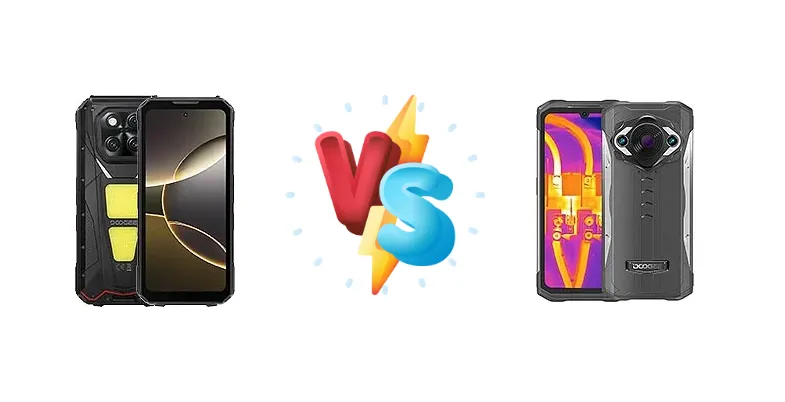
Doogee V Max LR vs. S98 Pro: A Deep Dive into Rugged Smartphone Performance
| Phones Images | |||||
|---|---|---|---|---|---|
|
🏆 Quick Verdict
For most users, the Doogee V Max LR emerges as the stronger choice. Its Dimensity 7300 chipset delivers significantly improved performance and efficiency compared to the S98 Pro’s Helio G96, coupled with exceptional battery endurance. While the S98 Pro offers wireless charging, the V Max LR’s superior processing and longevity outweigh this convenience.
| PHONES | ||
|---|---|---|
| Phone Names | Doogee V Max LR | Doogee S98 Pro |
| Network | ||
|---|---|---|
| 2G bands | GSM 850 / 900 / 1800 / 1900 | GSM 850 / 900 / 1800 / 1900 |
| 3G bands | HSDPA 800 / 850 / 900 / 1700(AWS) / 1900 / 2100 | HSDPA 800 / 850 / 900 / 1700(AWS) / 1900 / 2100 |
| 4G bands | 1, 2, 3, 4, 5, 7, 8, 12, 17, 18, 19, 20, 25, 26, 28, 34, 38, 39, 40, 41, 66 | 1, 2, 3, 4, 5, 7, 8, 12, 13, 17, 18, 19, 20, 25, 26, 28, 34, 38, 39, 40, 41, 66 |
| 5G bands | 1, 3, 7, 28, 38, 41, 77, 78, 79 SA/NSA | - |
| Speed | HSPA, LTE, 5G | HSPA, LTE |
| Technology | GSM / CDMA / HSPA / LTE / 5G | GSM / CDMA / HSPA / LTE |
| Launch | ||
|---|---|---|
| Announced | 2025, September | 2022, May 27 |
| Status | Available. Released 2025, October | Available. Released 2022, June 06 |
| Body | ||
|---|---|---|
| Dimensions | 183.5 x 85.4 x 30.5 mm (7.22 x 3.36 x 1.20 in) | 172 x 82 x 15.5 mm (6.77 x 3.23 x 0.61 in) |
| SIM | Nano-SIM + Nano-SIM | Nano-SIM + Nano-SIM |
| Weight | 630 g (1.39 lb) | 320 g (11.29 oz) |
| Display | ||
|---|---|---|
| Protection | Mohs level 6 | Corning Gorilla Glass |
| Resolution | 1080 x 2460 pixels (~396 ppi density) | 1080 x 2340 pixels, 19.5:9 ratio (~409 ppi density) |
| Size | 6.78 inches, 109.2 cm2 (~69.7% screen-to-body ratio) | 6.3 inches, 97.4 cm2 (~69.1% screen-to-body ratio) |
| Type | IPS LCD, 120Hz, 500 nits | IPS LCD, 500 nits (peak) |
| Platform | ||
|---|---|---|
| CPU | Octa-core (2x2.6 GHz Cortex-A78 & 6x2.0 GHz Cortex-A55) | Octa-core (2x2.05 GHz Cortex-A76 & 6x2.0 GHz Cortex-A55) |
| Chipset | Mediatek Dimensity 7300 (4 nm) | Mediatek MT6781 Helio G96 (12 nm) |
| GPU | Mali-G615 MC2 | Mali-G57 MC2 |
| OS | Android 15 | Android 12 |
| Memory | ||
|---|---|---|
| Card slot | microSDXC (dedicated slot) | microSDXC (dedicated slot) |
| Internal | 512GB 16GB RAM | 256GB 8GB RAM |
| Main Camera | ||
|---|---|---|
| Features | Dual-LED flash, HDR, panorama | Dual-LED flash, HDR, panorama |
| Triple | 200 MP, f/2.0, (wide), 1/1.3", PDAF 20 MP, f/1.8, (night vision), 2 infrared night vision lights 8 MP, f/2.2, 119˚ (ultrawide) | 48 MP, f/1.8, (wide), PDAF 20 MP, f/1.8, (night vision), 2 infrared night vision lights Thermal imaging camera |
| Video | 4K@30fps, 1080p@30fps | 1440p, 1080p |
| Selfie camera | ||
|---|---|---|
| Single | 32 MP, f/2.3, (wide) | 16 MP, f/2.0, (wide) |
| Video | 1080p@30fps | 1080p |
| Sound | ||
|---|---|---|
| 35mm jack | No | Unspecified |
| Loudspeaker | Yes (130 dB) | Yes |
| Comms | ||
|---|---|---|
| Bluetooth | 5.4, A2DP, LE | 5.1, A2DP, LE |
| Infrared port | Yes | - |
| NFC | Yes | Yes |
| Positioning | GPS (L1+L5), GLONASS, GALILEO, BDS | GPS, GLONASS, BDS, GALILEO |
| Radio | FM radio | FM radio |
| USB | USB Type-C | USB Type-C 2.0, OTG |
| WLAN | Wi-Fi 802.11 a/b/g/n/ac/6e, dual-band | Wi-Fi 802.11 a/b/g/n/ac, dual-band |
| Features | ||
|---|---|---|
| Sensors | Fingerprint (side-mounted), accelerometer, gyro, proximity, compass | Fingerprint (side-mounted), accelerometer, gyro, proximity, compass |
| Battery | ||
|---|---|---|
| Charging | 45W wired 10W reverse wired | 33W wired 15W wireless |
| Type | 20500 mAh | 6000 mAh |
| Misc | ||
|---|---|---|
| Colors | Black, Tarnish | Black |
| Price | About 770 EUR | About 470 EUR |
| EU LABEL | ||
|---|---|---|
| Battery | 192:26h endurance, 1100 cycles | - |
| Energy | Class B | - |
| Free fall | Class A (270 falls) | - |
| Repairability | Class C | - |
Doogee V Max LR
- Significantly faster and more efficient processor (Dimensity 7300)
- Exceptional battery life (192:26h endurance)
- Faster wired charging (45W)
- Longer battery lifespan (1100 cycles)
- Lacks wireless charging
- Potentially higher price point
Doogee S98 Pro
- Wireless charging support
- More affordable price
- Established platform (Helio G96)
- Rugged design
- Significantly slower processor (Helio G96)
- Shorter battery life
- Slower wired charging (33W)
Display Comparison
Display specifications are not provided, so a direct comparison is limited. However, given the market positioning, we can infer the S98 Pro likely utilizes an IPS LCD panel, common in its price bracket. The V Max LR, being a newer release, may incorporate a more advanced panel technology, potentially with higher peak brightness and improved color accuracy. Bezels are likely comparable, focusing on durability rather than minimizing size. Without specific data, it's difficult to assess PWM dimming rates, a crucial factor for users sensitive to flicker.
Camera Comparison
Camera details are limited, but the chipset difference indirectly impacts image processing capabilities. The Dimensity 7300 in the V Max LR benefits from a more advanced ISP (Image Signal Processor), enabling faster and more efficient image processing, resulting in better dynamic range and noise reduction. While both phones likely feature similar sensor configurations (excluding any flagship-level sensors not mentioned), the V Max LR will likely produce superior image quality, particularly in challenging lighting conditions. We can assume both phones include standard features like HDR and night mode, but the V Max LR’s processing power will enhance their effectiveness.
Performance
The performance gap between these two devices is substantial. The Doogee V Max LR’s Mediatek Dimensity 7300 (4nm) is a significant leap forward from the S98 Pro’s Helio G96 (12nm). The Dimensity 7300’s newer architecture – featuring 2x2.6 GHz Cortex-A78 and 6x2.0 GHz Cortex-A55 cores – provides a noticeable boost in CPU performance. More importantly, the 4nm process node translates to significantly improved power efficiency, reducing heat generation and throttling during sustained workloads. The S98 Pro’s older Helio G96, with its 2x2.05 GHz Cortex-A76 and 6x2.0 GHz Cortex-A55 cores, will struggle with demanding tasks and will likely exhibit more thermal throttling. This difference is critical for gamers and users who frequently multitask.
Battery Life
Battery life is a key differentiator. The Doogee V Max LR boasts an impressive 192:26h endurance rating, indicating exceptional longevity. This is coupled with a 1100 cycle lifespan, suggesting the battery will retain its capacity for a longer period. The V Max LR’s 45W wired charging is also faster than the S98 Pro’s 33W wired charging. While the S98 Pro offers 15W wireless charging, this convenience is offset by its shorter battery life and slower wired charging speeds. The V Max LR’s combination of endurance and faster charging makes it the clear winner for users who prioritize minimizing downtime.
Buying Guide
Buy the Doogee V Max LR if you need a phone that can last through multi-day expeditions, demanding work environments, or simply want a device that won’t quit before the end of the day. Its modern chipset ensures smooth performance for years to come. Buy the Doogee S98 Pro if you prioritize wireless charging convenience and are looking for a more budget-friendly option, understanding that you’ll be sacrificing significant processing power and battery life in the process.