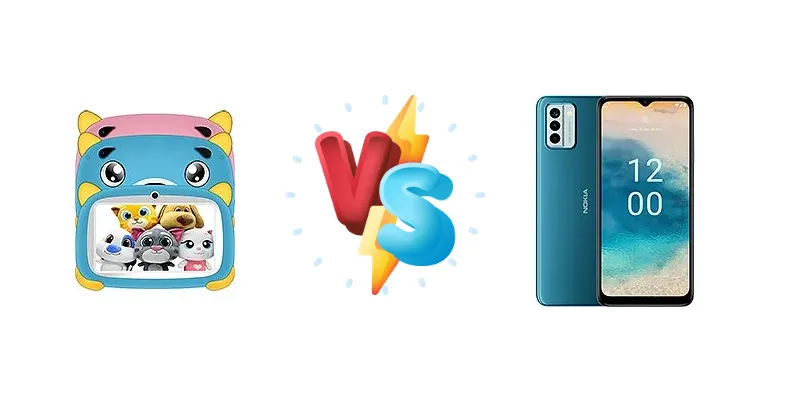
The Doogee U7 and Nokia G22 represent the extreme end of the budget smartphone market. Both aim to deliver essential functionality at a minimal cost, but they take different approaches to achieving this. The U7 prioritizes sheer affordability, while the G22 attempts to offer a more modern experience with faster charging and a more capable chipset.
🏆 Quick Verdict
For most users, the Nokia G22 is the better choice. Its Unisoc T606 chipset provides a significantly smoother experience than the Doogee U7’s aging Mediatek MT6580, and the 20W charging with PD3.0 support drastically reduces charging times. While the U7 is cheaper, the performance trade-off is substantial.
| Network |
|---|
| 2G bands | N/A | GSM 850 / 900 / 1800 / 1900 |
| 3G bands | N/A | HSDPA 850 / 900 / 2100 |
| 4G bands | N/A | 1, 3, 5, 7, 8, 20, 28, 38, 39, 40, 41 |
| EDGE | No | - |
| GPRS | No | - |
| Speed | - | HSPA, LTE |
| Technology | No cellular connectivity | GSM / HSPA / LTE |
| Launch |
|---|
| Announced | 2021 | 2023, February 25 |
| Status | Available. Released 2021 | Available. Released 2023, February 25 |
| Body |
|---|
| Build | - | Glass front (Gorilla Glass 3), plastic frame, plastic back |
| Dimensions | 209.5 x 142.5 x 20 mm (8.25 x 5.61 x 0.79 in) | 165 x 76.2 x 8.5 mm (6.50 x 3.00 x 0.33 in) |
| SIM | No | Nano-SIM + Nano-SIM |
| Weight | 373 g (13.16 oz) | 196.2 g (6.91 oz) |
| | - | Dust and splash resistant
QuickFix user-reparable design |
| Display |
|---|
| Protection | - | Corning Gorilla Glass 3 |
| Resolution | 600 x 1024 pixels, 16:9 ratio (~170 ppi density) | 720 x 1600 pixels, 20:9 ratio (~270 ppi density) |
| Size | 7.0 inches, 137.9 cm2 (~46.2% screen-to-body ratio) | 6.5 inches, 102.0 cm2 (~81.1% screen-to-body ratio) |
| Type | IPS LCD | IPS LCD, 90Hz, 500 nits (typ) |
| Platform |
|---|
| CPU | Quad-core 1.3 GHz | Octa-core (2x1.6 GHz Cortex-A75 & 6x1.6 GHz Cortex-A55) |
| Chipset | Mediatek MT6580 | Unisoc T606 (12 nm) |
| GPU | - | Mali-G57 MP1 |
| OS | Android 10 | Android 12 |
| Memory |
|---|
| Card slot | microSDXC (dedicated slot) | microSDXC (uses shared SIM slot) |
| Internal | 32GB 2GB RAM | 64GB 4GB RAM, 128GB 4GB RAM, 256GB 6GB RAM |
| | - | UFS 2.2 |
| Main Camera |
|---|
| Features | - | LED flash, HDR, panorama |
| Single | 2 MP | - |
| Triple | - | 50 MP, f/1.8, (wide), 1/2.76", 0.64µm, PDAF
2 MP (macro)
Auxiliary lens |
| Video | 720p@30fps | 1080p@30fps |
| Selfie camera |
|---|
| Single | 0.3 MP | 8 MP, f/2.0, (wide) |
| Video | Yes | 1080p@30fps |
| Sound |
|---|
| 3.5mm jack | - | Yes |
| 35mm jack | Yes | Yes |
| Loudspeaker | Yes | Yes |
| Comms |
|---|
| Bluetooth | 4.0 | 5.0, A2DP, LE |
| NFC | No | Yes (market/region dependent) |
| Positioning | No | GPS, GLONASS, GALILEO |
| Radio | No | FM radio, RDS |
| USB | USB Type-C 2.0, OTG | USB Type-C 2.0, OTG |
| WLAN | Wi-Fi 802.11 b/g/n | Wi-Fi 802.11 a/b/g/n/ac, dual-band |
| Features |
|---|
| Sensors | Accelerometer | Fingerprint (side-mounted), accelerometer, proximity |
| Battery |
|---|
| Charging | 10W wired | 20W wired, PD3.0 |
| Type | 3400 mAh | Li-Po 5050 mAh |
| Misc |
|---|
| Colors | Blue, Pink | Lagoon Blue, Meteor Gray, So Peach |
| Price | - | About 120 EUR |
Doogee U7
- Lowest possible price point
- Simple and straightforward user experience
- Potentially longer standby time due to less powerful processor
- Significantly slower performance
- Slow 10W charging
- Outdated chipset architecture
Nokia G22
- Faster and more responsive performance
- 20W charging with PD3.0
- More efficient chipset
- Slightly higher price
- May not offer significantly better camera performance
- Unisoc chipsets sometimes have less software support
Display Comparison
Neither device boasts a standout display. Given the price point, details like panel type and resolution are not provided. However, the focus should be on usability. The lack of information suggests both likely utilize basic LCD panels. The real difference lies elsewhere.
Camera Comparison
Without detailed camera specifications, a direct comparison is difficult. However, it’s safe to assume both phones feature basic camera setups geared towards casual photography. The absence of information suggests neither phone will excel in low-light conditions or offer advanced features like optical image stabilization. The focus here is likely on affordability, not image quality. The Nokia G22's chipset may offer slightly better image processing capabilities, but the sensor quality will be the limiting factor.
Performance
The core difference between these two phones is the chipset. The Doogee U7’s Mediatek MT6580 is a quad-core processor, while the Nokia G22 features the Unisoc T606, an octa-core chip built on a more efficient 12nm process. This architectural difference is crucial; the T606’s Cortex-A75 and A55 cores provide a substantial performance uplift over the MT6580’s older Cortex-A53 cores. This translates to faster app loading times, smoother multitasking, and a more responsive overall experience for the G22. The G22’s chipset will handle modern social media apps and light gaming far better than the U7.
Battery Life
While battery capacity isn't specified, the charging capabilities are a clear differentiator. The Doogee U7 is limited to 10W wired charging, meaning a full charge will take a considerable amount of time. The Nokia G22, on the other hand, supports 20W wired charging with PD3.0, significantly reducing charging times. This is a major convenience factor, especially for users who rely heavily on their phones throughout the day. The faster charging speed effectively mitigates any potential disadvantage if the G22 has a slightly smaller battery capacity.
Buying Guide
Buy the Doogee U7 if you absolutely need the lowest possible price and your smartphone usage is limited to basic tasks like calls, texts, and light web browsing. Buy the Nokia G22 if you value a more responsive user experience, faster charging, and a chipset capable of handling more demanding apps and occasional gaming.
Frequently Asked Questions
❓ Will the Nokia G22’s Unisoc T606 handle popular apps like Facebook and WhatsApp smoothly?
Yes, the Unisoc T606 is more than capable of running popular social media apps like Facebook and WhatsApp smoothly. Its octa-core architecture and more modern core designs provide a significant performance advantage over the Doogee U7’s Mediatek MT6580, resulting in faster app loading times and a more responsive user experience.
❓ How much faster is the 20W charging on the Nokia G22 compared to the 10W charging on the Doogee U7?
The 20W charging on the Nokia G22 is significantly faster. While exact 0-100% times depend on battery capacity (which isn't specified), you can expect the G22 to charge roughly twice as quickly as the U7. This means less time tethered to a charger and more time using your phone.
❓ Is the Doogee U7 a good option for someone who primarily uses their phone for calls and texts?
Yes, the Doogee U7 is a viable option for basic use cases like calls and texts. Its lower price point makes it attractive for users who don't require advanced features or performance. However, be prepared for a slower and less responsive experience compared to the Nokia G22.