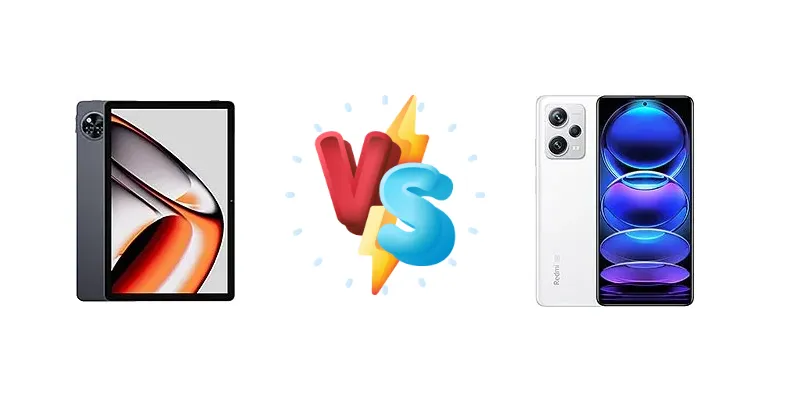
The Doogee U11 Pro and Xiaomi Redmi Note 12 Pro+ represent distinct approaches to the mid-range smartphone market. The Doogee prioritizes exceptional battery longevity, while the Xiaomi focuses on delivering a premium experience with incredibly fast charging and a more powerful processor. This comparison dissects their strengths and weaknesses to help you choose the right device.
🏆 Quick Verdict
For the average user prioritizing longevity and value, the Doogee U11 Pro emerges as the winner. Its astounding 131:38h battery endurance significantly outweighs the Redmi Note 12 Pro+'s faster charging, especially considering the Doogee's more affordable price point. However, power users will appreciate the Redmi Note 12 Pro+'s superior performance.
| Network |
|---|
| 2G bands | N/A | GSM 850 / 900 / 1800 / 1900 - SIM 1 & SIM 2 |
| 3G bands | N/A | HSDPA 800 / 850 / 900 / 1900 / 2100 |
| 4G bands | N/A | 1, 3, 5, 8, 19, 34, 38, 39, 40, 41 - International, China |
| 5G bands | - | 1, 3, 5, 8, 28, 38, 40, 41, 77, 78 SA/NSA - International |
| EDGE | No | - |
| GPRS | No | - |
| Speed | - | HSPA, LTE-A (CA), 5G |
| Technology | No cellular connectivity | GSM / CDMA / HSPA / EVDO / LTE / 5G |
| | - | 1, 3, 5, 8, 28, 38, 41, 77, 78 SA/NSA - China |
| Launch |
|---|
| Announced | 2025, April | 2022, October 27 |
| Status | Available. Released 2025, April | Available. Released 2022, November 01 |
| Body |
|---|
| Build | - | Glass front (Gorilla Glass 5), glass back |
| Dimensions | 257.3 x 168.8 x 8.1 mm (10.13 x 6.65 x 0.32 in) | 162.9 x 76 x 8.9 mm (6.41 x 2.99 x 0.35 in) |
| SIM | No | Dual SIM (Nano-SIM, dual stand-by) |
| Weight | 537 g (1.18 lb) | 208.4 g (7.34 oz) |
| | - | IP53, dust and splash resistant |
| Display |
|---|
| Protection | Mohs level 5 | Corning Gorilla Glass 5 |
| Resolution | 800 x 1280 pixels, 16:10 ratio (~137 ppi density) | 1080 x 2400 pixels, 20:9 ratio (~395 ppi density) |
| Size | 11.0 inches, 350.9 cm2 (~80.8% screen-to-body ratio) | 6.67 inches, 107.4 cm2 (~86.8% screen-to-body ratio) |
| Type | IPS LCD, 90Hz | OLED, 1B colors, 120Hz, Dolby Vision, HDR10+, 500 nits (typ), 900 nits (HBM) |
| Platform |
|---|
| CPU | Octa-core (2x1.6 GHz Cortex-A75 & 6x1.6 GHz Cortex-A55) | Octa-core (2x2.6 GHz Cortex-A78 & 6x2.0 GHz Cortex-A55) |
| Chipset | Unisoc T7200 (12 nm) | Mediatek MT6877V Dimensity 1080 (6 nm) |
| GPU | Mali-G57 MP1 | Mali-G68 MC4 |
| OS | Android 15 | Android 12, MIUI 13 |
| Memory |
|---|
| Card slot | microSDXC (dedicated slot) | No |
| Internal | 256GB 6GB RAM | 256GB 8GB RAM, 256GB 12GB RAM |
| | - | UFS 2.2 |
| Main Camera |
|---|
| Features | LED flash, HDR | Dual-LED dual-tone flash, HDR, panorama |
| Single | 13 MP, f/2.2, (wide), 1/3.1", AF | - |
| Triple | - | 200 MP, f/1.7, 24mm (wide), 1/1.4", 0.56µm, PDAF, OIS
8 MP, f/2.2, 120˚ (ultrawide), 1/4", 1.12µm
2 MP, f/2.4, (macro) |
| Video | 1080p@30fps | 4K@30fps, 1080p@30/60/120fps, 720p@960fps |
| Selfie camera |
|---|
| Features | - | HDR |
| Single | 5 MP, f/2.4, (wide), 1/5.0" | 16 MP, f/2.5, (wide), 1/3.06", 1.0µm |
| Video | 720p@30fps | 1080p@30/60fps |
| Sound |
|---|
| 3.5mm jack | - | Yes |
| 35mm jack | Yes | - |
| Loudspeaker | Yes, with stereo speakers | Yes, with stereo speakers |
| | - | 24-bit/192kHz audio |
| Comms |
|---|
| Bluetooth | 5.0, A2DP, LE | 5.2, A2DP, LE |
| Infrared port | - | Yes |
| NFC | No | Yes (market/region dependent) |
| Positioning | GPS, GALILEO, GLONASS, BDS | GPS (L1), GLONASS (G1), BDS (B1I+B1c), GALILEO (E1), QZSS (L1) |
| Radio | FM radio | No |
| USB | USB Type-C 2.0, OTG | USB Type-C 2.0, OTG |
| WLAN | Wi-Fi 802.11 a/b/g/n/ac, dual-band | Wi-Fi 802.11 a/b/g/n/ac/6, dual-band, Wi-Fi Direct |
| Features |
|---|
| Sensors | Accelerometer | Fingerprint (side-mounted), accelerometer, proximity, gyro, compass |
| Battery |
|---|
| Charging | 10W wired | 120W wired, PD3.0, 100% in 19 min (advertised) |
| Type | 8580 mAh | Li-Po 5000 mAh, non-removable |
| Misc |
|---|
| Colors | Black, Blue, Gray | Arctic White, Iceberg Blue, Obsidian Black, Trend edition |
| Models | - | 22101316UCP, 22101316UG |
| Price | - | $ 348.00 / £ 439.00 / € 399.00 / ₹ 29,949 |
| Tests |
|---|
| Battery life | - |
Endurance rating 88h
|
| Camera | - |
Photo / Video |
| Display | - |
Contrast ratio: Infinite (nominal) |
| Loudspeaker | - |
-26.7 LUFS (Good)
|
| Performance | - |
AnTuTu: 498710 (v9)
GeekBench: 2208 (v5.1), 2372 (v6)
GFXBench: 22fps (ES 3.1 onscreen) |
| EU LABEL |
|---|
| Battery | 131:38h endurance, 1000 cycles | - |
| Energy | Class E | - |
| Free fall | Class C (104 falls) | - |
| Repairability | Class B | - |
Doogee U11 Pro
- Exceptional battery life (131:38h endurance)
- High battery cycle count (1000 cycles)
- Potentially more affordable price point
- Slower processor (Unisoc T7200)
- Slow charging speed (10W)
- Likely less advanced camera system
Xiaomi Redmi Note 12 Pro+
- Faster processor (Dimensity 1080)
- Ultra-fast 120W charging (19 min to 100%)
- Likely superior display quality
- Significantly shorter battery life (88h endurance)
- Potentially higher price
- Faster battery degradation with frequent fast charging
Display Comparison
The Redmi Note 12 Pro+ boasts an 'Infinite' (nominal) contrast ratio, suggesting a high-quality AMOLED panel, though specific brightness data is missing. The Doogee U11 Pro’s display specifications are not provided, making a direct comparison difficult. However, given its price point, it likely utilizes an IPS LCD panel with lower contrast and potentially lower peak brightness. The Redmi Note 12 Pro+ likely offers a more vibrant and visually appealing experience, especially in direct sunlight.
Camera Comparison
While both phones feature camera systems, the Redmi Note 12 Pro+ is expected to have a more sophisticated setup, though specific details are missing. The Doogee U11 Pro’s camera specs are not provided, but its price suggests a more basic sensor and image processing pipeline. The Redmi Note 12 Pro+ likely benefits from features like Optical Image Stabilization (OIS) and more advanced computational photography algorithms, resulting in better low-light performance and overall image quality. The absence of details on the Doogee makes a detailed comparison impossible, but the Redmi is expected to be the superior camera phone.
Performance
The Xiaomi Redmi Note 12 Pro+’s Mediatek Dimensity 1080 (6nm) chipset significantly outperforms the Doogee U11 Pro’s Unisoc T7200 (12nm). The Dimensity 1080 features faster Cortex-A78 cores (2.6 GHz vs 1.6 GHz) and a more efficient manufacturing process, resulting in superior CPU and GPU performance. This translates to smoother multitasking, faster app loading times, and a better gaming experience. The Doogee’s Unisoc T7200 is adequate for everyday tasks, but will struggle with graphically intensive games and demanding applications. The Redmi Note 12 Pro+ also benefits from potentially faster RAM (LPDDR5x is common in this tier) compared to the Doogee.
Battery Life
The Doogee U11 Pro’s 131:38h endurance rating is its standout feature, dwarfing the Redmi Note 12 Pro+'s 88h. This massive difference is due to the Doogee’s optimized power efficiency and likely larger battery capacity (though not specified). However, the Redmi Note 12 Pro+ compensates with its 120W wired charging, capable of reaching 100% charge in a claimed 19 minutes. The Doogee U11 Pro’s 10W charging is significantly slower. This creates a trade-off: the Doogee offers days of use, while the Redmi offers minutes of charge time.
Buying Guide
Buy the Doogee U11 Pro if you need a phone that can reliably last for days on a single charge, and if you value long-term battery health thanks to its 1000 cycle rating. You'll benefit from this device if you frequently travel, work outdoors, or simply dislike the hassle of daily charging. Buy the Xiaomi Redmi Note 12 Pro+ if you prioritize performance for gaming and demanding apps, and if you absolutely need the convenience of a full charge in under 20 minutes. This is the phone for those who want a fast, feature-rich experience and don't mind more frequent charging.
Frequently Asked Questions
❓ How does the Unisoc T7200 in the Doogee U11 Pro handle demanding games like PUBG or Genshin Impact?
The Unisoc T7200 is not designed for high-end gaming. While it can run PUBG, you'll likely need to lower graphics settings to achieve playable frame rates. Genshin Impact may struggle to run smoothly even on the lowest settings. The Redmi Note 12 Pro+'s Dimensity 1080 is significantly better suited for gaming.
❓ Is the 120W charging on the Redmi Note 12 Pro+ safe for long-term battery health?
While 120W charging is incredibly fast, it can generate more heat and potentially accelerate battery degradation over time. Xiaomi likely incorporates safety mechanisms to mitigate this, but the Doogee U11 Pro's slower 10W charging is inherently gentler on the battery, and its 1000 cycle rating suggests a focus on longevity.
❓ What type of display technology does the Doogee U11 Pro use, and how does it compare to the Redmi Note 12 Pro+?
The Doogee U11 Pro's display technology is not specified, but given its price point, it's likely an IPS LCD panel. This will result in lower contrast, less vibrant colors, and potentially lower brightness compared to the Redmi Note 12 Pro+'s expected AMOLED display with an 'Infinite' contrast ratio.
❓ Does the Redmi Note 12 Pro+ support wireless charging?
No, the Xiaomi Redmi Note 12 Pro+ does not support wireless charging. It relies solely on its incredibly fast 120W wired charging for power replenishment.