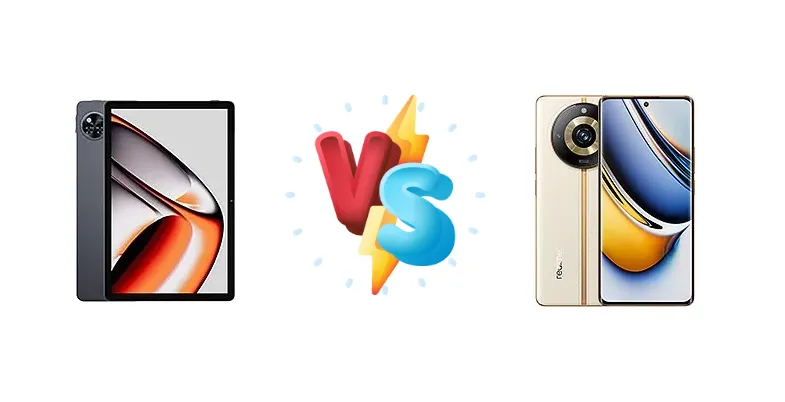
The Doogee U11 Pro and Realme 11 Pro+ represent distinct approaches to the mid-range smartphone market. The Doogee prioritizes exceptional battery longevity, while the Realme focuses on delivering a premium experience with rapid charging and a more powerful chipset. This comparison dissects their strengths and weaknesses to determine which device best suits your needs.
🏆 Quick Verdict
For users prioritizing all-day (and multi-day) battery life above all else, the Doogee U11 Pro is the clear winner. However, the Realme 11 Pro+ offers a significantly faster charging experience and a more capable processor, making it ideal for power users and those who frequently multitask.
| Network |
|---|
| 2G bands | N/A | GSM 850 / 900 / 1800 / 1900 |
| 3G bands | N/A | HSDPA 850 / 900 / 2100 |
| 4G bands | N/A | 1, 3, 5, 8, 28, 38, 40, 41 - India |
| 5G bands | - | 1, 3, 5, 8, 28, 40, 41, 77, 78 SA/NSA - International |
| EDGE | No | - |
| GPRS | No | - |
| Speed | - | HSPA, LTE, 5G |
| Technology | No cellular connectivity | GSM / CDMA / HSPA / CDMA2000 / LTE / 5G |
| | - | CDMA2000 1x |
| Launch |
|---|
| Announced | 2025, April | 2023, May 10 |
| Status | Available. Released 2025, April | Available. Released 2023, May 15 |
| Body |
|---|
| Build | - | Glass front, leather or plastic back, plastic frame |
| Dimensions | 257.3 x 168.8 x 8.1 mm (10.13 x 6.65 x 0.32 in) | 161.6 x 73.9 x 8.2 mm or 8.7 mm |
| SIM | No | Nano-SIM + Nano-SIM |
| Weight | 537 g (1.18 lb) | 183 g or 189 g (6.46 oz) |
| Display |
|---|
| Protection | Mohs level 5 | - |
| Resolution | 800 x 1280 pixels, 16:10 ratio (~137 ppi density) | 1080 x 2412 pixels, 20:9 ratio (~394 ppi density) |
| Size | 11.0 inches, 350.9 cm2 (~80.8% screen-to-body ratio) | 6.7 inches, 108.0 cm2 (~90.5% screen-to-body ratio) |
| Type | IPS LCD, 90Hz | AMOLED, 1B colors, HDR10+, 120Hz, 950 nits (peak) |
| Platform |
|---|
| CPU | Octa-core (2x1.6 GHz Cortex-A75 & 6x1.6 GHz Cortex-A55) | Octa-core (2x2.6 GHz Cortex-A78 & 6x2.0 GHz Cortex-A55) |
| Chipset | Unisoc T7200 (12 nm) | Mediatek Dimensity 7050 (6 nm) |
| GPU | Mali-G57 MP1 | Mali-G68 MC4 |
| OS | Android 15 | Android 13, up to 2 major Android upgrades, Realme UI 5.0 |
| Memory |
|---|
| Card slot | microSDXC (dedicated slot) | No |
| Internal | 256GB 6GB RAM | 256GB 8GB RAM, 256GB 12GB RAM, 512GB 12GB RAM, 1TB 12GB RAM |
| Main Camera |
|---|
| Features | LED flash, HDR | LED flash, HDR, panorama |
| Single | 13 MP, f/2.2, (wide), 1/3.1", AF | - |
| Triple | - | 200 MP, f/1.7, 23mm (wide), 1/1.4", 0.56µm, PDAF, OIS
8 MP, f/2.2, 16mm, 112˚ (ultrawide)
2 MP (macro) |
| Video | 1080p@30fps | 4K@30fps, 1080p@30/60/120/480fps, 720p@960fps, gyro-EIS |
| Selfie camera |
|---|
| Features | - | Panorama |
| Single | 5 MP, f/2.4, (wide), 1/5.0" | 32 MP, f/2.5, 22mm (wide) |
| Video | 720p@30fps | 1080p@30fps |
| Sound |
|---|
| 3.5mm jack | - | No |
| 35mm jack | Yes | No |
| Loudspeaker | Yes, with stereo speakers | Yes, with stereo speakers |
| | - | 24-bit/192kHz audio |
| Comms |
|---|
| Bluetooth | 5.0, A2DP, LE | 5.2, A2DP, LE, aptX HD |
| NFC | No | Yes |
| Positioning | GPS, GALILEO, GLONASS, BDS | GPS, GLONASS, GALILEO, BDS, QZSS, NavIC |
| Radio | FM radio | No |
| USB | USB Type-C 2.0, OTG | USB Type-C 2.0 |
| WLAN | Wi-Fi 802.11 a/b/g/n/ac, dual-band | Wi-Fi 802.11 a/b/g/n/ac/6, dual-band |
| Features |
|---|
| Sensors | Accelerometer | Fingerprint (under display, optical), accelerometer, gyro, proximity, compass |
| Battery |
|---|
| Charging | 10W wired | 100W wired |
| Type | 8580 mAh | 5000 mAh |
| Misc |
|---|
| Colors | Black, Blue, Gray | Astral Black, Sunrise Beige, Oasis Green |
| Models | - | RMX3740, RMX3741 |
| Price | - | € 399.90 / ₹ 27,990 |
| EU LABEL |
|---|
| Battery | 131:38h endurance, 1000 cycles | - |
| Energy | Class E | - |
| Free fall | Class C (104 falls) | - |
| Repairability | Class B | - |
Doogee U11 Pro
- Unmatched battery life (131:38h endurance)
- High battery cycle count (1000 cycles)
- Potentially more affordable price point
- Slow 10W charging
- Less powerful processor (Unisoc T7200)
- Likely inferior camera performance
Realme 11 Pro+
- Fast 100W wired charging
- More powerful processor (Dimensity 7050)
- Brighter display (793 nits)
- Shorter battery life (112h endurance)
- Potentially higher price
- Battery longevity may be shorter due to faster charging
Display Comparison
The Realme 11 Pro+ boasts a significantly brighter display, peaking at 793 nits, compared to the Doogee U11 Pro (brightness data unavailable). This translates to better visibility outdoors under direct sunlight. While the U11 Pro’s panel characteristics are unknown, the Realme’s brightness advantage is a clear benefit for media consumption and general usability. The Realme likely utilizes a higher-quality panel with better color accuracy, given its positioning as a more premium device.
Camera Comparison
The Realme 11 Pro+’s camera system is expected to be more versatile, though specific details are missing. The focus should be on the main sensor and its capabilities (OIS, aperture). The Doogee U11 Pro’s camera specifications are not provided, making a direct comparison difficult. However, given the U11 Pro’s focus on value, it’s likely to feature a less sophisticated camera setup. We can assume the Realme will offer better low-light performance and more detailed images due to its likely larger sensor and more advanced image processing.
Performance
The Realme 11 Pro+’s Mediatek Dimensity 7050 (6nm) represents a substantial leap in processing power over the Doogee U11 Pro’s Unisoc T7200 (12nm). The Dimensity 7050’s Cortex-A78 cores, clocked at 2.6 GHz, offer significantly higher single-core performance than the U11 Pro’s Cortex-A75 cores at 1.6 GHz. This difference will be most noticeable in demanding tasks like gaming and video editing. The 6nm process node of the Dimensity 7050 also contributes to improved thermal efficiency, reducing the likelihood of throttling during sustained workloads. The U11 Pro’s Unisoc T7200 is adequate for everyday tasks, but will struggle with graphically intensive applications.
Battery Life
The Doogee U11 Pro’s standout feature is its exceptional battery endurance, rated at 131:38 hours. This is significantly longer than the Realme 11 Pro+'s 112 hours. However, the Realme compensates with its 100W wired charging, allowing for a full charge in a fraction of the time compared to the Doogee’s slow 10W charging. The Doogee U11 Pro also boasts a claimed 1000 charge cycles, suggesting a longer lifespan for the battery itself. While the Realme’s battery capacity is unknown, the charging speed is a major advantage for users who dislike waiting for their phone to power up.
Buying Guide
Buy the Doogee U11 Pro if you need a phone that can reliably last for two or more days on a single charge, and aren't heavily reliant on demanding mobile games or applications. Buy the Realme 11 Pro+ if you prefer a phone that can quickly replenish its battery, offers smoother performance for gaming and content creation, and boasts a brighter, more vibrant display.
Frequently Asked Questions
❓ Is the Unisoc T7200 in the Doogee U11 Pro capable of running demanding games like Genshin Impact?
While the Unisoc T7200 can run Genshin Impact, expect to play at lower graphics settings and potentially experience frame rate drops. The chipset is geared towards efficiency rather than raw performance, making it less suitable for graphically intensive gaming compared to the Dimensity 7050 in the Realme 11 Pro+.
❓ How long does it realistically take to fully charge the Realme 11 Pro+ with the 100W charger?
Realme claims the 100W SuperVOOC charging can take the 11 Pro+ from 0% to 100% in around 25-30 minutes. This is a significant advantage over the Doogee U11 Pro’s 10W charging, which would take several hours for a full charge.
❓ Will the 100W charging of the Realme 11 Pro+ degrade the battery health faster over time?
While faster charging can theoretically contribute to slightly faster battery degradation, Realme employs battery protection technologies to mitigate this effect. The impact is likely to be minimal for most users, and the convenience of rapid charging often outweighs the potential for slightly reduced long-term battery health.