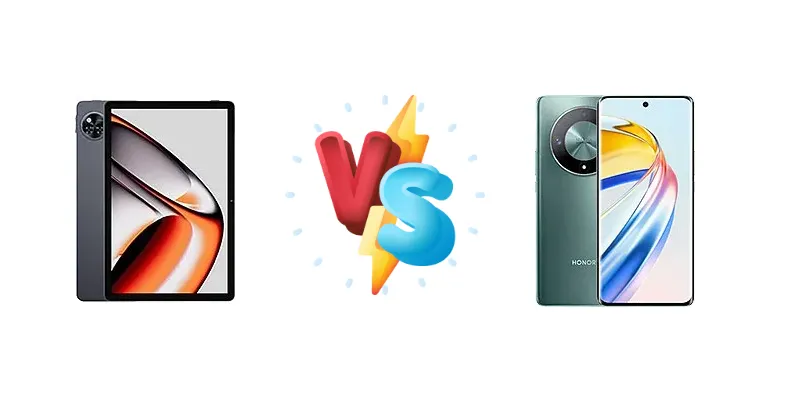
The Doogee U11 Pro and Honor X9b represent distinct approaches to the budget smartphone market. The U11 Pro prioritizes extreme battery endurance, while the X9b focuses on delivering a more responsive experience with a newer chipset. This comparison dissects their core components to determine which device best suits your needs.
🏆 Quick Verdict
For users prioritizing multi-day battery life and aren't demanding gamers, the Doogee U11 Pro is the clear winner. However, the Honor X9b’s Snapdragon 6 Gen 1 offers a significantly smoother and faster experience for everyday tasks and light gaming, coupled with much faster charging.
| Network |
|---|
| 2G bands | N/A | GSM 850 / 900 / 1800 / 1900 |
| 3G bands | N/A | HSDPA 850 / 900 / 1900 / 2100 |
| 4G bands | N/A | 1, 2, 3, 4, 5, 7, 8, 20, 28, 32, 38, 40, 41 |
| 5G bands | - | 1, 3, 7, 8, 20, 28, 38, 40, 41, 77, 78 SA/NSA |
| EDGE | No | - |
| GPRS | No | - |
| Speed | - | HSPA, LTE, 5G |
| Technology | No cellular connectivity | GSM / HSPA / LTE / 5G |
| Launch |
|---|
| Announced | 2025, April | 2023, October 18 |
| Status | Available. Released 2025, April | Available. Released 2023, October |
| Body |
|---|
| Dimensions | 257.3 x 168.8 x 8.1 mm (10.13 x 6.65 x 0.32 in) | 163.6 x 75.5 x 8 mm (6.44 x 2.97 x 0.31 in) |
| SIM | No | Nano-SIM + Nano-SIM |
| Weight | 537 g (1.18 lb) | 185 g (6.53 oz) |
| Display |
|---|
| Protection | Mohs level 5 | - |
| Resolution | 800 x 1280 pixels, 16:10 ratio (~137 ppi density) | 1220 x 2652 pixels, 19.5:9 ratio (~431 ppi density) |
| Size | 11.0 inches, 350.9 cm2 (~80.8% screen-to-body ratio) | 6.78 inches, 112.6 cm2 (~91.2% screen-to-body ratio) |
| Type | IPS LCD, 90Hz | AMOLED, 1B colors, 120Hz, 1200 nits (peak) |
| Platform |
|---|
| CPU | Octa-core (2x1.6 GHz Cortex-A75 & 6x1.6 GHz Cortex-A55) | Octa-core (4x2.2 GHz Cortex-A78 & 4x1.8 GHz Cortex-A55) |
| Chipset | Unisoc T7200 (12 nm) | Qualcomm SM6450 Snapdragon 6 Gen 1 (4 nm) |
| GPU | Mali-G57 MP1 | Adreno 710 |
| OS | Android 15 | Android 13, Magic OS 7.2 |
| Memory |
|---|
| Card slot | microSDXC (dedicated slot) | No |
| Internal | 256GB 6GB RAM | 256GB 8GB RAM, 256GB 12GB RAM, 512GB 8GB RAM, 512GB 12GB RAM |
| Main Camera |
|---|
| Features | LED flash, HDR | LED flash, panorama, HDR |
| Single | 13 MP, f/2.2, (wide), 1/3.1", AF | - |
| Triple | - | 108 MP, f/1.8, (wide), 1/1.67", PDAF
5 MP, f/2.2, (ultrawide)
2 MP (macro) |
| Video | 1080p@30fps | 4K@30fps, 1080p@30fps |
| Selfie camera |
|---|
| Single | 5 MP, f/2.4, (wide), 1/5.0" | 16 MP, f/2.5, (wide) |
| Video | 720p@30fps | 1080p@30fps |
| Sound |
|---|
| 35mm jack | Yes | No |
| Loudspeaker | Yes, with stereo speakers | Yes |
| Comms |
|---|
| Bluetooth | 5.0, A2DP, LE | 5.1, A2DP, LE |
| Infrared port | - | Yes |
| NFC | No | Yes (market/region dependent) |
| Positioning | GPS, GALILEO, GLONASS, BDS | GPS, GLONASS, GALILEO, BDS |
| Radio | FM radio | No |
| USB | USB Type-C 2.0, OTG | USB Type-C 2.0, OTG |
| WLAN | Wi-Fi 802.11 a/b/g/n/ac, dual-band | Wi-Fi 802.11 a/b/g/n/ac, dual-band, Wi-Fi Direct |
| Features |
|---|
| Sensors | Accelerometer | Fingerprint (under display, optical), accelerometer, gyro, proximity, compass |
| Battery |
|---|
| Charging | 10W wired | 35W wired
Reverse wired |
| Type | 8580 mAh | Li-Po 5800 mAh |
| Misc |
|---|
| Colors | Black, Blue, Gray | Sunrise Orange, Midnight Black, Emerald Green |
| Models | - | ALI-NX1 |
| Price | - | About 970 EUR |
| EU LABEL |
|---|
| Battery | 131:38h endurance, 1000 cycles | - |
| Energy | Class E | - |
| Free fall | Class C (104 falls) | - |
| Repairability | Class B | - |
Doogee U11 Pro
- Exceptional battery life (131:38h endurance)
- Long battery lifespan (1000 charge cycles)
- Potentially lower price point
- Slow 10W charging
- Less powerful processor
- Likely basic camera system
Honor X9b
- Faster Snapdragon 6 Gen 1 processor
- 35W fast charging with reverse wired charging
- More responsive user experience
- Shorter battery life compared to Doogee U11 Pro
- Potentially higher price point
- Battery lifespan may be shorter than Doogee
Display Comparison
Neither device's display specifications are provided, so a direct comparison is limited. However, given the price points, we can assume both utilize LCD panels. The absence of details like refresh rate or resolution suggests neither prioritizes a premium display experience. The focus is clearly on core functionality and battery optimization.
Camera Comparison
Without specific camera sensor details, a detailed comparison is impossible. However, the market segment suggests both phones will feature modest camera systems. The absence of any mention of advanced features like OIS or large sensor sizes indicates a focus on basic photography capabilities. Image processing will likely be the differentiating factor, and Honor typically offers more refined software algorithms.
Performance
The Honor X9b’s Qualcomm Snapdragon 6 Gen 1 (4nm) represents a significant architectural leap over the Doogee U11 Pro’s Unisoc T7200 (12nm). The 4nm process node inherently delivers better power efficiency and thermal performance, allowing the Snapdragon 6 Gen 1 to sustain higher clock speeds for longer periods. The X9b’s CPU configuration – 4x2.2 GHz Cortex-A78 & 4x1.8 GHz Cortex-A55 – also boasts more powerful core designs compared to the U11 Pro’s 2x1.6 GHz Cortex-A75 & 6x1.6 GHz Cortex-A55. This translates to noticeably faster app launches, smoother multitasking, and a more enjoyable gaming experience on the Honor X9b.
Battery Life
The Doogee U11 Pro’s standout feature is its exceptional battery endurance, rated at 131:38 hours. This is likely achieved through a combination of a large battery capacity (not specified) and the power-efficient Unisoc T7200 chipset. However, the U11 Pro is limited to 10W wired charging, meaning a full charge will take a considerable amount of time. In contrast, the Honor X9b supports 35W wired charging, significantly reducing charging times. While the X9b’s battery capacity isn’t specified, the Snapdragon 6 Gen 1’s efficiency and faster charging capabilities make it a more convenient option for users who prefer not to wait hours for a full charge. The U11 Pro also boasts 1000 charge cycles, suggesting a longer lifespan for the battery itself.
Buying Guide
Buy the Doogee U11 Pro if you need a phone that can reliably last for two or more days on a single charge, and your usage primarily involves calls, texts, and light social media. Buy the Honor X9b if you prefer a more responsive user interface, faster app loading times, and the convenience of 35W fast charging, even if it means charging your phone more frequently.
Frequently Asked Questions
❓ How much faster is the Honor X9b's charging compared to the Doogee U11 Pro?
The Honor X9b's 35W charging is significantly faster than the Doogee U11 Pro's 10W charging. While exact 0-100% times aren't available, the X9b will likely charge in under 2 hours, while the U11 Pro could take 6 hours or more.
❓ Will the Unisoc T7200 in the Doogee U11 Pro struggle with demanding apps or games?
Yes, the Unisoc T7200 is a budget-focused chipset. While it's suitable for everyday tasks like calls, texts, and social media, it will likely struggle with graphically intensive games or demanding applications. Expect lower frame rates and potential lag.
❓ Does the Honor X9b support reverse wired charging, and what does that mean?
Yes, the Honor X9b supports reverse wired charging. This allows you to use your phone as a power bank to charge other devices, like wireless earbuds or another smartphone, using a USB-C cable.
❓ What does the 1000 charge cycle rating on the Doogee U11 Pro mean for long-term battery health?
The 1000 charge cycle rating indicates that the Doogee U11 Pro's battery is designed to retain a significant portion of its original capacity after being fully charged and discharged 1000 times. This suggests a longer overall battery lifespan compared to phones with lower cycle ratings.