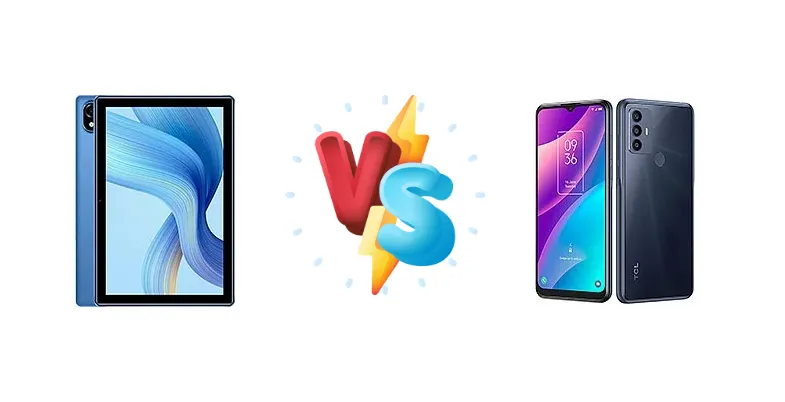
The Doogee U10 Pro and TCL 30 SE represent two distinct approaches to the ultra-budget smartphone market. The Doogee leverages a Rockchip RK3562, while the TCL opts for MediaTek’s Helio G25. This comparison dissects their core components to determine which device delivers the best value for users prioritizing affordability and basic functionality.
🏆 Quick Verdict
For the average user seeking a functional, everyday smartphone, the TCL 30 SE emerges as the slightly better choice. Its octa-core Helio G25 chipset, built on a more efficient 12nm process, provides a noticeable performance advantage over the Doogee U10 Pro’s quad-core RK3562, despite the slower RAM speeds likely present in both devices.
| Network |
|---|
| 2G bands | N/A | GSM 850 / 900 / 1800 / 1900 |
| 3G bands | N/A | HSDPA 850 / 900 / 1900 / 2100 - EMEA/APAC |
| 4G bands | N/A | 1, 3, 5, 7, 8, 20, 28, 38, 40, 41 - EMEA |
| EDGE | No | - |
| GPRS | No | - |
| Speed | - | HSPA 42.2/11.5 Mbps, LTE Cat4 150/50 Mbps |
| Technology | No cellular connectivity | GSM / HSPA / LTE |
| | - | 2, 3, 4, 5, 7, 8, 12, 13, 17, 26, 28, 66 - LATAM |
| Launch |
|---|
| Announced | 2023, September | 2022, February 27 |
| Status | Available. Released 2023, September | Available. Released 2022, April 20 |
| Body |
|---|
| Build | - | Glass front, plastic frame, plastic back |
| Dimensions | 245.3 x 163.3 x 9.9 mm (9.66 x 6.43 x 0.39 in) | 165.2 x 75.5 x 8.9 mm (6.50 x 2.97 x 0.35 in) |
| SIM | No | · Nano-SIM· Nano-SIM + Nano-SIM |
| Weight | 478 g (1.05 lb) | 190 g (6.70 oz) |
| Display |
|---|
| Resolution | 800 x 1280 pixels, 16:10 ratio (~149 ppi density) | 720 x 1600 pixels, 20:9 ratio (~269 ppi density) |
| Size | 10.1 inches, 295.8 cm2 (~73.8% screen-to-body ratio) | 6.52 inches, 102.6 cm2 (~82.3% screen-to-body ratio) |
| Type | IPS LCD | IPS LCD, 450 nits (typ) |
| Platform |
|---|
| CPU | Quad-core 2.0 GHz | Octa-core (4x2.0 GHz Cortex-A53 & 4x1.5 GHz Cortex-A53) |
| Chipset | RK3562 | Mediatek MT6762G Helio G25 (12 nm) |
| GPU | - | PowerVR GE8320 |
| OS | Android 13 | Android 12, TCL UI 4.0 |
| Memory |
|---|
| Card slot | microSDXC (dedicated slot) | microSDXC (dedicated slot) |
| Internal | 128GB 8GB RAM | 64GB 4GB RAM, 128GB 4GB RAM |
| | - | eMMC 5.1 |
| Main Camera |
|---|
| Features | LED flash | LED flash, HDR, panorama |
| Single | 8 MP | 8 MP, f/2.0, 26mm (wide), 1/4", 1.12µm |
| Triple | - | 50 MP, f/1.9, 28mm (wide), 1/2.76", 0.64µm, PDAF
2 MP (macro)
Auxiliary lens |
| Video | 720p@30fps | 1080p@30fps |
| Selfie camera |
|---|
| Features | - | HDR |
| Single | 5 MP | 8 MP, f/2.0, 26mm (wide), 1/4.0", 1.12µm |
| Video | 720p@30fps | 1080p@30fps |
| Sound |
|---|
| 3.5mm jack | - | Yes |
| 35mm jack | Yes | Yes |
| Loudspeaker | Yes, with stereo speakers | Yes |
| Comms |
|---|
| Bluetooth | 5.0, A2DP, LE | 5.0, A2DP, LE |
| NFC | No | Yes (6165H/6165H1 only) |
| Positioning | No | GPS, GLONASS, GALILEO, BDS |
| Radio | No | Unspecified |
| USB | USB Type-C 2.0, OTG | USB Type-C 2.0 |
| WLAN | Wi-Fi 802.11 a/b/g/n/ac/6, dual-band | Wi-Fi 802.11 b/g/n, Wi-Fi Direct |
| Features |
|---|
| Sensors | Accelerometer | Fingerprint (rear-mounted), accelerometer, proximity, compass |
| Battery |
|---|
| Charging | 10W wired | 15W wired |
| Type | 5060 mAh | Li-Po 5000 mAh |
| Misc |
|---|
| Colors | Black, Pink, Blue | Atlantic Blue, Space Gray, Glacial Blue |
| Models | - | 6165H, 6156H1, 6165A, 6165A1, 6165S |
Doogee U10 Pro
- Potentially more rugged build quality (Doogee brand reputation)
- Simpler software experience (potentially less bloatware)
- Lower price point (potentially)
- Quad-core processor limits multitasking
- Slower 10W charging
- Less efficient chipset (likely)
TCL 30 SE
- Octa-core processor for smoother performance
- Faster 15W charging
- More efficient chipset (12nm process)
- Potential for more bloatware (TCL’s software history)
- Build quality may be less robust than Doogee
- Macro camera is likely low quality
Display Comparison
Neither device boasts a standout display. Given the price point, we can assume both utilize IPS LCD panels with 720p+ resolutions. However, specifics like peak brightness and color gamut coverage are unavailable. The TCL 30 SE’s slightly larger screen size (typically found in this class) may offer a marginally more immersive viewing experience, but the difference will be minimal. Bezels are expected to be substantial on both.
Camera Comparison
Camera performance is likely to be similar on both devices, leaning towards basic functionality. Without sensor size details, it’s difficult to make definitive claims. However, the inclusion of a dedicated macro lens on the TCL 30 SE (often 2MP) is unlikely to significantly enhance image quality. Both phones will likely struggle in low-light conditions. Image processing will be basic, prioritizing speed over detail. Expect acceptable results in well-lit environments.
Performance
The core difference lies in the chipsets. The TCL 30 SE’s MediaTek Helio G25, fabricated on a 12nm process, features an octa-core configuration (4x2.0 GHz Cortex-A53 & 4x1.5 GHz Cortex-A53). This contrasts sharply with the Doogee U10 Pro’s Rockchip RK3562, a quad-core 2.0 GHz processor. The Helio G25’s higher core count and more modern architecture translate to superior multitasking and application launch speeds. While neither chipset is a gaming powerhouse, the G25 will handle less demanding games with greater fluidity. The RK3562’s efficiency is unknown, but the 12nm process of the G25 suggests better power management.
Battery Life
Battery capacity is not specified, but both devices likely house batteries in the 4000-5000 mAh range. The TCL 30 SE’s 15W wired charging offers a clear advantage over the Doogee U10 Pro’s 10W charging. This translates to a faster 0-100% charge time, reducing downtime. While a larger battery capacity on the Doogee could offset the slower charging, the Helio G25’s potentially better power efficiency on the TCL 30 SE could result in comparable real-world battery life.
Buying Guide
Buy the Doogee U10 Pro if you need a device primarily for extremely basic tasks like calls, texts, and light web browsing, and prioritize a potentially more rugged build quality (based on Doogee’s brand reputation). Buy the TCL 30 SE if you prefer a smoother multitasking experience, slightly better gaming performance for casual titles, and faster charging, even if it means sacrificing some potential durability.
Frequently Asked Questions
❓ Will the Helio G25 in the TCL 30 SE struggle with popular games like PUBG Mobile?
While the Helio G25 isn't a gaming powerhouse, it can run PUBG Mobile at lower settings (balanced graphics, medium frame rate). Expect occasional frame drops during intense action. The Doogee U10 Pro’s RK3562 will likely offer a less smooth experience, even at the lowest settings.
❓ Is the 10W charging on the Doogee U10 Pro significantly slower than the 15W charging on the TCL 30 SE?
Yes, the difference is noticeable. A full charge from 0-100% on the Doogee U10 Pro will take considerably longer – potentially several hours – compared to the TCL 30 SE, which should charge fully in around 2.5-3 hours, depending on battery capacity.
❓ Does either phone support fast charging standards like Quick Charge or Power Delivery?
Neither device is likely to support advanced fast charging standards like Quick Charge or Power Delivery. Both utilize standard USB charging, limiting their charging speeds to the advertised 10W and 15W respectively.
❓ How much RAM does each phone have, and will that impact performance?
RAM capacity is not specified. However, both devices likely feature 2GB or 3GB of RAM. While the TCL 30 SE’s more powerful chipset will mitigate some of the limitations of lower RAM, multitasking will still be constrained on both devices. Expect apps to reload frequently.