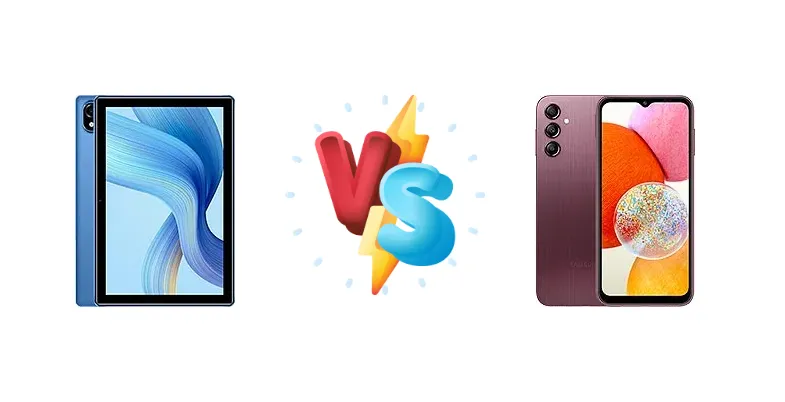
The sub-$200 smartphone market is fiercely competitive. The Doogee U10 Pro, with its focus on ruggedness and affordability, clashes with the Samsung Galaxy A14, a mainstream contender offering Samsung’s brand recognition and a more versatile chipset. This comparison dissects the key differences to determine which device delivers the best value.
🏆 Quick Verdict
For the average user, the Samsung Galaxy A14 is the superior choice. While the Doogee U10 Pro offers a unique value proposition for those needing extreme durability, the A14’s more powerful Mediatek Helio G80 (or Exynos 850) chipset and faster 15W charging provide a smoother, more responsive experience.
| Network |
|---|
| 2G bands | N/A | GSM 850 / 900 / 1800 / 1900 |
| 3G bands | N/A | HSDPA 850 / 900 / 2100 |
| 4G bands | N/A | 1, 3, 5, 7, 8, 20, 28, 38, 40, 41 |
| EDGE | No | - |
| GPRS | No | - |
| Speed | - | HSPA, LTE |
| Technology | No cellular connectivity | GSM / HSPA / LTE |
| Launch |
|---|
| Announced | 2023, September | 2023, February 28 |
| Status | Available. Released 2023, September | Available. Released 2023, March 27 |
| Body |
|---|
| Build | - | Glass front, plastic back, plastic frame |
| Dimensions | 245.3 x 163.3 x 9.9 mm (9.66 x 6.43 x 0.39 in) | 167.7 x 78 x 9.1 mm (6.60 x 3.07 x 0.36 in) |
| SIM | No | · Nano-SIM· Nano-SIM + Nano-SIM |
| Weight | 478 g (1.05 lb) | 201 g (7.09 oz) |
| Display |
|---|
| Resolution | 800 x 1280 pixels, 16:10 ratio (~149 ppi density) | 1080 x 2408 pixels, 20:9 ratio (~400 ppi density) |
| Size | 10.1 inches, 295.8 cm2 (~73.8% screen-to-body ratio) | 6.6 inches, 104.9 cm2 (~80.2% screen-to-body ratio) |
| Type | IPS LCD | PLS LCD |
| Platform |
|---|
| CPU | Quad-core 2.0 GHz | Octa-core (2x2.0 GHz Cortex-A75 & 6x1.8 GHz Cortex-A55) - Version AOcta-core (4x2.0 GHz Cortex-A55 & 4x2.0 GHz Cortex-A55) - Version B |
| Chipset | RK3562 | Mediatek MT6769 Helio G80 (12 nm) - Version AExynos 850 (8 nm) - Version B |
| GPU | - | Mali-G52 MC2 |
| OS | Android 13 | Android 13, upgradable to Android 15, One UI 7 |
| Memory |
|---|
| Card slot | microSDXC (dedicated slot) | microSDXC (dedicated slot) |
| Internal | 128GB 8GB RAM | 64GB 4GB RAM, 128GB 4GB RAM, 128GB 6GB RAM |
| Main Camera |
|---|
| Features | LED flash | LED flash, panorama, HDR |
| Single | 8 MP | 13 MP, f/2.0, (wide) |
| Triple | - | 50 MP, f/1.8, 26mm (wide), 1/2.75", 0.64µm, PDAF
5 MP, f/2.2, 17mm (ultrawide), 1/5.0", 1.12µm
2 MP (macro) |
| Video | 720p@30fps | 1080p@30fps |
| Selfie camera |
|---|
| Single | 5 MP | 13 MP, f/2.0, 26mm (wide), 1/3.1", 1.12µm |
| Video | 720p@30fps | 1080p@30fps |
| Sound |
|---|
| 3.5mm jack | - | Yes |
| 35mm jack | Yes | Yes |
| Loudspeaker | Yes, with stereo speakers | Yes |
| Comms |
|---|
| Bluetooth | 5.0, A2DP, LE | 5.1 or 5.3, A2DP, LE |
| NFC | No | Yes (market/region dependent) |
| Positioning | No | GPS, GALILEO, GLONASS, BDS, QZSS |
| Radio | No | Unspecified |
| USB | USB Type-C 2.0, OTG | USB Type-C 2.0 |
| WLAN | Wi-Fi 802.11 a/b/g/n/ac/6, dual-band | Wi-Fi 802.11 a/b/g/n/ac, dual-band, Wi-Fi Direct |
| Features |
|---|
| Sensors | Accelerometer | Fingerprint (side-mounted), accelerometer, proximity, compass |
| Battery |
|---|
| Charging | 10W wired | 15W wired |
| Type | 5060 mAh | Li-Po 5000 mAh |
| Misc |
|---|
| Colors | Black, Pink, Blue | Black, Dark Red, Silver, Green |
| Models | - | SM-A145F, SM-A145F/DSN, SM-A145M, SM-A145M/DS, SM-A145P, SM-A145R |
| Price | - | € 85.76 / $ 147.60 / £ 79.95 |
| SAR EU | - | 0.46 W/kg (head) 1.37 W/kg (body) |
Doogee U10 Pro
- Potentially more rugged build quality (Doogee's brand focus)
- Lower price point (likely)
- Simple, uncluttered software experience
- Significantly weaker processor performance
- Slower 10W charging
- Likely inferior camera quality
Samsung Galaxy A14
- More powerful processor (Helio G80 or Exynos 850)
- Faster 15W charging
- Samsung’s brand reputation and software support
- May be slightly more expensive
- Potentially less durable build
- Samsung’s One UI can be resource-intensive
Display Comparison
Neither device boasts a standout display. Both likely utilize LCD panels, a common trait in this price bracket. The lack of specified resolution or refresh rate data suggests both are targeting 720p or 1080p at 60Hz. The A14’s potential for a slightly larger screen size (based on typical A-series sizing) could offer a more immersive viewing experience, but without detailed specs, it’s difficult to quantify. Bezels are expected to be noticeable on both.
Camera Comparison
Camera performance is likely to be similar in real-world usage, given the focus on affordability. Both devices will likely feature a primary camera accompanied by auxiliary lenses of limited utility (often 2MP macro or depth sensors). The A14’s potential for a larger sensor (based on Samsung’s typical camera configurations) could offer better low-light performance, but without specific sensor size data, it’s speculative. Image processing will likely favor Samsung’s more refined algorithms, resulting in more pleasing and consistent results. The Doogee’s camera is likely to be serviceable for basic snapshots, but won’t compete with the A14 in terms of detail or dynamic range.
Performance
The performance gap is significant. The Samsung Galaxy A14, even in its Helio G80 configuration, benefits from an octa-core CPU built on a 12nm process, offering a substantial advantage over the Doogee U10 Pro’s quad-core RK3562. The G80’s Cortex-A75 cores provide a noticeable boost in single-core performance, crucial for app launch speeds and general responsiveness. The Exynos 850 version of the A14 further widens the gap, utilizing an 8nm process for improved efficiency and sustained performance. The RK3562, while adequate for basic tasks, will struggle with demanding applications and multitasking. This translates to a smoother gaming experience and faster app loading times on the A14.
Battery Life
Both phones offer adequate battery capacity for all-day use, but the charging speeds differ. The Galaxy A14’s 15W wired charging is 50% faster than the Doogee U10 Pro’s 10W charging. While neither is particularly fast by modern standards, the A14 will reach a full charge significantly quicker. The actual battery life will depend on usage patterns, but the A14’s more efficient chipset (especially the Exynos version) could contribute to slightly longer runtimes.
Buying Guide
Buy the Doogee U10 Pro if you prioritize extreme durability and are willing to compromise on processing power for tasks beyond basic communication. It’s ideal for outdoor workers or those prone to dropping their phones. Buy the Samsung Galaxy A14 if you value a more responsive user experience, better gaming capabilities, and the broader ecosystem of Samsung’s software and support. It’s the better all-rounder for everyday use.
Frequently Asked Questions
❓ Does the Mediatek Helio G80 in the Galaxy A14 get hot during extended gaming sessions?
The Helio G80 is a relatively efficient chipset. While it will generate heat during prolonged gaming, it’s unlikely to experience severe throttling. Samsung’s software likely includes thermal management features to mitigate overheating, providing a reasonably stable gaming experience for titles like PUBG Mobile or Call of Duty Mobile at medium settings.
❓ Is the RK3562 chipset in the Doogee U10 Pro sufficient for running popular social media apps like TikTok and Instagram?
The RK3562 can handle basic social media apps like TikTok and Instagram, but expect some lag and slower loading times, especially when multitasking. The limited processing power will become noticeable when scrolling through feeds or recording videos. It’s adequate for casual use, but not ideal for power users.
❓ What version of Android does the Samsung Galaxy A14 ship with, and is there a guaranteed update path?
The Samsung Galaxy A14 typically ships with Android 13 with Samsung’s One UI on top. Samsung generally provides at least two major Android updates and four years of security patches for its A-series devices, offering a reasonable level of software support.
❓ How does the build quality of the Doogee U10 Pro compare to the Samsung Galaxy A14 in terms of drop resistance?
Doogee specializes in rugged phones, so the U10 Pro is likely to withstand drops and impacts better than the Galaxy A14. While the A14 is reasonably well-built, it lacks the reinforced chassis and protective features commonly found in Doogee’s lineup. If drop resistance is a primary concern, the U10 Pro is the clear choice.