
Doogee Tab G6+ vs. Oukitel RT3 Pro: A Deep Dive into Rugged Tablet Performance and Battery Life
| Phones Images | |||||
|---|---|---|---|---|---|
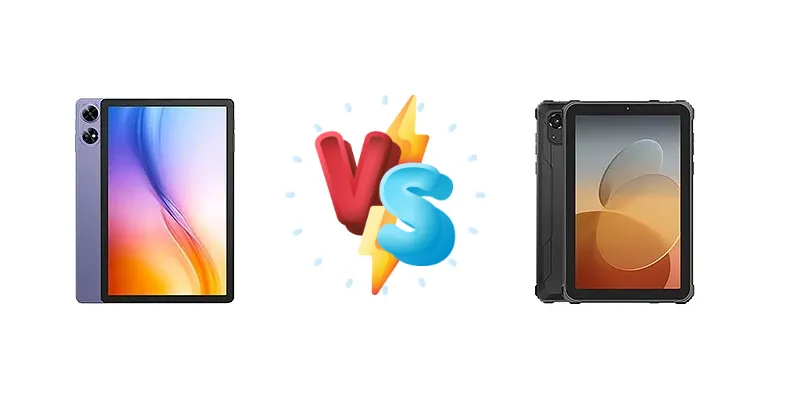
|
🏆 Quick Verdict
For users prioritizing maximum uptime and extended field work, the Oukitel RT3 Pro is the clear winner. Its significantly larger battery, offering 138:26h endurance, outweighs the slightly slower CPU. However, the Doogee Tab G6+ remains a viable option for those seeking a balance of performance and longevity at a potentially lower price point.
| PHONES | ||
|---|---|---|
| Phone Names | Doogee Tab G6+ | Oukitel RT3 Pro |
| Network | ||
|---|---|---|
| 2G bands | GSM 850 / 900 / 1800 / 1900 | GSM 850 / 900 / 1800 / 1900 |
| 3G bands | HSDPA 850 / 900 / 1700(AWS) / 1900 / 2100 | HSDPA 850 / 900 / 1700(AWS) / 1900 / 2100 |
| 4G bands | 1, 2, 3, 4, 5, 7, 8, 18, 19, 20, 25, 26, 28, 34, 38, 39, 40, 41, 66 | 1, 2, 3, 4, 5, 7, 8, 12, 17, 18, 19, 20, 25, 26, 28, 38, 39, 40, 41, 66 |
| Speed | HSPA, LTE | HSPA, LTE |
| Technology | GSM / HSPA / LTE | GSM / HSPA / LTE |
| Launch | ||
|---|---|---|
| Announced | 2025, May | 2024, October |
| Status | Available. Released 2025, May | Available. Released 2024, October |
| Body | ||
|---|---|---|
| Dimensions | 256.9 x 168.4 x 8.3 mm (10.11 x 6.63 x 0.33 in) | 207 x 134 x 13.9 mm (8.15 x 5.28 x 0.55 in) |
| SIM | Nano-SIM + Nano-SIM | Nano-SIM + Nano-SIM |
| Weight | 528 g (1.16 lb) | 538 g (1.19 lb) |
| Display | ||
|---|---|---|
| Protection | Mohs level 6 | Corning Gorilla Glass 5, Mohs level 4 |
| Resolution | 1200 x 1920 pixels, 16:10 ratio (~206 ppi density) | 800 x 1280 pixels, 16:10 ratio (~189 ppi density) |
| Size | 11.0 inches, 350.9 cm2 (~81.1% screen-to-body ratio) | 8.0 inches, 185.6 cm2 (~66.9% screen-to-body ratio) |
| Type | IPS LCD, 90Hz | IPS LCD, 600 nits |
| Platform | ||
|---|---|---|
| CPU | Octa-core (2x2.2 GHz Cortex-A75 & 6x1.8 GHz Cortex-A55) | Octa-core (2x2.0 GHz Cortex-A75 & 6x1.7 GHz Cortex-A55) |
| Chipset | Unisoc T7280 (12 nm) | Mediatek Helio G81 (12 nm) |
| GPU | Mali-G57 MP1 | Mali-G52 MC2 |
| OS | Android 15 | Android 14 |
| Memory | ||
|---|---|---|
| Card slot | microSDXC (uses shared SIM slot) | microSDXC (uses shared SIM slot) |
| Internal | 256GB 8GB RAM | 128GB 4GB RAM |
| Main Camera | ||
|---|---|---|
| Dual | - | 16 MP, f/2.0, (wide), 1/3.06", PDAF Auxiliary lens |
| Features | LED flash | LED flash |
| Single | 13 MP | - |
| Video | 1080p@30fps | 1080p@30fps |
| Selfie camera | ||
|---|---|---|
| Single | 5 MP | 8 MP, f/2.0, (wide), 1/4.0" |
| Video | Yes | 720p@30fps |
| Sound | ||
|---|---|---|
| 35mm jack | Yes | No |
| Loudspeaker | Yes, with stereo speakers | Yes, with stereo speakers |
| Comms | ||
|---|---|---|
| Bluetooth | 5.0, A2DP, LE | 5.0, A2DP, LE |
| NFC | No | Yes |
| Positioning | GPS, GALILEO, GLONASS, BDS | GPS, GLONASS, GALILEO, BDS |
| Radio | No | FM radio |
| USB | USB Type-C | USB Type-C 2.0, OTG |
| WLAN | Wi-Fi 802.11 a/b/g/n/ac, dual-band | Wi-Fi 802.11 a/b/g/n/ac, dual-band |
| Features | ||
|---|---|---|
| Sensors | Accelerometer | Accelerometer, compass |
| Battery | ||
|---|---|---|
| Charging | 18W wired | 10W wired |
| Type | 8000 mAh | Li-Po 5150 mAh |
| Misc | ||
|---|---|---|
| Colors | Black, Gray, Purple | Black, Orange, Green |
| Price | About 200 EUR | About 180 EUR |
| EU LABEL | ||
|---|---|---|
| Battery | 88:26h endurance, 1000 cycles | 138:44h endurance, 1000 cycles |
| Energy | Class F | Class B |
| Free fall | Class E (52 falls) | Class A (208 falls) |
| Repairability | Class B | Class B |
Doogee Tab G6+
- Faster CPU clock speeds (2.2 GHz vs 2.0 GHz)
- Potentially faster charging with 18W support
- Likely a more affordable price point
- Significantly shorter battery life (88:26h vs 138:26h)
- Less powerful GPU for gaming and graphics-intensive tasks
- Unisoc chipset may have less software optimization
Oukitel RT3 Pro
- Exceptional battery life (138:26h endurance)
- More capable GPU (Mali-G52 MC2)
- Mediatek Helio G81 offers broader software compatibility
- Slower CPU clock speeds (2.0 GHz vs 2.2 GHz)
- Slower charging with 10W support
- Likely a higher price tag
Display Comparison
Neither device's display specifications are provided, so a direct comparison is limited. However, given their rugged nature, both likely utilize IPS LCD panels for durability and viewing angles. The market segment suggests resolutions around 1920x1200 are probable. The absence of details like peak brightness or refresh rate means the display experience will likely be similar, focusing on practicality over visual fidelity.
Camera Comparison
Camera specifications are not provided for either device. Given the rugged tablet category, image quality is likely a secondary concern. Expect basic camera setups suitable for documentation and quick snapshots, rather than high-end photography. The inclusion of a dedicated night mode or advanced image processing features is unlikely.
Performance
The Oukitel RT3 Pro, powered by the Mediatek Helio G81 (12nm), holds a slight performance edge over the Doogee Tab G6+'s Unisoc T7280 (12nm). While both chipsets utilize an octa-core configuration with 2x Cortex-A75 and 6x Cortex-A55 cores, the Helio G81's cores are clocked slightly lower (2.0 GHz vs 2.2 GHz). However, the G81's Mali-G52 MC2 GPU is generally more capable than the T7280's integrated graphics, offering a smoother experience in graphically intensive applications and games. This translates to better responsiveness for users running demanding apps or multitasking.
Battery Life
The Oukitel RT3 Pro dominates in battery life, boasting an impressive 138:26h endurance compared to the Doogee Tab G6+'s 88:26h. Both devices claim 1000 charge cycles, indicating similar battery longevity in terms of lifespan. However, the RT3 Pro's larger capacity allows for significantly longer usage between charges. The Doogee Tab G6+ compensates with 18W wired charging, potentially offering a faster 0-100% charge time than the RT3 Pro's 10W charging, but the difference in overall runtime is substantial.
Buying Guide
Buy the Doogee Tab G6+ if you need a reliable tablet for basic productivity tasks, media consumption, and occasional outdoor use, and value a potentially lower upfront cost. Buy the Oukitel RT3 Pro if you require exceptional battery life for demanding work in remote locations, extended travel, or frequent use away from power sources, and are willing to pay a premium for that longevity.