
Doogee Tab G6+ vs Nokia T20: A Deep Dive into Budget Tablet Performance
| Phones Images | |||||
|---|---|---|---|---|---|
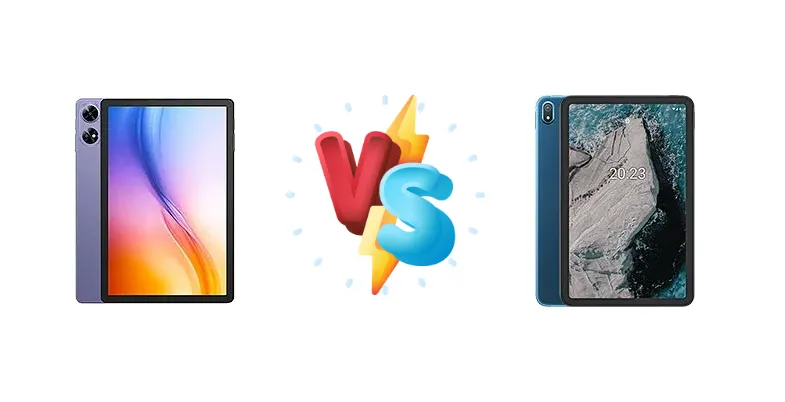
|
🏆 Quick Verdict
For users prioritizing longevity and sustained performance, the Doogee Tab G6+ emerges as the winner. Its significantly longer 88:26h battery endurance, coupled with the slightly more powerful Unisoc T7280, makes it ideal for travel or extended use. However, the Nokia T20 offers a brighter, more visually appealing display.
| PHONES | ||
|---|---|---|
| Phone Names | Doogee Tab G6+ | Nokia T20 |
| Network | ||
|---|---|---|
| 2G bands | GSM 850 / 900 / 1800 / 1900 | GSM 850 / 900 / 1800 / 1900 |
| 3G bands | HSDPA 850 / 900 / 1700(AWS) / 1900 / 2100 | HSDPA 850 / 900 / 1700(AWS) / 1900 / 2100 - US, LATAM |
| 4G bands | 1, 2, 3, 4, 5, 7, 8, 18, 19, 20, 25, 26, 28, 34, 38, 39, 40, 41, 66 | 1, 2, 3, 4, 5, 7, 8, 12, 13, 17, 20, 28, 40, 66 - US, LATAM |
| Speed | HSPA, LTE | HSPA, LTE Cat4 150/50 Mbps - cellular model only |
| Technology | GSM / HSPA / LTE | GSM / HSPA / LTE |
| - | 1, 3, 5, 7, 8, 20, 28, 38, 40, 41 - International | |
| Launch | ||
|---|---|---|
| Announced | 2025, May | 2021, October 06 |
| Status | Available. Released 2025, May | Available. Released 2021, November 02 |
| Body | ||
|---|---|---|
| Build | - | Glass front, aluminum back |
| Dimensions | 256.9 x 168.4 x 8.3 mm (10.11 x 6.63 x 0.33 in) | 247.6 x 157.5 x 7.8 mm (9.75 x 6.20 x 0.31 in) |
| SIM | Nano-SIM + Nano-SIM | Nano-SIM (cellular model only) |
| Weight | 528 g (1.16 lb) | 465 g (Wi-Fi), 470 g (LTE) (1.03 lb) |
| - | Splash resistant | |
| Display | ||
|---|---|---|
| Protection | Mohs level 6 | Scratch-resistant glass |
| Resolution | 1200 x 1920 pixels, 16:10 ratio (~206 ppi density) | 1200 x 2000 pixels, 5:3 ratio (~224 ppi density) |
| Size | 11.0 inches, 350.9 cm2 (~81.1% screen-to-body ratio) | 10.4 inches, 307.9 cm2 (~78.9% screen-to-body ratio) |
| Type | IPS LCD, 90Hz | IPS LCD, 400 nits (typ) |
| Platform | ||
|---|---|---|
| CPU | Octa-core (2x2.2 GHz Cortex-A75 & 6x1.8 GHz Cortex-A55) | Octa-core (2x1.8 GHz Cortex-A75 & 6x1.8 GHz Cortex-A55) |
| Chipset | Unisoc T7280 (12 nm) | Unisoc T610 (12 nm) |
| GPU | Mali-G57 MP1 | Mali-G52 MP2 |
| OS | Android 15 | Android 11, upgradable to Android 13 |
| Memory | ||
|---|---|---|
| Card slot | microSDXC (uses shared SIM slot) | microSDXC (dedicated slot) |
| Internal | 256GB 8GB RAM | 32GB 3GB RAM, 64GB 4GB RAM |
| - | eMMC 5.1 | |
| Main Camera | ||
|---|---|---|
| Features | LED flash | LED flash |
| Single | 13 MP | 8 MP, AF |
| Video | 1080p@30fps | 1080p@30fps |
| Selfie camera | ||
|---|---|---|
| Single | 5 MP | 5 MP |
| Video | Yes | Yes |
| Sound | ||
|---|---|---|
| 3.5mm jack | - | Yes |
| 35mm jack | Yes | Yes |
| Loudspeaker | Yes, with stereo speakers | Yes, with stereo speakers |
| Comms | ||
|---|---|---|
| Bluetooth | 5.0, A2DP, LE | 5.0, A2DP, LE |
| NFC | No | No |
| Positioning | GPS, GALILEO, GLONASS, BDS | GPS - cellular model only |
| Radio | No | FM radio |
| USB | USB Type-C | USB Type-C 2.0 |
| WLAN | Wi-Fi 802.11 a/b/g/n/ac, dual-band | Wi-Fi 802.11 a/b/g/n/ac, dual-band |
| Features | ||
|---|---|---|
| Sensors | Accelerometer | Accelerometer |
| Battery | ||
|---|---|---|
| Charging | 18W wired | 15W wired |
| Type | 8000 mAh | Li-Po 8200 mAh |
| Misc | ||
|---|---|---|
| Colors | Black, Gray, Purple | Deep Ocean |
| Models | - | TA-1397, TA-1394, TA-1392 |
| Price | About 200 EUR | About 200 EUR |
| SAR | - | 1.34 W/kg (body) |
| SAR EU | - | 1.35 W/kg (body) |
| EU LABEL | ||
|---|---|---|
| Battery | 88:26h endurance, 1000 cycles | - |
| Energy | Class F | - |
| Free fall | Class E (52 falls) | - |
| Repairability | Class B | - |
Doogee Tab G6+
- Exceptional battery life (88:26h endurance)
- More powerful processor (Unisoc T7280)
- Long-lasting battery (1000 cycles)
- Display brightness and quality are unknown
- Limited camera information
Nokia T20
- Brighter display (422 nits)
- High contrast ratio (1786:1)
- Reputable brand (Nokia)
- Shorter battery life (estimated)
- Less powerful processor (Unisoc T610)
Display Comparison
The Nokia T20 boasts a brighter display, reaching a measured 422 nits, which will be noticeably better in brightly lit environments compared to the Doogee G6+, whose brightness is not specified. While the Doogee doesn't provide brightness data, the Nokia’s 1786:1 contrast ratio suggests a more visually dynamic image. The absence of information regarding panel technology (IPS, TFT) for the Doogee makes a direct comparison difficult, but the Nokia’s specifications indicate a more refined viewing experience for media consumption.
Camera Comparison
Neither tablet is positioned as a photography powerhouse, and detailed camera specifications are lacking. Without sensor size or aperture information, a meaningful comparison is impossible. It’s safe to assume both tablets offer basic camera functionality suitable for casual snapshots, but not for serious photography. Focusing on camera performance would be a misdirection given the target market.
Performance
Both tablets utilize Unisoc chipsets, but the Doogee Tab G6+ features the Unisoc T7280, while the Nokia T20 uses the T610. The T7280’s octa-core configuration with 2x2.2 GHz Cortex-A75 cores provides a slight performance edge over the T610’s 2x1.8 GHz Cortex-A75 cores. This difference, though not massive, will translate to snappier app loading and smoother multitasking. Both chipsets are built on a 12nm process, suggesting similar thermal characteristics, but the higher clock speeds of the T7280 indicate a potential for slightly better sustained performance under load.
Battery Life
The Doogee Tab G6+ truly shines in battery endurance, offering an impressive 88:26h of usage. This is a significant advantage over what we would expect from the Nokia T20, which lacks published endurance testing. The Doogee also boasts a 1000-cycle battery lifespan, suggesting long-term reliability. While the Nokia T20 supports 15W charging, the Doogee G6+ offers 18W wired charging, potentially leading to slightly faster recharge times, though the difference is likely marginal given the battery capacity isn't specified for either device.
Buying Guide
Buy the Doogee Tab G6+ if you need a tablet that can reliably last through long flights, workdays, or extended media sessions without needing a recharge. It’s the choice for power users and those who dislike battery anxiety. Buy the Nokia T20 if you prioritize a brighter, more vibrant display for content consumption and are willing to compromise on overall battery life. It’s better suited for casual users and home entertainment.