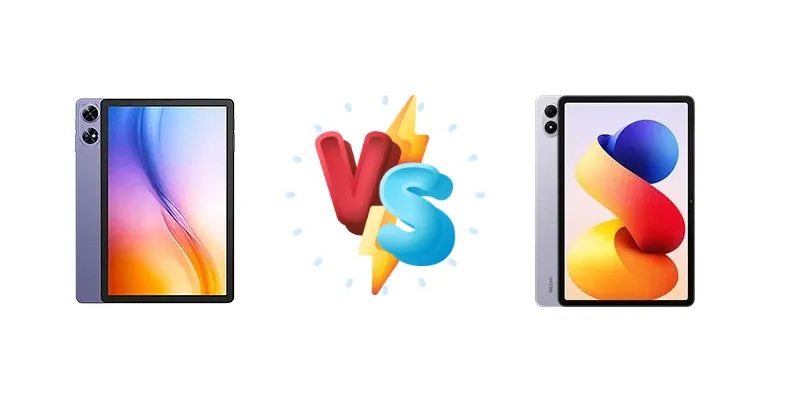
The tablet market is heating up, particularly in the budget segment. The Doogee Tab G6 and Xiaomi Redmi Pad 2 Pro both aim to deliver a compelling experience without breaking the bank. However, they take different approaches – Doogee prioritizes longevity with a focus on battery cycle count, while Xiaomi emphasizes raw performance with a newer chipset and faster charging. This comparison dives deep into the specs to determine which tablet best suits your needs.
🏆 Quick Verdict
For most users, the Xiaomi Redmi Pad 2 Pro is the better choice. Its Snapdragon 7s Gen 4 chipset provides a significantly smoother and more responsive experience than the Doogee Tab G6’s Unisoc T7250, and the 33W charging is a game-changer. While the Doogee boasts impressive battery cycle longevity, the Redmi Pad 2 Pro’s overall package is more compelling.
| Network |
|---|
| 2G bands | GSM 850 / 900 / 1800 / 1900 | N/A |
| 3G bands | HSDPA 850 / 900 / 1700(AWS) / 1900 / 2100 | N/A |
| 4G bands | 1, 2, 3, 4, 5, 7, 8, 18, 19, 20, 25, 26, 28, 34, 38, 39, 40, 41, 66 | - |
| EDGE | - | N/A |
| GPRS | - | N/A |
| Speed | HSPA, LTE | - |
| Technology | GSM / HSPA / LTE | No cellular connectivity |
| Launch |
|---|
| Announced | 2025, May | 2025, September 24 |
| Status | Available. Released 2025, May | Available. Released 2025, September 24 |
| Body |
|---|
| Build | - | Glass front, aluminum frame, aluminum back |
| Dimensions | 257.3 x 168.8 x 8.1 mm (10.13 x 6.65 x 0.32 in) | 279.8 x 181.7 x 7.5 mm (11.02 x 7.15 x 0.30 in) |
| SIM | Nano-SIM + Nano-SIM | No |
| Weight | 554 g (1.22 lb) | 610 g (1.34 lb) |
| Display |
|---|
| Protection | Mohs level 5 | Mohs level 6 |
| Resolution | 800 x 1280 pixels, 16:10 ratio (~138 ppi density) | 1600 x 2560 pixels, 16:10 ratio (~249 ppi density) |
| Size | 11.0 inches, 345.8 cm2 (~79.6% screen-to-body ratio) | 12.1 inches, 424.5 cm2 (~83.5% screen-to-body ratio) |
| Type | IPS LCD, 90Hz | IPS LCD, 1B colors, 120Hz, Dolby Vision, 600 nits (HBM) |
| Platform |
|---|
| CPU | Octa-core (2x1.8 GHz Cortex-A75 & 6x1.6 GHz Cortex-A55) | Octa-core (1x2.7 GHz Cortex-A720 & 3x2.4 GHz Cortex-A720 & 4x1.8 GHz Cortex-A520) |
| Chipset | Unisoc T7250 (12 nm) | Qualcomm SM7635-AC Snapdragon 7s Gen 4 (4 nm) |
| GPU | Mali-G57 MP1 | Adreno 810 |
| OS | Android 15 | Android 15, HyperOS 2 |
| Memory |
|---|
| Card slot | microSDXC (uses shared SIM slot) | microSDXC (dedicated slot) |
| Internal | 256GB 6GB RAM | 128GB 6GB RAM, 256GB 8GB RAM |
| Main Camera |
|---|
| Features | LED flash | Color spectrum sensor, LED flash, HDR |
| Single | 8 MP | 8 MP, f/2.0, (wide), 1/4.0", 1.12µm |
| Video | 1080p@30fps | 1080p@30fps |
| Selfie camera |
|---|
| Single | 5 MP | 8 MP, f/2.3, (wide), 1/4.0", 1.12µm |
| Video | Yes | 1080p@30fps |
| Sound |
|---|
| 35mm jack | Yes | Yes |
| Loudspeaker | Yes, with stereo speakers | Yes, with stereo speakers, Dolby Atmos (4 speakers) |
| Comms |
|---|
| Bluetooth | 5.0, A2DP, LE | 5.4, A2DP, LE, aptX HD, aptX Adaptive |
| NFC | No | No |
| Positioning | GPS, GALILEO, GLONASS, BDS | No |
| Radio | No | No |
| USB | USB Type-C | USB Type-C 2.0, OTG |
| WLAN | Wi-Fi 802.11 a/b/g/n/ac, dual-band | Wi-Fi 802.11 a/b/g/n/a/6, dual-band, Wi-Fi Direct |
| Features |
|---|
| Sensors | Accelerometer | Accelerometer, gyro, proximity (accessories only), compass |
| Battery |
|---|
| Charging | 10W wired | 33W wired, PD3.0, QC3+
27W reverse wired |
| Type | 8000 mAh | 12000 mAh |
| Misc |
|---|
| Colors | Black, Gray, Purple | Graphite Gray, Silver, Lavender Purple, Matte Glass Version |
| Models | - | 25099RP13G |
| Price | About 180 EUR | About 300 EUR |
| EU LABEL |
|---|
| Battery | 109:24h endurance, 800 cycles | 103:18h endurance, 1000 cycles |
| Energy | Class E | Class G |
| Free fall | Class D (52 falls) | Class A (208 falls) |
| Repairability | Class B | Class C |
Doogee Tab G6
- Excellent battery cycle longevity (800 cycles)
- Competitive battery endurance (109:24h)
- Potentially lower price point
- Older Unisoc T7250 chipset
- Slow 10W charging
- Likely less responsive user experience
Xiaomi Redmi Pad 2 Pro
- Powerful Snapdragon 7s Gen 4 chipset
- Fast 33W charging with PD3.0/QC3+
- Longer battery cycle longevity (1000 cycles)
- Better real-world performance (12:55h active use)
- Potentially higher price
- Slightly shorter overall battery endurance (103:18h)
Display Comparison
Neither device’s display specifications are provided, so a direct comparison is limited. However, given the price points, we can assume both utilize IPS LCD panels. The Redmi Pad 2 Pro, being the newer device, likely benefits from improved color accuracy and potentially higher brightness. The absence of information regarding refresh rates suggests both are likely capped at 60Hz. Bezels are a key area where Xiaomi often excels, and it’s reasonable to expect a more modern, streamlined design on the Redmi Pad 2 Pro.
Camera Comparison
Without specific camera specs beyond the chipsets, a detailed comparison is impossible. It’s safe to assume both tablets feature modest camera setups geared towards video calls and casual snapshots. Given Xiaomi’s history, the Redmi Pad 2 Pro likely incorporates more sophisticated image processing algorithms, potentially resulting in slightly better image quality. The absence of information suggests neither device will excel in low-light photography.
Performance
The performance gap is the most significant differentiator. The Xiaomi Redmi Pad 2 Pro’s Qualcomm Snapdragon 7s Gen 4 (4nm) is a substantial upgrade over the Doogee Tab G6’s Unisoc T7250 (12nm). The Snapdragon 7s Gen 4 features a prime Cortex-A720 core clocked at 2.7GHz, alongside three additional A720 cores and four efficiency cores, offering a considerable boost in CPU and GPU performance. The 4nm process node also translates to better thermal efficiency, reducing the likelihood of throttling during sustained workloads. The Doogee’s Cortex-A75 cores, while capable, are older architecture and less efficient. This difference will be most noticeable in multitasking, gaming, and demanding applications.
Battery Life
Both tablets offer impressive battery endurance, with the Doogee Tab G6 lasting 109:24h and the Xiaomi Redmi Pad 2 Pro at 103:18h. However, the difference lies in charging and longevity. The Redmi Pad 2 Pro’s 33W wired charging (with PD3.0 and QC3+ support) is significantly faster than the Doogee’s 10W charging. A full charge on the Redmi Pad 2 Pro will take considerably less time. The Doogee compensates with a rated 800 battery cycles, suggesting it can withstand more charge-discharge cycles before significant degradation, while the Redmi Pad 2 Pro boasts 1000 cycles. The Redmi Pad 2 Pro also has an active use score of 12:55h, indicating real-world performance under load.
Buying Guide
Buy the Doogee Tab G6 if you prioritize long-term battery health and are primarily using the tablet for basic tasks like reading, web browsing, and light video streaming. Its 800 charge cycles offer peace of mind for extended use. Buy the Xiaomi Redmi Pad 2 Pro if you demand smoother multitasking, enjoy mobile gaming, or frequently use demanding applications. The Snapdragon 7s Gen 4 and faster charging make it a more versatile and enjoyable daily driver.
Frequently Asked Questions
❓ How much faster is the charging on the Xiaomi Redmi Pad 2 Pro compared to the Doogee Tab G6?
The Xiaomi Redmi Pad 2 Pro’s 33W charging is significantly faster than the Doogee Tab G6’s 10W charging. While exact 0-100% times aren’t available, expect the Redmi Pad 2 Pro to charge in roughly half the time, or even less, making it much more convenient for users who need a quick top-up.
❓ Will the Unisoc T7250 in the Doogee Tab G6 struggle with demanding games?
Yes, the Unisoc T7250 is likely to struggle with graphically intensive games. The Snapdragon 7s Gen 4 in the Redmi Pad 2 Pro offers a much more capable GPU, allowing for smoother frame rates and higher graphics settings. The Doogee Tab G6 is better suited for casual gaming and less demanding titles.
❓ Is the 800 battery cycle rating on the Doogee Tab G6 a significant advantage?
It is a notable advantage for users who plan to use the tablet heavily for several years. While both tablets offer good battery life, the Doogee Tab G6 is designed to maintain a higher capacity over a longer period of repeated charging and discharging. However, the Redmi Pad 2 Pro's 1000 cycles is even better.
❓ Does the Xiaomi Redmi Pad 2 Pro support video playback in high resolutions?
Given the Snapdragon 7s Gen 4 chipset, the Redmi Pad 2 Pro is expected to handle 1080p and potentially even 4K video playback without issue. The hardware decoding capabilities of the Snapdragon chipset are well-suited for streaming and local playback of high-resolution content.