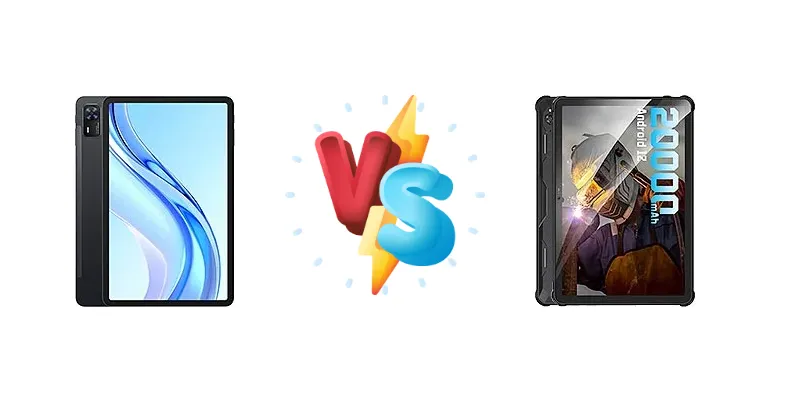
The Doogee Tab E3+ and Oukitel RT2 represent compelling options in the increasingly competitive budget tablet space. While both aim to deliver functionality without breaking the bank, they take distinctly different approaches to achieving this. The E3+ prioritizes long-term endurance with a modern, efficient chipset, while the RT2 focuses on quicker replenishment with faster charging, despite utilizing an older processor architecture. This comparison will dissect these choices to determine which tablet best suits your usage patterns.
🏆 Quick Verdict
For users prioritizing sustained usage and longevity, the Doogee Tab E3+ emerges as the winner. Its Mediatek Helio G100 chipset, built on a 6nm process, offers superior efficiency, translating to a remarkable 93:08h endurance. While the Oukitel RT2 boasts faster 33W charging, its older 12nm MT8788 chipset can't match the E3+'s stamina.
| Network |
|---|
| 2G bands | GSM 850 / 900 / 1800 / 1900 | GSM 850 / 900 / 1800 / 1900 |
| 3G bands | HSDPA 800 / 850 / 900 / 1700(AWS) / 1900 / 2100 | HSDPA 850 / 900 / 1700(AWS) / 1900 / 2100 |
| 4G bands | 1, 2, 3, 4, 5, 7, 8, 12, 17, 18, 19, 20, 25, 26, 28, 34, 38, 39, 40, 41, 66 | LTE |
| Speed | HSPA, LTE | HSPA, LTE |
| Technology | GSM / HSPA / LTE | GSM / HSPA / LTE |
| Launch |
|---|
| Announced | 2025, May | 2022, September |
| Status | Available. Released 2025, May | Available. Released 2022, September |
| Body |
|---|
| Dimensions | 278.8 x 174.3 x 7.7 mm (10.98 x 6.86 x 0.30 in) | - |
| SIM | Nano-SIM + Nano-SIM | Nano-SIM + Nano-SIM |
| Weight | 583 g (1.29 lb) | - |
| Display |
|---|
| Protection | Mohs level 5 | - |
| Resolution | 1200 x 2000 pixels, 5:3 ratio (~195 ppi density) | 1200 x 1920 pixels, 16:10 ratio (~224 ppi density) |
| Size | 11.97 inches, 407.8 cm2 (~83.9% screen-to-body ratio) | 10.1 inches, 295.8 cm2 |
| Type | IPS LCD, 90Hz, 380 nis | IPS LCD, 350 nits |
| Platform |
|---|
| CPU | Octa-core (2x2.2 GHz Cortex-A76 & 6x2.0 GHz Cortex-A55) | Octa-core (4x2.0 GHz Cortex-A73 & 4x2.0 GHz Cortex-A53) |
| Chipset | Mediatek Helio G100 (6 nm) | Mediatek MT8788 (12 nm) |
| GPU | Mali-G57 MC2 | Mali-G72 MP3 |
| OS | Android 15 | Android 12 |
| Memory |
|---|
| Card slot | microSDXC (uses shared SIM slot) | microSDXC (uses shared SIM slot) |
| Internal | 256GB 8GB RAM | 128GB 8GB RAM |
| Main Camera |
|---|
| Features | LED flash, HDR | LED flash |
| Single | 13 MP, f/2.2, AF | 16 MP |
| Video | 1440p@30/60fps, 1080p@30/60fps | 1080p@30fps |
| Selfie camera |
|---|
| Single | 5 MP, f/2.4 | 16 MP |
| Video | 1440p@30fps, 1080p@30/120fps | Yes |
| Sound |
|---|
| 35mm jack | No | Unspecified |
| Loudspeaker | Yes, with stereo speakers (4 speakers) | Yes, with stereo speakers |
| Comms |
|---|
| Bluetooth | 5.0, A2DP, LE | 4.2, A2DP |
| NFC | No | No |
| Positioning | GPS, GALILEO, GLONASS, BDS | GPS, GLONASS, GALILEO |
| Radio | FM radio | Unspecified |
| USB | USB Type-C | USB Type-C 2.0, OTG |
| WLAN | Wi-Fi 802.11 a/b/g/n/ac, dual-band | Wi-Fi 802.11 a/b/g/n/ac, dual-band |
| Features |
|---|
| Sensors | Accelerometer, compass | Unspecified |
| Battery |
|---|
| Charging | 18W wired
2.5W reverse wired | 33W wired
Reverse wired |
| Type | 8800 mAh | Li-Po 20000 mAh |
| Misc |
|---|
| Colors | Black, Gray, Blue | Black, Orange |
| Price | About 250 EUR | About 350 EUR |
| EU LABEL |
|---|
| Battery | 93:08h endurance, 1000 cycles | - |
| Energy | Class F | - |
| Free fall | Class E (52 falls) | - |
| Repairability | Class B | - |
Doogee Tab E3+
- Exceptional battery life (93:08h endurance)
- Modern and efficient Mediatek Helio G100 chipset
- 6nm fabrication process for improved thermal management
- Slower 18W charging
- No reverse charging capability
Oukitel RT2
- Faster 33W wired charging
- Includes 2.5W reverse wired charging
- Potentially quicker initial setup and app loading
- Less efficient Mediatek MT8788 chipset
- Older 12nm fabrication process
- Likely shorter battery life compared to the E3+
Display Comparison
Display specifications are absent from the provided data, making a direct comparison impossible. However, given the price points of both devices, we can anticipate both utilizing IPS LCD panels. The absence of details like resolution, refresh rate, and peak brightness suggests neither tablet will excel in this area. Users seeking a premium viewing experience should consider alternatives.
Camera Comparison
Camera details are unavailable, making a meaningful comparison impossible. Given the target market, it’s reasonable to expect both tablets to feature modest camera setups focused on basic functionality rather than photographic excellence. Without sensor size, aperture, or image processing information, any assessment would be speculative.
Performance
The core difference lies in the chipsets. The Doogee Tab E3+’s Mediatek Helio G100 (6nm) utilizes a modern CPU configuration – 2x2.2 GHz Cortex-A76 and 6x2.0 GHz Cortex-A55 cores. This architecture, combined with the smaller 6nm fabrication process, delivers significantly improved performance-per-watt compared to the Oukitel RT2’s MT8788 (12nm). The RT2’s CPU, featuring 4x2.0 GHz Cortex-A73 and 4x2.0 GHz Cortex-A53 cores, is older and less efficient. While both are octa-core, the A76 cores in the G100 offer a substantial architectural advantage, resulting in snappier responsiveness and better multitasking capabilities. The 6nm process also means less heat generation, potentially leading to more sustained performance under load.
Battery Life
The Doogee Tab E3+ truly shines in battery endurance, boasting a remarkable 93:08h rating. This is a direct result of the efficient Mediatek Helio G100 chipset. While the Oukitel RT2 doesn’t disclose endurance, its 33W wired charging is significantly faster than the E3+'s 18W charging. The RT2 also offers 2.5W reverse wired charging, a feature absent on the E3+. However, faster charging doesn’t compensate for a less efficient processor. The E3+’s longevity will likely outweigh the convenience of quicker charging for many users, especially those away from power sources for extended periods.
Buying Guide
Buy the Doogee Tab E3+ if you need a tablet for extended travel, long reading sessions, or situations where access to power is limited. Its exceptional battery life and efficient processor make it ideal for digital nomads and power users. Buy the Oukitel RT2 if you prioritize quick top-ups and frequently find yourself needing to recharge rapidly, even if it means sacrificing overall endurance. This tablet is better suited for users who have consistent access to power outlets.
Frequently Asked Questions
❓ How will the older chipset in the Oukitel RT2 affect app performance compared to the Doogee Tab E3+?
The Oukitel RT2’s MT8788 chipset, while capable, utilizes an older CPU architecture and a less efficient 12nm process. This translates to potentially slower app loading times, less responsive multitasking, and a lower ceiling for demanding applications compared to the Doogee Tab E3+'s Helio G100. The G100’s Cortex-A76 cores provide a noticeable performance boost.
❓ Is the 33W charging on the Oukitel RT2 worth sacrificing battery life for?
That depends on your usage. If you frequently find yourself needing to quickly top up your tablet and have consistent access to a power source, the 33W charging could be beneficial. However, the Doogee Tab E3+'s exceptional 93:08h endurance significantly reduces the need for frequent charging, making it a better choice for users prioritizing longevity over speed.
❓ What kind of user would benefit most from the reverse wired charging feature on the Oukitel RT2?
The 2.5W reverse wired charging on the Oukitel RT2 is useful for users who occasionally need to provide a small emergency charge to accessories like Bluetooth headphones or a smartwatch. It's not a fast charging solution, but it can be a convenient feature in a pinch.