
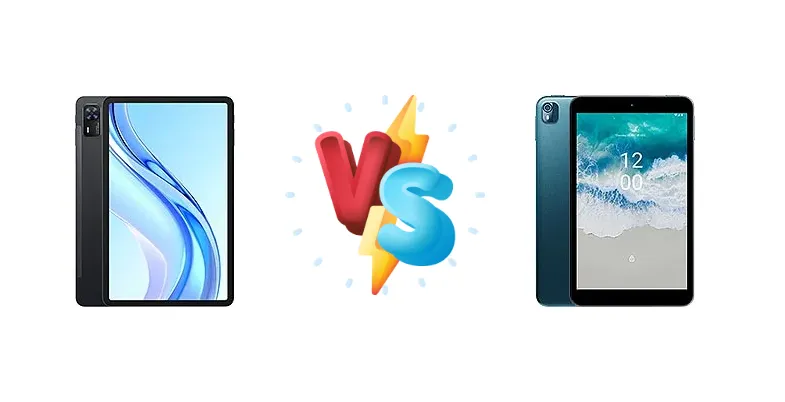
Doogee Tab E3+ vs Nokia T10: A Deep Dive into Budget Tablet Performance
| Phones Images | |||||
|---|---|---|---|---|---|
|
🏆 Quick Verdict
For users prioritizing sustained performance and extended battery life, the Doogee Tab E3+ emerges as the clear winner. Its Mediatek Helio G100 chipset and impressive 93-hour endurance significantly outperform the Nokia T10, making it ideal for demanding tasks and prolonged use.
| PHONES | ||
|---|---|---|
| Phone Names | Doogee Tab E3+ | Nokia T10 |
| Network | ||
|---|---|---|
| 2G bands | GSM 850 / 900 / 1800 / 1900 | GSM 850 / 900 / 1800 / 1900 |
| 3G bands | HSDPA 800 / 850 / 900 / 1700(AWS) / 1900 / 2100 | HSDPA 850 / 900 / 2100 |
| 4G bands | 1, 2, 3, 4, 5, 7, 8, 12, 17, 18, 19, 20, 25, 26, 28, 34, 38, 39, 40, 41, 66 | 1, 3, 5, 7, 8, 20, 28, 38, 40, 41 |
| Speed | HSPA, LTE | HSPA 42.2/5.76 Mbps, LTE Cat4 150/50 Mbps |
| Technology | GSM / HSPA / LTE | GSM / HSPA / LTE |
| Launch | ||
|---|---|---|
| Announced | 2025, May | 2022, July 12 |
| Status | Available. Released 2025, May | Available. Released 2022, August 20 |
| Body | ||
|---|---|---|
| Build | - | Glass front, plastic back, plastic frame |
| Dimensions | 278.8 x 174.3 x 7.7 mm (10.98 x 6.86 x 0.30 in) | 208 x 123.2 x 9 mm (8.19 x 4.85 x 0.35 in) |
| SIM | Nano-SIM + Nano-SIM | Nano-SIM |
| Weight | 583 g (1.29 lb) | 375 g (13.23 oz) |
| - | Splash resistant | |
| Display | ||
|---|---|---|
| Protection | Mohs level 5 | - |
| Resolution | 1200 x 2000 pixels, 5:3 ratio (~195 ppi density) | 800 x 1280 pixels, 16:10 ratio (~189 ppi density) |
| Size | 11.97 inches, 407.8 cm2 (~83.9% screen-to-body ratio) | 8.0 inches, 185.6 cm2 (~72.4% screen-to-body ratio) |
| Type | IPS LCD, 90Hz, 380 nis | IPS LCD, 360 nits (typ), 450 nits (peak) |
| Platform | ||
|---|---|---|
| CPU | Octa-core (2x2.2 GHz Cortex-A76 & 6x2.0 GHz Cortex-A55) | Octa-core (2x1.6 GHz Cortex-A75 & 6x1.6 GHz Cortex-A55) |
| Chipset | Mediatek Helio G100 (6 nm) | Unisoc T606 (12 nm) |
| GPU | Mali-G57 MC2 | Mali-G57 MP1 |
| OS | Android 15 | Android 12, upgradable to Android 13 |
| Memory | ||
|---|---|---|
| Card slot | microSDXC (uses shared SIM slot) | microSDXC |
| Internal | 256GB 8GB RAM | 32GB 3GB RAM, 64GB 4GB RAM |
| Main Camera | ||
|---|---|---|
| Features | LED flash, HDR | LED flash |
| Single | 13 MP, f/2.2, AF | 8 MP, 1/4.0", 1.12µm, AF |
| Video | 1440p@30/60fps, 1080p@30/60fps | 1080p |
| Selfie camera | ||
|---|---|---|
| Single | 5 MP, f/2.4 | 2 MP, 1/5.0", 1.65µm |
| Video | 1440p@30fps, 1080p@30/120fps | 720p |
| Sound | ||
|---|---|---|
| 3.5mm jack | - | Yes |
| 35mm jack | No | Yes |
| Loudspeaker | Yes, with stereo speakers (4 speakers) | Yes, with stereo speakers |
| Comms | ||
|---|---|---|
| Bluetooth | 5.0, A2DP, LE | 5.0, A2DP, LE |
| NFC | No | No |
| Positioning | GPS, GALILEO, GLONASS, BDS | GPS, GLONASS, GALILEO |
| Radio | FM radio | No |
| USB | USB Type-C | USB Type-C 2.0, OTG |
| WLAN | Wi-Fi 802.11 a/b/g/n/ac, dual-band | Wi-Fi 802.11 a/b/g/n/ac, dual-band |
| Features | ||
|---|---|---|
| Sensors | Accelerometer, compass | Accelerometer, proximity |
| Battery | ||
|---|---|---|
| Charging | 18W wired 2.5W reverse wired | 10W wired |
| Type | 8800 mAh | Li-Po 5250 mAh |
| Misc | ||
|---|---|---|
| Colors | Black, Gray, Blue | Ocean Blue |
| Models | - | TA-1503, TA-1472, TA-1462, TA-1457 |
| Price | About 250 EUR | About 160 EUR |
| SAR | - | 1.19 W/kg (body) |
| SAR EU | - | 0.27 W/kg (head) 1.57 W/kg (body) |
| EU LABEL | ||
|---|---|---|
| Battery | 93:08h endurance, 1000 cycles | - |
| Energy | Class F | - |
| Free fall | Class E (52 falls) | - |
| Repairability | Class B | - |
Doogee Tab E3+
- Superior performance with the Mediatek Helio G100 chipset
- Exceptional battery life (93:08h endurance)
- Faster charging (18W) and reverse charging capabilities
- Display specifications are unknown
- Camera details are unavailable
Nokia T10
- Potentially lower price point
- Simple and reliable Android experience
- Brand recognition (Nokia)
- Significantly weaker performance with the Unisoc T606 chipset
- Slower charging (10W)
- Likely shorter battery life
Display Comparison
Neither device provides display specifications, so a direct comparison is limited. However, given the price points, both likely utilize IPS LCD panels. The focus here shifts to internal performance, as display quality is often a secondary consideration in this segment. Bezels are likely comparable, and color accuracy will likely be standard for budget tablets.
Camera Comparison
Camera details are absent for both devices. Given the market segment, we can expect basic camera setups focused on video calls and casual snapshots. Image quality will likely be similar, with neither tablet excelling in low-light conditions. The absence of detailed specifications makes a meaningful comparison impossible.
Performance
The Doogee Tab E3+ boasts a significant performance advantage thanks to its Mediatek Helio G100 chipset, fabricated on a more efficient 6nm process. This contrasts sharply with the Nokia T10’s Unisoc T606, built on a 12nm node. The G100’s octa-core configuration (2x2.2 GHz Cortex-A76 & 6x2.0 GHz Cortex-A55) offers higher clock speeds and more powerful cores compared to the T606’s (2x1.6 GHz Cortex-A75 & 6x1.6 GHz Cortex-A55). This translates to faster app loading times, smoother multitasking, and a more responsive user experience on the Doogee. The 6nm process also implies better thermal efficiency, potentially reducing throttling during sustained workloads.
Battery Life
The Doogee Tab E3+ truly shines in battery endurance, achieving a remarkable 93 hours and 8 minutes of usage. While the Nokia T10’s battery capacity is unknown, the Doogee’s longevity is further bolstered by its more efficient chipset. The Doogee also supports 18W wired charging and 2.5W reverse wired charging, offering faster replenishment and the ability to top up other devices. The Nokia T10 is limited to 10W wired charging, meaning significantly longer charge times.
Buying Guide
Buy the Doogee Tab E3+ if you need a tablet capable of handling multitasking, light gaming, and extended media consumption without frequent charging. Its more powerful processor and longer battery life make it suitable for students, travelers, and anyone who relies on their tablet throughout the day. Buy the Nokia T10 if you prioritize a simple, reliable tablet for basic tasks like web browsing, email, and video calls, and are willing to trade performance for potentially lower cost (depending on current pricing).