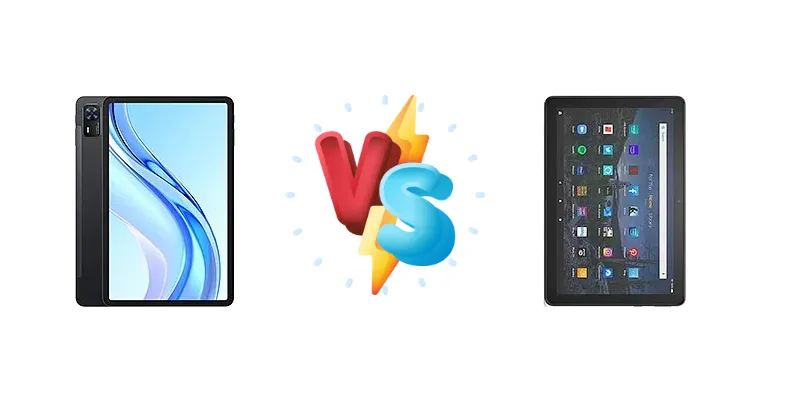
The tablet market offers a wide range of options, but finding the right balance between performance, battery life, and price can be challenging. We pit the Doogee Tab E3+ against the Amazon Fire HD 10 Plus (2021) – two tablets targeting the budget-conscious consumer – to determine which delivers the best overall experience. The Doogee focuses on raw processing power, while the Fire HD 10 Plus leverages Amazon’s ecosystem and wireless charging.
🏆 Quick Verdict
For users prioritizing sustained performance and exceptional battery life, the Doogee Tab E3+ emerges as the clear winner. Its newer Mediatek Helio G100 chipset and impressive 93-hour endurance significantly outperform the Fire HD 10 Plus, making it ideal for demanding tasks and extended use. However, the Fire HD 10 Plus remains a viable option for those deeply invested in the Amazon ecosystem.
| Network |
|---|
| 2G bands | GSM 850 / 900 / 1800 / 1900 | N/A |
| 3G bands | HSDPA 800 / 850 / 900 / 1700(AWS) / 1900 / 2100 | - |
| 4G bands | 1, 2, 3, 4, 5, 7, 8, 12, 17, 18, 19, 20, 25, 26, 28, 34, 38, 39, 40, 41, 66 | - |
| EDGE | - | No |
| GPRS | - | No |
| Speed | HSPA, LTE | - |
| Technology | GSM / HSPA / LTE | No cellular connectivity |
| Launch |
|---|
| Announced | 2025, May | 2021, April 27. Released 2021, May 26 |
| Status | Available. Released 2025, May | Discontinued |
| Body |
|---|
| Dimensions | 278.8 x 174.3 x 7.7 mm (10.98 x 6.86 x 0.30 in) | 247 x 166 x 9.2 mm (9.72 x 6.54 x 0.36 in) |
| SIM | Nano-SIM + Nano-SIM | No |
| Weight | 583 g (1.29 lb) | 468 g (1.03 lb) |
| Display |
|---|
| Protection | Mohs level 5 | Aluminosilicate glass |
| Resolution | 1200 x 2000 pixels, 5:3 ratio (~195 ppi density) | 1920 x 1200 pixels, 16:10 ratio (~224 ppi density) |
| Size | 11.97 inches, 407.8 cm2 (~83.9% screen-to-body ratio) | 10.1 inches, 295.8 cm2 (~72.1% screen-to-body ratio) |
| Type | IPS LCD, 90Hz, 380 nis | IPS LCD |
| Platform |
|---|
| CPU | Octa-core (2x2.2 GHz Cortex-A76 & 6x2.0 GHz Cortex-A55) | Octa-core (4x2.0 GHz Cortex-A73 & 4x2.0 GHz Cortex-A53) |
| Chipset | Mediatek Helio G100 (6 nm) | Mediatek MT8183 Helio P60T (12 nm) |
| GPU | Mali-G57 MC2 | Mali-G72 MP3 |
| OS | Android 15 | Android 9.0 (Pie), Fire OS 7 |
| Memory |
|---|
| Card slot | microSDXC (uses shared SIM slot) | microSDXC (dedicated slot) |
| Internal | 256GB 8GB RAM | 32GB 4GB RAM, 64GB 4GB RAM |
| | - | eMMC 5.1 |
| Main Camera |
|---|
| Features | LED flash, HDR | - |
| Single | 13 MP, f/2.2, AF | 5 MP |
| Video | 1440p@30/60fps, 1080p@30/60fps | 720p |
| Selfie camera |
|---|
| Single | 5 MP, f/2.4 | 2 MP |
| Video | 1440p@30fps, 1080p@30/120fps | 720p |
| Sound |
|---|
| 3.5mm jack | - | Yes |
| 35mm jack | No | Yes |
| Loudspeaker | Yes, with stereo speakers (4 speakers) | Yes, with stereo speakers |
| Comms |
|---|
| Bluetooth | 5.0, A2DP, LE | 5.0, A2DP, LE |
| NFC | No | No |
| Positioning | GPS, GALILEO, GLONASS, BDS | No |
| Radio | FM radio | No |
| USB | USB Type-C | USB Type-C 2.0, OTG |
| WLAN | Wi-Fi 802.11 a/b/g/n/ac, dual-band | Wi-Fi 802.11 a/b/g/n/ac, dual-band |
| Features |
|---|
| Sensors | Accelerometer, compass | Accelerometer |
| | - | Text-to-Speech English-language content reader |
| Battery |
|---|
| Charging | 18W wired
2.5W reverse wired | Wireless |
| Type | 8800 mAh | Li-Ion |
| Misc |
|---|
| Colors | Black, Gray, Blue | Slate |
| Models | - | T76N2P |
| Price | About 250 EUR | About 150 EUR |
| EU LABEL |
|---|
| Battery | 93:08h endurance, 1000 cycles | - |
| Energy | Class F | - |
| Free fall | Class E (52 falls) | - |
| Repairability | Class B | - |
Doogee Tab E3+
- Exceptional battery life (93:08h endurance)
- More powerful processor (Helio G100)
- Efficient 6nm fabrication process
- Display specs are unknown
- Lacks wireless charging
Amazon Fire HD 10 Plus (2021)
- Wireless charging convenience
- Integration with Amazon ecosystem
- Lower price point (potentially)
- Older, less efficient processor (Helio P60T)
- Significantly shorter battery life
- 12nm process leads to higher heat
Display Comparison
Neither device boasts a cutting-edge display. While specific display specs (resolution, brightness) are absent for the Doogee Tab E3+, the Fire HD 10 Plus features a 10.1-inch IPS LCD. The key difference lies in the underlying architecture impacting performance. The older 12nm process of the Fire HD 10 Plus’s chipset likely contributes to lower overall efficiency, potentially impacting display brightness and color accuracy over extended use. The Doogee’s 6nm Helio G100 suggests better power management, potentially allowing for a brighter and more consistent display experience, though this requires further testing.
Camera Comparison
Neither tablet is positioned as a photography powerhouse. Given the context data, a detailed camera comparison is limited. However, it’s safe to assume both tablets feature modest camera setups geared towards video calls and casual snapshots. The absence of specific sensor details suggests neither device will excel in low-light conditions or offer advanced photographic features. Focusing on the chipset, the Doogee’s more powerful ISP (Image Signal Processor) within the Helio G100 *could* offer slightly improved image processing capabilities, but the difference is unlikely to be substantial.
Performance
The performance gap is the most significant differentiator. The Doogee Tab E3+ utilizes the Mediatek Helio G100 (6nm) with an octa-core CPU configuration (2x2.2 GHz Cortex-A76 & 6x2.0 GHz Cortex-A55). This is a substantial upgrade over the Amazon Fire HD 10 Plus’s Mediatek MT8183 Helio P60T (12nm) and its octa-core CPU (4x2.0 GHz Cortex-A73 & 4x2.0 GHz Cortex-A53). The Cortex-A76 cores in the Doogee offer a significant architectural advantage over the Cortex-A73 cores in the Fire HD 10 Plus, translating to faster single-core and multi-core performance. The 6nm fabrication process further enhances efficiency, reducing heat and enabling sustained performance. This benefits users engaged in gaming, video editing, or running multiple applications simultaneously.
Battery Life
Battery life is where the Doogee Tab E3+ truly shines. Its reported 93:08h endurance is exceptional for a tablet in this price range. While the Fire HD 10 Plus offers the convenience of wireless charging, it lacks the sheer longevity of the Doogee. The 6nm process of the Helio G100 contributes significantly to this advantage, allowing the Doogee to extract more usage from its battery. The Doogee also offers 2.5W reverse wired charging, a niche feature for topping up smaller devices, absent on the Fire HD 10 Plus. The Fire HD 10 Plus’s charging speed is not specified, but the Doogee’s 18W wired charging provides a faster replenishment option.
Buying Guide
Buy the Doogee Tab E3+ if you need a tablet capable of handling demanding applications, multitasking, and extended gaming sessions without frequent charging. It’s the better choice for students, professionals, or anyone who values performance and longevity. Buy the Amazon Fire HD 10 Plus (2021) if you primarily consume media, rely heavily on Amazon services (Prime Video, Kindle), and appreciate the convenience of wireless charging, even if it means sacrificing some processing power and battery endurance.
Frequently Asked Questions
❓ Will the Doogee Tab E3+ handle demanding games like Genshin Impact or Call of Duty Mobile?
The Mediatek Helio G100 in the Doogee Tab E3+ is a capable chipset, but demanding games will likely require reduced graphics settings for a smooth experience. The 6nm process and efficient CPU architecture will help mitigate thermal throttling, allowing for longer gaming sessions compared to the Fire HD 10 Plus.
❓ How does the Amazon Fire HD 10 Plus’s integration with Amazon services affect the user experience?
The Fire HD 10 Plus is deeply integrated with Amazon’s ecosystem. Users benefit from seamless access to Prime Video, Kindle, Amazon Music, and other Amazon services. However, this integration comes at the cost of a heavily customized Android experience (Fire OS) that lacks the full Google Play Store and may include Amazon’s advertising.
❓ What is the practical impact of the 6nm vs 12nm fabrication process?
A smaller fabrication process (6nm vs 12nm) generally translates to improved power efficiency and reduced heat generation. This means the Doogee Tab E3+’s Helio G100 will consume less power for the same level of performance, resulting in longer battery life and less thermal throttling under sustained load.