
Doogee Tab E3 vs. Lenovo Tab M8 (4th Gen): A Deep Dive into Performance and Battery Life
| Phones Images | |||||
|---|---|---|---|---|---|
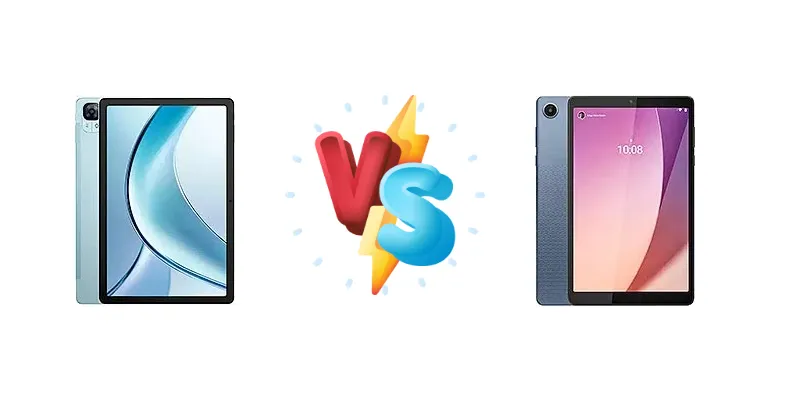
|
🏆 Quick Verdict
For users prioritizing performance and longevity, the Doogee Tab E3 emerges as the clear winner. Its Mediatek Helio G100 chipset, built on a 6nm process, offers a substantial performance advantage over the Lenovo Tab M8’s Helio A22, coupled with exceptional 93-hour battery endurance. While the M8 remains a viable option for basic tasks, the E3 provides a smoother, more future-proof experience.
| PHONES | ||
|---|---|---|
| Phone Names | Doogee Tab E3 | Lenovo Tab M8 (4th Gen) |
| Network | ||
|---|---|---|
| 2G bands | GSM 850 / 900 / 1800 / 1900 | GSM 850 / 900 / 1800 / 1900 |
| 3G bands | HSDPA 800 / 850 / 900 / 1700(AWS) / 1900 / 2100 | HSDPA 800 / 850 / 900 / 1900 / 2100 |
| 4G bands | 1, 2, 3, 4, 5, 7, 8, 12, 17, 18, 19, 20, 25, 26, 28, 34, 38, 39, 40, 41, 66 | 1, 2, 3, 4, 5, 7, 8, 19, 20, 26, 28, 38, 40, 41 |
| Speed | HSPA, LTE | HSPA, LTE - cellular model only |
| Technology | GSM / HSPA / LTE | GSM / HSPA / LTE |
| Launch | ||
|---|---|---|
| Announced | 2025, May | 2023, April 22 |
| Status | Available. Released 2025, May | Available. Released 2023, May |
| Body | ||
|---|---|---|
| Build | - | Glass front, plastic frame, plastic back |
| Dimensions | 257.3 x 168.8 x 7.5 mm (10.13 x 6.65 x 0.30 in) | 197.8 x 119.8 x 9 mm (7.79 x 4.72 x 0.35 in) |
| SIM | Nano-SIM + Nano-SIM | Nano-SIM (cellular model only) |
| Weight | 512 g (1.13 lb) | 320 g (11.29 oz) |
| Display | ||
|---|---|---|
| Protection | Mohs level 5 | - |
| Resolution | 1200 x 1920 pixels, 16:10 ratio (~207 ppi density) | 800 x 1280 pixels, 16:10 ratio (~189 ppi density) |
| Size | 10.95 inches, 347.7 cm2 (~80.0% screen-to-body ratio) | 8.0 inches, 185.6 cm2 (~78.3% screen-to-body ratio) |
| Type | IPS LCD, 90Hz, 330 nis | IPS LCD, 350 nits (typ) |
| Platform | ||
|---|---|---|
| CPU | Octa-core (2x2.2 GHz Cortex-A76 & 6x2.0 GHz Cortex-A55) | Octa-core (4x2.3 GHz Cortex-A53 & 4x1.6 GHz Cortex-A53) |
| Chipset | Mediatek Helio G100 (6 nm) | Mediatek MT8768 Helio A22 (12 nm) |
| GPU | Mali-G57 MC2 | PowerVR GE8320 |
| OS | Android 15 | Android 13 |
| Memory | ||
|---|---|---|
| Card slot | microSDXC (uses shared SIM slot) | microSDXC (dedicated slot) |
| Internal | 256GB 8GB RAM | 32GB 3GB RAM, 64GB 4GB RAM |
| Main Camera | ||
|---|---|---|
| Features | LED flash, HDR | - |
| Single | 13 MP, f/2.2, AF | 5 MP, AF or 8MP, AF |
| Video | 1440p@30/60fps, 1080p@30/60fps | 1080p |
| Selfie camera | ||
|---|---|---|
| Single | 5 MP, f/2.4 | 2 MP |
| Video | 1440p@30fps, 1080p@30/120fps | 720p |
| Sound | ||
|---|---|---|
| 35mm jack | Yes | Yes |
| Loudspeaker | Yes, with stereo speakers | Yes, with dual speakers |
| Comms | ||
|---|---|---|
| Bluetooth | 5.0, A2DP, LE | 5.0, A2DP, LE |
| NFC | No | No |
| Positioning | GPS, GALILEO, GLONASS, BDS | GPS, GLONASS, BDS - cellular model only |
| Radio | FM radio | FM radio |
| USB | USB Type-C | USB Type-C 2.0, OTG |
| WLAN | Wi-Fi 802.11 a/b/g/n/ac, dual-band | Wi-Fi 802.11 a/b/g/n/ac, dual-band, Wi-Fi Direct |
| Features | ||
|---|---|---|
| Sensors | Accelerometer, compass | Accelerometer, proximity |
| Battery | ||
|---|---|---|
| Charging | 18W wired 2.5W reverse wired | 10W wired |
| Type | 8800 mAh | Li-Po 5100 mAh |
| Misc | ||
|---|---|---|
| Colors | Black, Gray, Blue | Abyss blue, Arctic grey |
| Price | About 220 EUR | About 150 EUR |
| EU LABEL | ||
|---|---|---|
| Battery | 93:08h endurance, 1000 cycles | - |
| Energy | Class F | - |
| Free fall | Class E (52 falls) | - |
| Repairability | Class B | - |
Doogee Tab E3
- Significantly faster processor (Helio G100)
- Exceptional battery life (93:08h endurance)
- Faster 18W charging with reverse wired charging
- Display specifications are unknown
- Camera details are limited
Lenovo Tab M8 (4th Gen)
- More affordable price point
- Simple and user-friendly interface
- Lightweight and portable
- Outdated processor (Helio A22)
- Slower 10W charging
- Limited performance for demanding tasks
Display Comparison
Neither device provides display specifications, so a direct comparison is limited. However, given the Tab E3’s focus on performance, it’s reasonable to expect a slightly higher resolution or brighter panel than the Tab M8. The M8, being a more basic offering, likely prioritizes cost savings over display quality. Bezels are likely similar on both, reflecting their budget positioning.
Camera Comparison
Without specific camera details beyond the chipsets, a detailed comparison is impossible. Both tablets likely feature basic camera setups geared towards video calls rather than photography. It’s safe to assume image quality will be similar, and neither device will excel in low-light conditions. The focus should be on video conferencing capabilities rather than photographic prowess.
Performance
The performance gap between these tablets is substantial. The Doogee Tab E3’s Mediatek Helio G100 (6nm) features a more modern architecture – two Cortex-A76 cores clocked at 2.2 GHz and six Cortex-A55 cores at 2.0 GHz – compared to the Lenovo Tab M8’s Helio A22 (12nm) with its four Cortex-A53 cores at 2.3 GHz and another four at 1.6 GHz. The 6nm process of the G100 translates to improved power efficiency and thermal management, reducing throttling during sustained workloads. The A76 cores in the E3 offer significantly higher single-core performance, crucial for responsive app launches and smoother UI navigation. The M8’s older A53 cores will struggle with demanding applications.
Battery Life
The Doogee Tab E3 boasts an impressive 93:08h endurance, a testament to its efficient chipset and optimized software. While the Tab M8’s battery capacity is unknown, its 10W charging is significantly slower than the E3’s 18W wired charging. The E3 also offers 2.5W reverse wired charging, a useful feature for topping up smaller devices. The combination of longer endurance and faster charging makes the E3 the superior choice for users who rely on their tablet throughout the day.
Buying Guide
Buy the Doogee Tab E3 if you need a tablet capable of handling multitasking, moderate gaming, and extended use without frequent charging. It’s ideal for students, travelers, or anyone who demands more than basic functionality. Buy the Lenovo Tab M8 (4th Gen) if you prioritize simplicity and affordability for light tasks like web browsing, video calls, and casual media consumption, and are willing to compromise on performance and battery life.