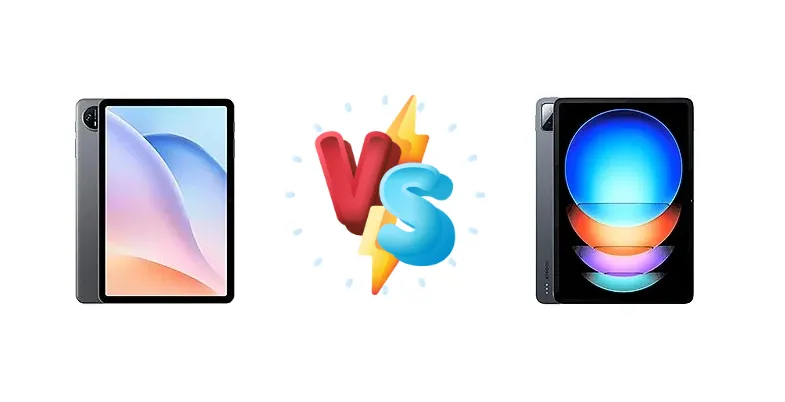
The Android tablet market is heating up, with options ranging from ultra-affordable to premium flagships. We're pitting the Doogee Tab A9+, a budget-focused device prioritizing longevity, against the Xiaomi Pad 6S Pro 12.4, a powerhouse boasting cutting-edge performance and rapid charging. This comparison will dissect their key differences to help you determine which tablet best suits your needs and budget.
🏆 Quick Verdict
For the average user prioritizing raw performance and a premium experience, the Xiaomi Pad 6S Pro 12.4 is the clear winner. Its Snapdragon 8 Gen 2 chipset and stunning display offer a significant leap in capabilities. However, the Doogee Tab A9+ provides exceptional battery endurance and a lower price point, making it a viable option for those on a tighter budget.
| Network |
|---|
| 2G bands | N/A | N/A |
| 3G bands | N/A | N/A |
| 4G bands | N/A | - |
| EDGE | No | N/A |
| GPRS | No | N/A |
| Technology | No cellular connectivity | No cellular connectivity |
| Launch |
|---|
| Announced | 2025, May | 2024, February 22 |
| Status | Available. Released 2025, May | Available. Released 2024, February 22 |
| Body |
|---|
| Build | - | Glass front (Gorilla Glass 5), aluminum frame, aluminum back |
| Dimensions | 257.3 x 168.8 x 8.1 mm (10.13 x 6.65 x 0.32 in) | 278.7 x 191.6 x 6.3 mm (10.97 x 7.54 x 0.25 in) |
| SIM | No | No |
| Weight | 644 g (1.42 lb) | 590 g (1.30 lb) |
| Display |
|---|
| Protection | Mohs level 5 | Corning Gorilla Glass 5 |
| Resolution | 800 x 1280 pixels, 16:10 ratio (~137 ppi density) | 2032 x 3048 pixels, 3:2 ratio (~295 ppi density) |
| Size | 11.0 inches, 350.9 cm2 (~80.8% screen-to-body ratio) | 12.4 inches, 457.8 cm2 (~85.7% screen-to-body ratio) |
| Type | IPS LCD, 90Hz | IPS LCD, 68B colors, 144Hz, HDR10, Dolby Vision, 900 nits (peak) |
| Platform |
|---|
| CPU | Octa-core (2x1.6 GHz Cortex-A75 & 6x1.6 GHz Cortex-A55) | Octa-core (1x3.2 GHz Cortex-X3 & 2x2.8 GHz Cortex-A715 & 2x2.8 GHz Cortex-A710 & 3x2.0 GHz Cortex-A510) |
| Chipset | Unisoc T7200 (12 nm) | Qualcomm SM8550-AB Snapdragon 8 Gen 2 (4 nm) |
| GPU | Mali-G57 MP1 | Adreno 740 |
| OS | Android 15 | Android 14, up to 3 major Android upgrades, HyperOS |
| Memory |
|---|
| Card slot | microSDXC (dedicated slot) | No |
| Internal | 64GB 4GB RAM | 256GB 8GB RAM, 256GB 12GB RAM, 512GB 12GB RAM, 1TB 16GB RAM |
| Main Camera |
|---|
| Dual | - | 50 MP, f/1.8, (wide), 1/2.76", 0.64µm, PDAF
Auxiliary lens |
| Features | LED flash | LED flash, HDR, panorama |
| Single | 13 MP | - |
| Video | 1080p@30fps | 4K@30/60fps, 1080p@30/60fps |
| Selfie camera |
|---|
| Single | 5 MP | 32 MP, f/2.2, (wide), 1/3.6", 0.61µm |
| Video | Yes | 1080p@30fps |
| Sound |
|---|
| 35mm jack | Yes | No |
| Loudspeaker | Yes, with stereo speakers | Yes, with stereo speakers (6 speakers) |
| Comms |
|---|
| Bluetooth | 5.0, A2DP, LE | 5.3, A2DP, LE, LHDC |
| NFC | No | Yes (file transfer only) |
| Positioning | No | No |
| Radio | No | No |
| USB | USB Type-C | USB Type-C 3.2, accessory connector |
| WLAN | Wi-Fi 802.11 a/b/g/n/ac, dual-band | Wi-Fi 802.11 a/b/g/n/a/6/7, dual-band, Wi-Fi Direct |
| Features |
|---|
| Sensors | Accelerometer | Fingerprint (side-mounted), accelerometer, gyro, proximity (accessories only), compass |
| Battery |
|---|
| Charging | 10W wired | 120W wired, PD3.0, QC4, 45% in 10 min, 100% in 35 min |
| Type | 8580 mAh | 10000 mAh |
| Misc |
|---|
| Colors | Black, Gray, Blue | Black, Blue, Green |
| Models | - | 24018RPACG |
| Price | About 140 EUR | About 700 EUR |
| SAR EU | - | 0.99 W/kg (body) |
| EU LABEL |
|---|
| Battery | 92:32h endurance, 800 cycles | - |
| Energy | Class E | - |
| Free fall | Class C (104 falls) | - |
| Repairability | Class B | - |
Doogee Tab A9+
- Exceptional battery endurance (92:32h)
- Long-term battery health (800 cycles)
- More affordable price point
- Significantly weaker performance
- Slower charging speed (10W)
- Likely lower quality display
Xiaomi Pad 6S Pro 12.4
- Flagship-level performance (Snapdragon 8 Gen 2)
- Fast 120W charging (0-100% in 35 min)
- High-brightness, high-contrast display (848 nits, 1378:1)
- Shorter battery life (11:14h)
- Higher price
- Potential for thermal throttling under sustained load (though mitigated by 4nm process)
Display Comparison
The Xiaomi Pad 6S Pro 12.4 immediately distinguishes itself with a superior display. While the Doogee Tab A9+’s specifications are not provided, the Xiaomi boasts a measured peak brightness of 848 nits and a 1378:1 contrast ratio, ensuring excellent visibility even in bright environments and rich, detailed visuals. The larger screen size of the Xiaomi Pad 6S Pro (12.4 inches vs. assumed smaller on the Doogee) further enhances the viewing experience. The absence of display specs for the Doogee suggests a more basic panel, likely with lower brightness and contrast.
Camera Comparison
Camera details for the Doogee Tab A9+ are unavailable, making a direct comparison difficult. However, given its budget positioning, it’s likely to feature a simpler camera system. The Xiaomi Pad 6S Pro 12.4’s camera specifications are also not provided, but Xiaomi generally focuses on image quality in its Pad series. The absence of details suggests neither tablet is positioned as a photography powerhouse, but the Xiaomi likely has a more refined image processing pipeline.
Performance
The performance gap is substantial. The Xiaomi Pad 6S Pro 12.4 is powered by the Qualcomm Snapdragon 8 Gen 2 (4nm), featuring a prime Cortex-X3 core clocked at 3.2 GHz. This is a flagship-level chipset designed for demanding tasks. In contrast, the Doogee Tab A9+ utilizes the Unisoc T7200 (12nm) with a more modest CPU configuration (2x1.6 GHz Cortex-A75 & 6x1.6 GHz Cortex-A55). The 4nm process node of the Snapdragon 8 Gen 2 offers significantly better power efficiency and thermal performance, translating to sustained performance under load. The Xiaomi’s LPDDR5x RAM (spec not provided for Doogee) further contributes to its responsiveness and multitasking capabilities.
Battery Life
Battery life is where the Doogee Tab A9+ shines. Its reported 92:32h endurance is exceptional, suggesting it can easily last multiple days of moderate use. The Xiaomi Pad 6S Pro 12.4, with an active use score of 11:14h, offers respectable battery life, but falls significantly short of the Doogee. However, the Xiaomi compensates with incredibly fast 120W wired charging, capable of reaching 45% charge in just 10 minutes and 100% in 35 minutes. The Doogee Tab A9+ is limited to 10W charging, meaning a full charge will take considerably longer. The Doogee’s 800 charge cycles suggest a focus on long-term battery health.
Buying Guide
Buy the Doogee Tab A9+ if you need a tablet primarily for extended media consumption, reading, or basic productivity tasks and value long battery life above all else. Its 92:32h endurance is ideal for travel or situations where frequent charging isn't possible. Buy the Xiaomi Pad 6S Pro 12.4 if you demand top-tier performance for gaming, demanding applications, or creative workflows, and appreciate a vibrant, high-brightness display coupled with incredibly fast charging.
Frequently Asked Questions
❓ How will the Unisoc T7200 in the Doogee Tab A9+ handle demanding games like Genshin Impact?
The Unisoc T7200 is not designed for high-end gaming. While it can run less demanding titles, Genshin Impact will likely require significant graphical settings reductions and may still experience frame rate drops. The Xiaomi Pad 6S Pro 12.4, with its Snapdragon 8 Gen 2, will provide a much smoother and more enjoyable gaming experience.
❓ Is the 120W charging on the Xiaomi Pad 6S Pro 12.4 safe for long-term battery health?
While 120W charging is incredibly fast, Xiaomi incorporates intelligent charging algorithms to minimize heat generation and prevent overcharging. These algorithms slow down the charging rate as the battery approaches full capacity, mitigating potential long-term degradation. The Doogee Tab A9+'s slower 10W charging also contributes to battery health, but the convenience of the Xiaomi's rapid charging is a significant benefit.
❓ Does the Doogee Tab A9+ support external storage via microSD card?
This information is not provided in the context data. However, Doogee often includes microSD card slots in their devices, particularly in budget-oriented models. Checking the official product specifications is recommended to confirm support.