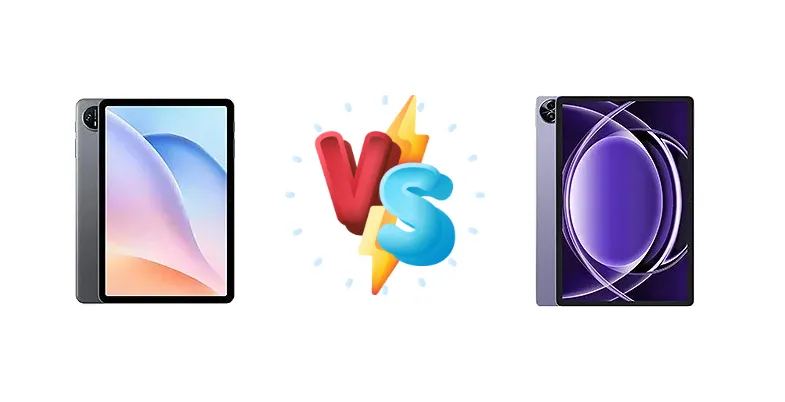
The budget tablet market is heating up, with the Doogee Tab A9+ and Realme Pad 2 Lite vying for attention. Both aim to deliver a capable Android experience without breaking the bank, but they take different approaches. The Doogee prioritizes longevity with a massive battery and cycle count, while the Realme focuses on a more modern chipset for improved performance. This comparison dives deep into the specs to determine which tablet best suits your needs.
🏆 Quick Verdict
For the average user prioritizing everyday tasks and occasional gaming, the Realme Pad 2 Lite emerges as the winner. Its Mediatek Helio G99 chipset, built on a 6nm process, offers a noticeable performance advantage over the Doogee’s Unisoc T7200. While the Doogee boasts impressive battery endurance, the Realme’s faster charging mitigates the difference for most users.
| Network |
|---|
| 2G bands | N/A | GSM 850 / 900 / 1800 / 1900 |
| 3G bands | N/A | HSDPA 850 / 900 / 2100 |
| 4G bands | N/A | 1, 3, 5, 7, 8, 20, 28, 38, 40, 41 |
| EDGE | No | - |
| GPRS | No | - |
| Speed | - | HSPA, LTE |
| Technology | No cellular connectivity | GSM / HSPA / LTE |
| Launch |
|---|
| Announced | 2025, May | 2024, September 13 |
| Status | Available. Released 2025, May | Available. Released 2024, September 26 |
| Body |
|---|
| Dimensions | 257.3 x 168.8 x 8.1 mm (10.13 x 6.65 x 0.32 in) | 258 x 169.5 x 8.3 mm (10.16 x 6.67 x 0.33 in) |
| SIM | No | No |
| Weight | 644 g (1.42 lb) | 525 g (1.16 lb) |
| Display |
|---|
| Protection | Mohs level 5 | - |
| Resolution | 800 x 1280 pixels, 16:10 ratio (~137 ppi density) | 1200 x 1920 pixels, 16:10 ratio (~207 ppi density) |
| Size | 11.0 inches, 350.9 cm2 (~80.8% screen-to-body ratio) | 10.95 inches, 347.7 cm2 (~79.5% screen-to-body ratio) |
| Type | IPS LCD, 90Hz | IPS LCD, 1B colors, 90Hz, 450 nits (peak) |
| Platform |
|---|
| CPU | Octa-core (2x1.6 GHz Cortex-A75 & 6x1.6 GHz Cortex-A55) | Octa-core (2x2.2 GHz Cortex-A76 & 6x2.0 GHz Cortex-A55) |
| Chipset | Unisoc T7200 (12 nm) | Mediatek Helio G99 (6 nm) |
| GPU | Mali-G57 MP1 | Mali-G57 MC2 |
| OS | Android 15 | Android 14, Realme UI 5.0 for Pad |
| Memory |
|---|
| Card slot | microSDXC (dedicated slot) | Unspecified |
| Internal | 64GB 4GB RAM | 128GB 4GB RAM, 128GB 8GB RAM |
| Main Camera |
|---|
| Features | LED flash | Panorama |
| Single | 13 MP | 8 MP, f/2.0 |
| Video | 1080p@30fps | 1080p@30fps |
| Selfie camera |
|---|
| Features | - | Panorama |
| Single | 5 MP | 5 MP, f/2.2 |
| Video | Yes | 1080p@30fps |
| Sound |
|---|
| 35mm jack | Yes | No |
| Loudspeaker | Yes, with stereo speakers | Yes, with stereo speakers (4 speakers) |
| Comms |
|---|
| Bluetooth | 5.0, A2DP, LE | 5.2, A2DP, LE |
| NFC | No | No |
| Positioning | No | GPS, GALILEO, GLONASS, BDS |
| Radio | No | No |
| USB | USB Type-C | USB Type-C |
| WLAN | Wi-Fi 802.11 a/b/g/n/ac, dual-band | Wi-Fi 802.11 a/b/g/n/ac, dual-band |
| Features |
|---|
| Sensors | Accelerometer | Accelerometer |
| Battery |
|---|
| Charging | 10W wired | 15W wired |
| Type | 8580 mAh | 8300 mAh |
| Misc |
|---|
| Colors | Black, Gray, Blue | Nebula Purple, Space Grey |
| Models | - | RMP2402 |
| Price | About 140 EUR | About 160 EUR |
| EU LABEL |
|---|
| Battery | 92:32h endurance, 800 cycles | - |
| Energy | Class E | - |
| Free fall | Class C (104 falls) | - |
| Repairability | Class B | - |
Doogee Tab A9+
- Exceptional battery endurance (92:32h)
- High charge cycle count (800 cycles) for long-term battery health
- Potentially lower operating temperatures due to less powerful chipset
- Slower processor (Unisoc T7200)
- Slower charging speed (10W)
- Likely less responsive user experience
Realme Pad 2 Lite
- More powerful processor (Helio G99)
- Faster charging speed (15W)
- More efficient 6nm chipset
- Potentially shorter battery life compared to Doogee
- May experience more thermal throttling under heavy load
- Lower advertised charge cycle count (assumed)
Display Comparison
Neither device’s display specifications are provided, so a direct comparison is limited. However, considering the price points, both likely utilize IPS LCD panels. The Realme Pad 2 Lite’s Helio G99 chipset suggests a potential for higher refresh rates (though unconfirmed), which would contribute to smoother scrolling and animations. The Doogee, lacking a more powerful chipset, is likely limited to a standard 60Hz refresh rate. Bezels are likely comparable, given the market segment.
Camera Comparison
Without detailed camera specifications, a meaningful comparison is difficult. Both tablets likely feature basic camera setups geared towards video calls and casual snapshots. Given the focus on affordability, image quality is unlikely to be a primary differentiator. It's safe to assume both will struggle in low-light conditions. The absence of information regarding sensor size or aperture makes it impossible to determine which might offer slightly better image quality.
Performance
The Realme Pad 2 Lite’s Mediatek Helio G99 (6nm) is the clear winner in terms of processing power. Its Cortex-A76 cores, clocked at 2.2 GHz, significantly outperform the Doogee Tab A9+’s Cortex-A75 cores (1.6 GHz). The 6nm fabrication process of the Helio G99 also translates to better power efficiency, meaning less heat generation and potentially less throttling under sustained load. While both utilize an octa-core configuration, the architectural differences and clock speeds give the Realme a substantial edge in CPU-intensive tasks and gaming.
Battery Life
The Doogee Tab A9+ boasts an impressive 92:32h endurance rating, suggesting exceptional battery life. However, the Realme Pad 2 Lite compensates with 15W wired charging, compared to the Doogee’s slower 10W charging. While the Doogee’s larger battery capacity (unspecified) will last longer on a single charge, the Realme’s faster charging allows for quicker top-ups. The Doogee’s advertised 800 charge cycles also indicate a focus on long-term battery health, a benefit for users planning to keep the tablet for several years.
Buying Guide
Buy the Doogee Tab A9+ if you absolutely need maximum battery life and a guaranteed number of charge cycles for long-term use, even at the expense of raw processing power. This is ideal for users who frequently travel or lack consistent access to power. Buy the Realme Pad 2 Lite if you prioritize a smoother, more responsive user experience for streaming, browsing, and light gaming. Its more efficient chipset and faster charging make it a better all-around choice for daily use.
Frequently Asked Questions
❓ Will the Unisoc T7200 in the Doogee Tab A9+ struggle with multitasking?
The Unisoc T7200 is a capable processor for basic tasks like browsing and video playback, but it may exhibit slowdowns when handling numerous apps simultaneously. Users who frequently switch between applications or run demanding software should consider the Realme Pad 2 Lite with its more powerful Helio G99.
❓ How long will it take to fully charge the Realme Pad 2 Lite from 0%?
With 15W charging, a full charge from 0% on the Realme Pad 2 Lite is estimated to take approximately 2.5 to 3 hours, assuming a typical battery capacity for this class of tablet. This is significantly faster than the Doogee Tab A9+'s 10W charging, which would likely take over 4 hours.
❓ Is the Mediatek Helio G99 chipset in the Realme Pad 2 Lite capable of playing demanding games?
The Helio G99 is a gaming-focused chipset and can handle many popular mobile games at medium to high settings. However, don't expect flagship-level performance. More graphically intensive titles may require reduced settings to maintain a smooth frame rate. The Doogee Tab A9+ will likely struggle with these same titles.