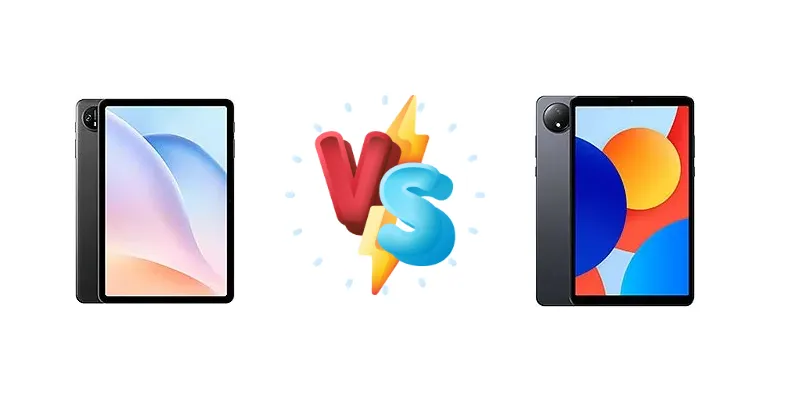
The budget tablet market is heating up, with the Doogee Tab A9 Pro and Xiaomi Redmi Pad SE 8.7 vying for attention. Both aim to deliver a capable tablet experience without breaking the bank, but they take different approaches to achieving this. This comparison dives deep into their specifications to determine which tablet offers the best value for your money.
🏆 Quick Verdict
For most users, the Xiaomi Redmi Pad SE 8.7 emerges as the better choice. Its Mediatek Helio G85 chipset provides a noticeable performance edge over the Doogee Tab A9 Pro’s Unisoc T310, and the faster 18W (International) charging significantly reduces downtime. While the Doogee boasts impressive battery endurance, the Redmi Pad SE’s overall responsiveness makes it more enjoyable for daily tasks.
| Network |
|---|
| 2G bands | N/A | GSM 850 / 900 / 1800 / 1900 |
| 3G bands | N/A | HSDPA 800 / 850 / 900 / 1700(AWS) / 1900 / 2100 |
| 4G bands | N/A | 1, 2, 3, 4, 5, 7, 8, 13, 18, 19, 20, 26, 28, 38, 40, 41, 66 |
| EDGE | No | - |
| GPRS | No | - |
| Speed | - | HSPA, LTE - cellular model only |
| Technology | No cellular connectivity | GSM / HSPA / LTE |
| Launch |
|---|
| Announced | 2025, May | 2024, July 29 |
| Status | Available. Released 2025, May | Available. Released 2024, August 08 |
| Body |
|---|
| Build | - | Glass front (Gorilla Glass 3) |
| Dimensions | 242.5 x 160.9 x 9.7 mm (9.55 x 6.33 x 0.38 in) | 211.6 x 125.5 x 8.8 mm (8.33 x 4.94 x 0.35 in) |
| SIM | No | Nano-SIM + Nano-SIM (cellular model only) |
| Weight | 512 g (1.13 lb) | 370 / 373 / 375 g (13.05 oz) |
| Display |
|---|
| Protection | Mohs level 5 | Corning Gorilla Glass 3 |
| Resolution | 800 x 1280 pixels, 16:10 ratio (~149 ppi density) | 800 x 1340 pixels, 5:3 ratio (~179 ppi density) |
| Size | 10.1 inches, 295.8 cm2 (~75.8% screen-to-body ratio) | 8.7 inches, 214.9 cm2 (~80.9% screen-to-body ratio) |
| Type | IPS LCD | IPS LCD, 1B colors, 90Hz, 600 nits (HBM) |
| Platform |
|---|
| CPU | Quad-core (1x2.0 GHz Cortex-A75 & 3x1.8 GHz Cortex-A55) | Octa-core (2x2.0 GHz Cortex-A75 & 6x1.8 GHz Cortex-A55) |
| Chipset | Unisoc T310 (12 nm) | Mediatek Helio G85 (12 nm) |
| GPU | Mali-G52 | Mali-G52 MC2 |
| OS | Android 15 | Android 14, HyperOS |
| Memory |
|---|
| Card slot | microSDXC (dedicated slot) | microSDXC (dedicated slot) |
| Internal | 128GB 4GB RAM | 64GB 4GB RAM, 128GB 4GB RAM, 128GB 6GB RAM |
| Main Camera |
|---|
| Features | LED flash | LED flash |
| Single | 8 MP | 8 MP, f/2.0, (wide), 1/4.0", 1.12µm |
| Video | 1080p@30fps | 1080p@30fps |
| Selfie camera |
|---|
| Single | 5 MP | 5 MP, f/2.2, (wide), 1/5.0", 1.12µm |
| Video | Yes | 1080p@30fps |
| Sound |
|---|
| 35mm jack | Yes | Yes |
| Loudspeaker | Yes, with stereo speakers | Yes, with stereo speakers |
| Comms |
|---|
| Bluetooth | 5.0, A2DP, LE | 5.3, A2DP, LE |
| Infrared port | - | Yes |
| NFC | No | No |
| Positioning | No | GPS, GALILEO, GLONASS, BDS - cellular model only |
| Radio | No | FM radio |
| USB | USB Type-C | USB Type-C 2.0 |
| WLAN | Wi-Fi 802.11 a/b/g/n/ac, dual-band | Wi-Fi 802.11 a/b/g/n/ac, dual-band |
| Features |
|---|
| Sensors | Accelerometer | Accelerometer, proximity (accessories only), compass |
| Battery |
|---|
| Charging | 10W wired | 18W wired (Int'l)
10W wired (India) |
| Type | 6580 mAh | 6650 mAh |
| Misc |
|---|
| Colors | Black, Gray, Blue | Aurora Green (Forest Green), Sky Blue (Ocean Blue), Graphite Gray (Urban Grey) |
| Models | - | 220233L2G |
| Price | About 130 EUR | About 120 EUR |
| SAR | - | 0.90 W/kg (head) 0.65 W/kg (body) |
| SAR EU | - | 0.40 W/kg (head) 0.99 W/kg (body) |
| EU LABEL |
|---|
| Battery | 92:32h endurance, 800 cycles | - |
| Energy | Class E | - |
| Free fall | Class C (104 falls) | - |
| Repairability | Class B | - |
Doogee Tab A9 Pro
- Exceptional battery life (92:32h endurance)
- Long-term battery health (800 charge cycles)
- Potentially lower price point
- Slower processor (Unisoc T310)
- Slow charging speed (10W)
- Likely less responsive user experience
Xiaomi Redmi Pad SE 8.7
- Faster processor (Helio G85)
- Faster charging (18W International)
- More responsive multitasking
- Potentially shorter battery life
- May be slightly more expensive
- Battery cycle count not specified
Display Comparison
Neither device boasts a particularly high-end display. Both are likely utilizing IPS LCD panels, common in this price bracket. Detailed display specs (resolution, color gamut coverage, peak brightness) are missing, but the Redmi Pad SE’s 8.7-inch size offers a slightly more portable experience. The absence of high refresh rates on both tablets suggests they are geared towards content consumption rather than fast-paced gaming. Bezels are expected to be noticeable on both, impacting the overall immersive experience.
Camera Comparison
Camera performance is unlikely to be a deciding factor for either tablet. Details regarding camera sensors are absent, but budget tablets typically feature basic cameras for video calls and occasional snapshots. Focusing on the primary sensor is key; any secondary sensors (often 2MP macro lenses) are generally of limited utility. Image processing will likely be basic on both devices, prioritizing speed over image quality.
Performance
The core difference lies in the chipset. The Xiaomi Redmi Pad SE 8.7’s Mediatek Helio G85 is an octa-core processor (2x2.0 GHz Cortex-A75 & 6x1.8 GHz Cortex-A55), offering a significant advantage over the Doogee Tab A9 Pro’s Unisoc T310 quad-core (1x2.0 GHz Cortex-A75 & 3x1.8 GHz Cortex-A55). The extra cores in the Helio G85 translate to better multitasking and smoother performance in demanding applications. While both utilize the same Cortex-A75 and A55 core architecture, the sheer number of cores gives the Redmi Pad SE a clear edge. Thermal management is likely similar on both, given the 12nm fabrication process, but the Helio G85 will likely generate more heat under sustained load.
Battery Life
The Doogee Tab A9 Pro shines in battery endurance, boasting a claimed 92:32h of usage. This is likely due to the less power-hungry Unisoc T310 chipset. However, the Redmi Pad SE 8.7 compensates with faster charging – 18W (International) versus the Doogee’s 10W. While the exact battery capacity of the Redmi Pad SE is unknown, the faster charging significantly reduces downtime. The Doogee’s 800 charge cycles suggest a focus on long-term battery health, but the slower charging speed means topping up takes considerably longer.
Buying Guide
Buy the Doogee Tab A9 Pro if you prioritize *extreme* battery life and are willing to sacrifice some performance for it. This tablet is ideal for users who primarily consume media offline or need a device for extended reading sessions away from a power source. Buy the Xiaomi Redmi Pad SE 8.7 if you value a smoother, more responsive user experience and faster charging. This tablet is better suited for users who frequently multitask, play casual games, or rely on streaming services.
Frequently Asked Questions
❓ Does the Unisoc T310 in the Doogee Tab A9 Pro struggle with demanding apps like video editors or large spreadsheets?
Yes, the Unisoc T310 is a relatively low-power chipset. While it's sufficient for basic tasks like web browsing, email, and video playback, it will likely exhibit noticeable lag and slowdowns when running resource-intensive applications. The quad-core configuration and lower clock speeds limit its ability to handle complex workloads.
❓ Is the 18W charging on the Redmi Pad SE significantly faster than the 10W charging on the Doogee Tab A9 Pro in real-world use?
Absolutely. While both offer wired charging, the 18W charging (available in international markets) on the Redmi Pad SE will drastically reduce charging times. Expect a much quicker top-up from 0% to 100% compared to the Doogee Tab A9 Pro’s 10W charging, which will take considerably longer. This is a significant advantage for users who need to quickly recharge their tablet.
❓ Which tablet is better for playing casual games like Candy Crush or Angry Birds?
The Xiaomi Redmi Pad SE 8.7 is the better choice for casual gaming. The Helio G85 chipset provides a smoother and more responsive experience, even with graphically simple games. The Doogee Tab A9 Pro will likely be able to run these games, but may exhibit occasional stuttering or lag.