
Doogee T40 vs Nokia XR20: A Deep Dive into Rugged Smartphone Choices
| Phones Images | |||||
|---|---|---|---|---|---|
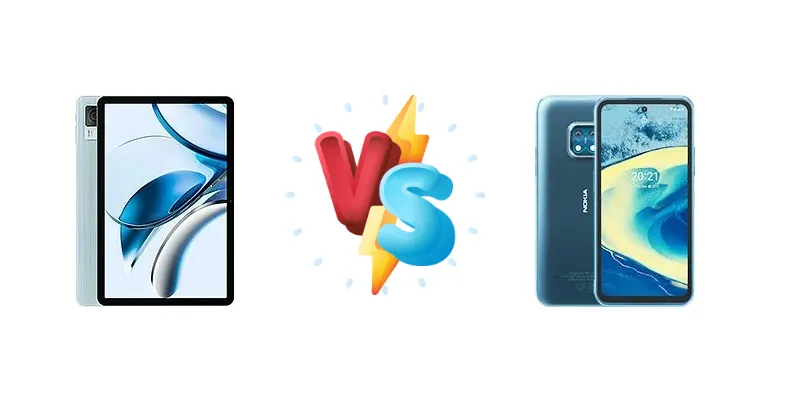
|
🏆 Quick Verdict
For users prioritizing sheer battery endurance and raw processing power for the price, the Doogee T40 emerges as the winner. Its Mediatek Helio G99 chipset and impressive 78:25h endurance rating outweigh the Nokia XR20’s 5G and wireless charging capabilities for most users seeking a reliable, long-lasting rugged device.
| PHONES | ||
|---|---|---|
| Phone Names | Doogee T40 | Nokia XR20 |
| Network | ||
|---|---|---|
| 2G bands | GSM 850 / 900 / 1800 / 1900 | GSM 850 / 900 / 1800 / 1900 |
| 3G bands | HSDPA 850 / 900 / 1700(AWS) / 1900 / 2100 | HSDPA 850 / 900 / 1700(AWS) / 1900 / 2100 |
| 4G bands | 1, 2, 3, 4, 5, 7, 8, 12, 17, 20, 25, 26, 28, 34, 38, 39, 40, 41, 66 | 1, 2, 3, 4, 5, 7, 8, 12, 13, 14, 20, 25, 26, 28, 30, 38, 40, 41, 48, 66, 71 |
| 5G bands | - | 2, 5, 25, 38, 41, 48, 66, 77, 78 SA/NSA |
| Speed | HSPA, LTE | HSPA, LTE, 5G |
| Technology | GSM / HSPA / LTE | GSM / CDMA / HSPA / EVDO / LTE / 5G |
| - | CDMA2000 1xEV-DO | |
| Launch | ||
|---|---|---|
| Announced | 2024, September | 2021, July 27 |
| Status | Available. Released 2024, September | Available. Released 2021, August 04 |
| Body | ||
|---|---|---|
| Build | Glass front, aluminum alloy frame, aluminum alloy back | - |
| Dimensions | 256.5 x 168 x 7.6 mm (10.10 x 6.61 x 0.30 in) | 171.6 x 81.5 x 10.6 mm (6.76 x 3.21 x 0.42 in) |
| SIM | Nano-SIM + Nano-SIM | · Nano-SIM· Nano-SIM + Nano-SIM |
| Weight | 530 g (1.17 lb) | 248 g (8.75 oz) |
| - | IP68 dust/water resistant (up to 1.5m for 60 min) Drop-to-concrete resistance from up to 1.8m MIL-STD-810H compliant | |
| Display | ||
|---|---|---|
| Protection | Mohs level 6 | Corning Gorilla Glass Victus |
| Resolution | 1600 x 2560 pixels, 16:10 ratio (~274 ppi density) | 1080 x 2400 pixels, 20:9 ratio (~395 ppi density) |
| Size | 11.0 inches, 350.9 cm2 (~81.4% screen-to-body ratio) | 6.67 inches, 107.4 cm2 (~76.8% screen-to-body ratio) |
| Type | IPS LCD | IPS LCD, 550 nits |
| Platform | ||
|---|---|---|
| CPU | Octa-core (2x2.2 GHz Cortex-A76 & 6x2.0 GHz Cortex-A55) | Octa-core (2x2.0 GHz Kryo 460 & 6x1.8 GHz Kryo 460) |
| Chipset | Mediatek Helio G99 (6 nm) | Qualcomm SM4350 Snapdragon 480 5G (8 nm) |
| GPU | Mali-G57 MC2 | Adreno 619 |
| OS | Android 14 | Android 11, upgradable to Android 13 |
| Memory | ||
|---|---|---|
| Card slot | microSDXC (uses shared SIM slot) | microSDXC (uses shared SIM slot) |
| Internal | 512GB 8GB RAM | 64GB 4GB RAM, 128GB 6GB RAM |
| Main Camera | ||
|---|---|---|
| Dual | - | 48 MP, f/1.8, (wide), 1/2.25", 0.8µm, PDAF 13 MP, f/2.4, 123˚ (ultrawide), 1/3.0", 1.12µm |
| Features | LED flash | Zeiss optics, Dual-LED dual-tone flash, second LED flash, HDR, panorama |
| Single | 16 MP | 8 MP, f/2.0 (wide), 1/4.0", 1.12µm |
| Video | 1440p@30fps, 1080p@30fps | 1080p@30fps |
| Selfie camera | ||
|---|---|---|
| Single | 8 MP | 8 MP, f/2.0 (wide), 1/4.0", 1.12µm |
| Video | 1080p@30fps | 1080p@30fps |
| Sound | ||
|---|---|---|
| 3.5mm jack | - | Yes |
| 35mm jack | Yes | Yes |
| Loudspeaker | Yes, with stereo speakers (4 speakers) | Yes, with stereo speakers |
| Comms | ||
|---|---|---|
| Bluetooth | 5.0, A2DP, LE | 5.1, A2DP, LE, aptX Adaptive |
| NFC | No | Yes |
| Positioning | GPS, GLONASS, GALILEO, BDS | GPS (L1+L5), GLONASS, BDS, GALILEO, QZSS, NavIC |
| Radio | FM radio | Unspecified |
| USB | USB Type-C 2.0, OTG, accessory connector | USB Type-C 3.0 |
| WLAN | Yes | Wi-Fi 802.11 a/b/g/n/ac/6, dual-band, Wi-Fi Direct |
| Features | ||
|---|---|---|
| Sensors | Accelerometer, proximity | Fingerprint (side-mounted), accelerometer, gyro, proximity, compass, barometer |
| Battery | ||
|---|---|---|
| Charging | 18W wired Reverse wired | 18W wired 15W wireless |
| Type | 8580 mAh | Li-Po 4630 mAh |
| Misc | ||
|---|---|---|
| Colors | Black, Gray, Blue | Ultra Blue, Granite Gray |
| Models | - | TA-1368, TA-1362 |
| Price | About 320 EUR | About 270 EUR |
| SAR EU | - | 1.13 W/kg (head) 1.43 W/kg (body) |
| EU LABEL | ||
|---|---|---|
| Battery | 78:25h endurance, 1100 cycles | - |
| Energy | Class G | - |
| Free fall | Class E (52 falls) | - |
| Repairability | Class B | - |
Doogee T40
- Exceptional battery life (78:25h endurance)
- More powerful processor (Helio G99)
- Higher CPU clock speeds for better performance
- Lacks 5G connectivity
- No wireless charging
Nokia XR20
- 5G connectivity for faster data speeds
- Wireless charging convenience
- Nokia’s software update commitment
- Less powerful processor (Snapdragon 480)
- Significantly shorter battery life
Display Comparison
Neither device’s display specifications are provided, so a direct comparison is limited. However, given the price points, we can assume both utilize LCD panels. The Nokia XR20, being a slightly more premium offering, *may* feature Gorilla Glass Victus for enhanced scratch resistance, a feature likely absent on the Doogee T40. The absence of high refresh rates is expected in this segment, focusing instead on visibility under direct sunlight and overall durability.
Camera Comparison
Without detailed camera specifications, a comprehensive comparison is challenging. However, the market segment suggests both phones will feature capable, but not exceptional, camera systems. The focus will likely be on practicality and reliability rather than cutting-edge image quality. The absence of information regarding sensor sizes and apertures prevents a definitive assessment, but the Doogee T40’s processing capabilities *may* allow for slightly faster image processing and better low-light performance, assuming similar sensor hardware.
Performance
The Doogee T40’s Mediatek Helio G99 (6nm) chipset presents a significant architectural advantage over the Nokia XR20’s Qualcomm Snapdragon 480 5G (8nm). The smaller 6nm process node generally translates to improved power efficiency and thermal performance. While the Snapdragon 480 offers 5G connectivity, the Helio G99’s octa-core configuration (2x2.2 GHz Cortex-A76 & 6x2.0 GHz Cortex-A55) is likely to deliver superior CPU performance, particularly in multi-threaded tasks. The XR20’s Kryo 460 cores, while efficient, operate at lower clock speeds (2x2.0 GHz & 6x1.8 GHz), resulting in a noticeable performance gap. This benefits users who engage in more demanding applications or light gaming.
Battery Life
The Doogee T40’s standout feature is its exceptional battery endurance, rated at 78:25 hours. This is significantly higher than what is typically seen in this price range. While both phones offer 18W wired charging, the Nokia XR20 adds the convenience of 15W wireless charging. However, the Doogee T40’s massive battery capacity and reported 1100 charge cycles suggest a longer overall lifespan and reduced need for frequent charging, making it ideal for users who prioritize longevity and minimal downtime. The XR20’s wireless charging is a convenience feature, but the T40’s endurance is a more substantial benefit.
Buying Guide
Buy the Doogee T40 if you need maximum battery life for extended outdoor use, frequent travel, or simply dislike frequent charging. Its Helio G99 chipset provides a noticeable performance edge for everyday tasks and light gaming. Buy the Nokia XR20 if you prioritize 5G connectivity for faster data speeds, appreciate the convenience of wireless charging, and value Nokia’s commitment to software updates and security.