
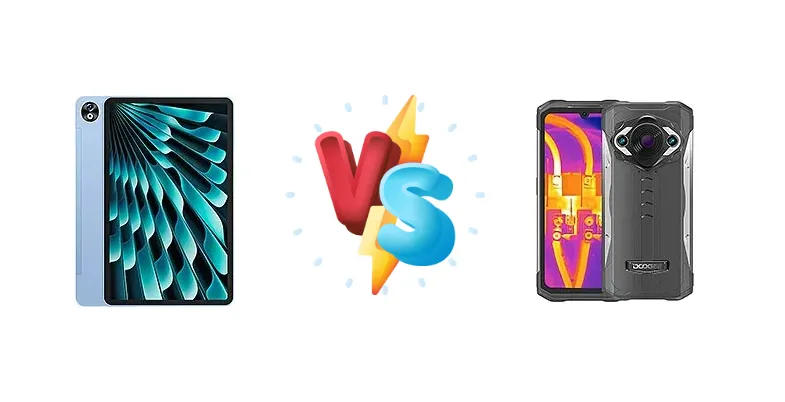
Doogee T40 Pro vs S98 Pro: Which Rugged Phone Reigns Supreme?
| Phones Images | |||||
|---|---|---|---|---|---|
|
🏆 Quick Verdict
For the average user prioritizing longevity and minimizing charging frequency, the Doogee T40 Pro is the clear winner. Its Helio G99 chipset, coupled with an astounding 59:53h endurance, outweighs the S98 Pro’s faster 33W charging, especially considering the S98 Pro uses a less efficient 12nm process.
| PHONES | ||
|---|---|---|
| Phone Names | Doogee T40 Pro | Doogee S98 Pro |
| Network | ||
|---|---|---|
| 2G bands | GSM 850 / 900 / 1800 / 1900 | GSM 850 / 900 / 1800 / 1900 |
| 3G bands | HSDPA 800 / 850 / 900 / 1700(AWS) / 1900 / 2100 | HSDPA 800 / 850 / 900 / 1700(AWS) / 1900 / 2100 |
| 4G bands | 1, 2, 3, 4, 5, 7, 8, 12, 17, 18, 19, 20, 25, 26, 28, 34, 38, 39, 40, 41, 66 | 1, 2, 3, 4, 5, 7, 8, 12, 13, 17, 18, 19, 20, 25, 26, 28, 34, 38, 39, 40, 41, 66 |
| Speed | HSPA, LTE | HSPA, LTE |
| Technology | GSM / HSPA / LTE | GSM / CDMA / HSPA / LTE |
| Launch | ||
|---|---|---|
| Announced | 2024, September | 2022, May 27 |
| Status | Available. Released 2024, September | Available. Released 2022, June 06 |
| Body | ||
|---|---|---|
| Build | Glass front, aluminum alloy frame, aluminum alloy back | - |
| Dimensions | 278.8 x 174.3 x 7.6 mm (10.98 x 6.86 x 0.30 in) | 172 x 82 x 15.5 mm (6.77 x 3.23 x 0.61 in) |
| SIM | Nano-SIM + Nano-SIM | Nano-SIM + Nano-SIM |
| Weight | 568 g (1.25 lb) | 320 g (11.29 oz) |
| Display | ||
|---|---|---|
| Protection | Mohs level 6 | Corning Gorilla Glass |
| Resolution | 1200 x 2000 pixels, 5:3 ratio (~194 ppi density) | 1080 x 2340 pixels, 19.5:9 ratio (~409 ppi density) |
| Size | 12.0 inches, 409.9 cm2 (~84.3% screen-to-body ratio) | 6.3 inches, 97.4 cm2 (~69.1% screen-to-body ratio) |
| Type | IPS LCD | IPS LCD, 500 nits (peak) |
| Platform | ||
|---|---|---|
| CPU | Octa-core (2x2.2 GHz Cortex-A76 & 6x2.0 GHz Cortex-A55) | Octa-core (2x2.05 GHz Cortex-A76 & 6x2.0 GHz Cortex-A55) |
| Chipset | Mediatek Helio G99 (6 nm) | Mediatek MT6781 Helio G96 (12 nm) |
| GPU | Mali-G57 MC2 | Mali-G57 MC2 |
| OS | Android 14 | Android 12 |
| Memory | ||
|---|---|---|
| Card slot | microSDXC (uses shared SIM slot) | microSDXC (dedicated slot) |
| Internal | 512GB 8GB RAM | 256GB 8GB RAM |
| Main Camera | ||
|---|---|---|
| Features | LED flash | Dual-LED flash, HDR, panorama |
| Single | 16 MP | - |
| Triple | - | 48 MP, f/1.8, (wide), PDAF 20 MP, f/1.8, (night vision), 2 infrared night vision lights Thermal imaging camera |
| Video | 1440p@30fps, 1080p@30fps | 1440p, 1080p |
| Selfie camera | ||
|---|---|---|
| Single | 8 MP | 16 MP, f/2.0, (wide) |
| Video | 1080p@30fps | 1080p |
| Sound | ||
|---|---|---|
| 35mm jack | Yes | Unspecified |
| Loudspeaker | Yes, with stereo speakers (4 speakers) | Yes |
| Comms | ||
|---|---|---|
| Bluetooth | 5.0, A2DP, LE | 5.1, A2DP, LE |
| NFC | No | Yes |
| Positioning | GPS, GLONASS, GALILEO, BDS | GPS, GLONASS, BDS, GALILEO |
| Radio | FM radio | FM radio |
| USB | USB Type-C 2.0, OTG, accessory connector | USB Type-C 2.0, OTG |
| WLAN | Yes | Wi-Fi 802.11 a/b/g/n/ac, dual-band |
| Features | ||
|---|---|---|
| Sensors | Accelerometer, proximity | Fingerprint (side-mounted), accelerometer, gyro, proximity, compass |
| Battery | ||
|---|---|---|
| Charging | 18W wired Reverse wired | 33W wired 15W wireless |
| Type | 10800 mAh | 6000 mAh |
| Misc | ||
|---|---|---|
| Colors | Black, Gray, Blue | Black |
| Price | About 340 EUR | About 470 EUR |
| EU LABEL | ||
|---|---|---|
| Battery | 59:53h endurance, 1300 cycles | - |
| Energy | Class E | - |
| Free fall | Class A (270 falls) | - |
| Repairability | Class C | - |
Doogee T40 Pro
- Exceptional 59:53h battery life
- More efficient Mediatek Helio G99 (6nm)
- 1300 charge cycles promise longevity
- Slower 18W wired charging
- Limited display information
Doogee S98 Pro
- Faster 33W wired charging
- 15W wireless charging support
- Potentially more refined software experience (depending on updates)
- Less efficient Mediatek Helio G96 (12nm)
- Likely shorter battery life
- Older chipset architecture
Display Comparison
Neither Doogee provides display specs beyond resolution, so a direct comparison is limited. However, the focus on ruggedness suggests both likely utilize durable, if not cutting-edge, panels. The absence of high refresh rate information suggests both are likely 60Hz. The real differentiator will be outdoor visibility, which is difficult to assess without direct testing, but the T40 Pro's focus on endurance suggests it may prioritize power efficiency over peak brightness.
Camera Comparison
Without detailed camera specifications, a thorough comparison is challenging. Both phones likely feature multi-camera setups geared towards versatility. However, Doogee’s marketing often emphasizes megapixel count over sensor size and image processing quality. It’s reasonable to assume both phones will perform adequately in good lighting conditions, but low-light performance will likely be a weak point. The absence of OIS information suggests neither phone prioritizes stabilized shooting.
Performance
The Doogee T40 Pro’s Mediatek Helio G99 (6nm) represents a significant architectural advantage over the S98 Pro’s Helio G96 (12nm). The smaller 6nm node translates to improved power efficiency and thermal performance, meaning the T40 Pro can sustain peak performance for longer periods without throttling. While both CPUs feature the same core configuration (2x2.2 GHz Cortex-A76 & 6x2.0 GHz Cortex-A55), the G99’s higher clock speed and more efficient process give it a performance edge. This benefits users engaged in demanding tasks like gaming or video editing.
Battery Life
The Doogee T40 Pro’s battery endurance of 59:53h is the standout feature. This is a remarkable figure, significantly exceeding what most smartphones offer. The 18W wired charging is comparatively slow, but the exceptional battery life mitigates this. The S98 Pro’s 33W wired charging and 15W wireless charging offer more convenient top-up options, but its battery endurance is not specified, implying it’s lower. The G99’s 6nm process contributes directly to the T40 Pro’s superior battery performance, reducing power consumption during both active use and standby.
Buying Guide
Buy the Doogee T40 Pro if you need a phone that can genuinely last for days on a single charge, ideal for outdoor adventures, travel, or situations where access to power is limited. Buy the Doogee S98 Pro if you prioritize faster charging speeds – including 15W wireless – and are willing to trade some battery endurance for the convenience of quicker top-ups, and potentially benefit from any software optimizations the S98 Pro may have received over time.