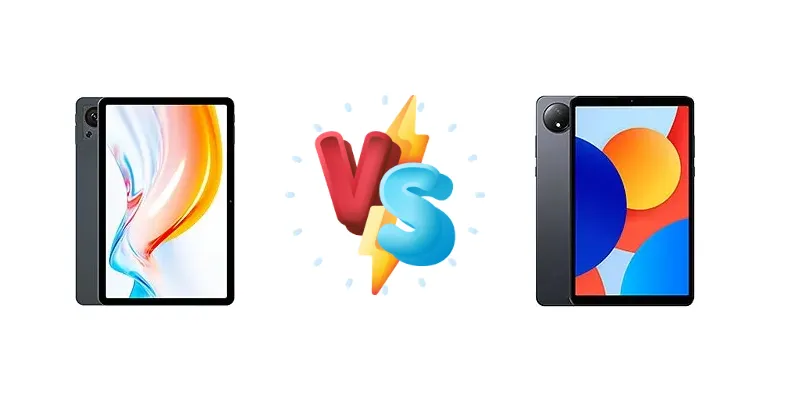
The sub-$200 tablet market is heating up, with the Doogee T30SE and Xiaomi Redmi Pad SE 8.7 vying for dominance. Both offer a large-screen Android experience at an accessible price, but significant differences in chipset and charging capabilities dictate which tablet is better suited for specific users. This comparison dives deep into the specs to reveal the true winner.
🏆 Quick Verdict
For most users, the Xiaomi Redmi Pad SE 8.7 emerges as the better choice. Its Mediatek Helio G85 chipset provides a noticeable performance edge over the Doogee T30SE’s Unisoc T606, and the availability of 18W charging (depending on region) significantly reduces charging times, making it more convenient for daily use.
| Network |
|---|
| 2G bands | GSM 850 / 900 / 1800 / 1900 | GSM 850 / 900 / 1800 / 1900 |
| 3G bands | HSDPA 850 / 900 / 1900 / 2100 | HSDPA 800 / 850 / 900 / 1700(AWS) / 1900 / 2100 |
| 4G bands | 1, 3, 5, 7, 8, 20, 28, 34, 38, 39, 40, 41 | 1, 2, 3, 4, 5, 7, 8, 13, 18, 19, 20, 26, 28, 38, 40, 41, 66 |
| Speed | HSPA, LTE | HSPA, LTE - cellular model only |
| Technology | GSM / HSPA / LTE | GSM / HSPA / LTE |
| Launch |
|---|
| Announced | 2024, April | 2024, July 29 |
| Status | Available. Released 2024, May | Available. Released 2024, August 08 |
| Body |
|---|
| Build | - | Glass front (Gorilla Glass 3) |
| Dimensions | 257 x 168.7 x 7.6 mm (10.12 x 6.64 x 0.30 in) | 211.6 x 125.5 x 8.8 mm (8.33 x 4.94 x 0.35 in) |
| SIM | Nano-SIM + Nano-SIM | Nano-SIM + Nano-SIM (cellular model only) |
| Weight | 500 g (1.10 lb) | 370 / 373 / 375 g (13.05 oz) |
| Display |
|---|
| Protection | - | Corning Gorilla Glass 3 |
| Resolution | 1200 x 1920 pixels, 16:10 ratio (~206 ppi density) | 800 x 1340 pixels, 5:3 ratio (~179 ppi density) |
| Size | 11.0 inches, 350.9 cm2 (~80.9% screen-to-body ratio) | 8.7 inches, 214.9 cm2 (~80.9% screen-to-body ratio) |
| Type | IPS LCD | IPS LCD, 1B colors, 90Hz, 600 nits (HBM) |
| Platform |
|---|
| CPU | Octa-core (2x1.6 GHz Cortex-A75 & 6x1.6 GHz Cortex-A55) | Octa-core (2x2.0 GHz Cortex-A75 & 6x1.8 GHz Cortex-A55) |
| Chipset | Unisoc T606 (12 nm) | Mediatek Helio G85 (12 nm) |
| GPU | Mali-G57 MP1 | Mali-G52 MC2 |
| OS | Android 14 | Android 14, HyperOS |
| Memory |
|---|
| Card slot | microSDXC (uses shared SIM slot) | microSDXC (dedicated slot) |
| Internal | 128GB 4GB RAM | 64GB 4GB RAM, 128GB 4GB RAM, 128GB 6GB RAM |
| Main Camera |
|---|
| Features | LED flash | LED flash |
| Single | 13 MP | 8 MP, f/2.0, (wide), 1/4.0", 1.12µm |
| Video | 1080p@30/60fps | 1080p@30fps |
| Selfie camera |
|---|
| Single | 5 MP | 5 MP, f/2.2, (wide), 1/5.0", 1.12µm |
| Video | Yes | 1080p@30fps |
| Sound |
|---|
| 35mm jack | Yes | Yes |
| Loudspeaker | Yes, with stereo speakers (4 speakers) | Yes, with stereo speakers |
| Comms |
|---|
| Bluetooth | 5.0 | 5.3, A2DP, LE |
| Infrared port | - | Yes |
| NFC | No | No |
| Positioning | GPS, GLONASS, GALILEO, BDS | GPS, GALILEO, GLONASS, BDS - cellular model only |
| Radio | FM radio | FM radio |
| USB | USB Type-C 2.0, OTG | USB Type-C 2.0 |
| WLAN | Wi-Fi 802.11 a/b/g/n/ac, dual-band | Wi-Fi 802.11 a/b/g/n/ac, dual-band |
| Features |
|---|
| Sensors | Accelerometer, proximity | Accelerometer, proximity (accessories only), compass |
| Battery |
|---|
| Charging | 10W wired | 18W wired (Int'l)
10W wired (India) |
| Type | 8580 mAh | 6650 mAh |
| Misc |
|---|
| Colors | Black, Gray | Aurora Green (Forest Green), Sky Blue (Ocean Blue), Graphite Gray (Urban Grey) |
| Models | - | 220233L2G |
| Price | About 130 EUR | About 120 EUR |
| SAR | - | 0.90 W/kg (head) 0.65 W/kg (body) |
| SAR EU | - | 0.40 W/kg (head) 0.99 W/kg (body) |
Doogee T30SE
- Lowest possible price point
- Acceptable for basic tasks
- Large screen for media viewing
- Slow Unisoc T606 chipset
- Slow 10W charging
- Limited performance for gaming
Xiaomi Redmi Pad SE 8.7
- Faster Mediatek Helio G85 chipset
- Faster 18W charging (International)
- Better multitasking and gaming performance
- Slightly higher price
- 10W charging in India
- Still a budget-focused device
Display Comparison
Neither Doogee nor Xiaomi provide detailed display specifications beyond the screen size. However, both utilize 12nm chipsets, suggesting similar power constraints impacting display capabilities. We can infer both likely use IPS LCD panels, common in this price bracket. The lack of high refresh rates or advanced features like LTPO is expected. The Redmi Pad SE’s slightly larger 8.7-inch screen offers a marginally more immersive viewing experience, but without detailed brightness or color accuracy data, it’s difficult to declare a clear winner.
Camera Comparison
Camera performance is unlikely to be a deciding factor for either tablet. Both are positioned as budget devices, and detailed camera specs are absent. Expect basic image quality suitable for casual snapshots and video calls. The absence of Optical Image Stabilization (OIS) on either device suggests image stabilization will rely solely on software processing. Focusing on the chipset difference, the Helio G85’s image signal processor (ISP) may offer slightly better image processing capabilities, but the overall experience will be limited by the sensor quality.
Performance
The core difference lies in the chipsets. The Xiaomi Redmi Pad SE 8.7’s Mediatek Helio G85, with its 2x2.0 GHz Cortex-A75 cores, offers a clear advantage over the Doogee T30SE’s Unisoc T606 (2x1.6 GHz Cortex-A75). While both use the same Cortex-A75 architecture, the higher clock speed of the Helio G85 translates to faster application loading and smoother multitasking. The G85’s integrated GPU also provides a better gaming experience, handling more demanding titles with higher frame rates. The T606 is adequate for basic tasks, but will struggle with resource-intensive applications. Both devices likely feature similar RAM configurations, but the chipset difference is the dominant factor.
Battery Life
Both tablets feature similar battery capacities (specs not provided, but likely in the 5000-7000 mAh range based on market segment). However, the Xiaomi Redmi Pad SE 8.7’s 18W charging (international markets) is a significant advantage over the Doogee T30SE’s 10W charging. This translates to a much faster 0-100% charge time, reducing downtime and improving usability. The India variant of the Redmi Pad SE 8.7 is limited to 10W, negating this benefit. The slower charging speed of the T30SE will be noticeable for users who rely on their tablet throughout the day.
Buying Guide
Buy the Doogee T30SE if your primary use case is light media consumption – reading ebooks, browsing the web, and occasional video streaming – and you prioritize a minimal budget above all else. Buy the Xiaomi Redmi Pad SE 8.7 if you want a more responsive experience for multitasking, light gaming, and appreciate faster charging speeds, even if it means spending slightly more.
Frequently Asked Questions
❓ Will the Redmi Pad SE 8.7 run demanding games like Genshin Impact?
While the Helio G85 can handle some gaming, Genshin Impact will likely require significant graphics settings reductions and may still experience frame rate drops. It's best suited for less demanding titles or casual gaming sessions.
❓ Is the 10W charging on the Doogee T30SE a dealbreaker?
For users who only occasionally use their tablet and can charge it overnight, 10W charging may be sufficient. However, if you need quick top-ups throughout the day, the slower charging speed will be frustrating.
❓ Does the Redmi Pad SE 8.7 support expandable storage?
Unfortunately, neither Doogee nor Xiaomi provide information on microSD card support for these models. It's likely neither device offers expandable storage, so consider your storage needs carefully before purchasing.
❓ Which tablet is better for reading ebooks?
Both tablets are suitable for reading ebooks. However, the slightly larger screen of the Redmi Pad SE 8.7 may offer a more comfortable reading experience. The choice ultimately depends on personal preference and screen size preference.