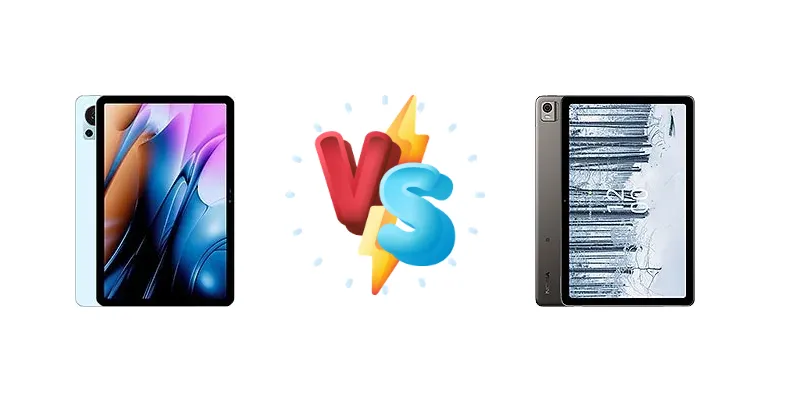
The Doogee T30S and Nokia T21 represent compelling options in the increasingly competitive budget tablet space. Both leverage Unisoc chipsets to deliver affordable Android experiences, but key differences in CPU clock speeds and charging capabilities dictate which tablet is better suited for specific user needs. This comparison dissects those differences to help you make an informed decision.
🏆 Quick Verdict
For most users, the Nokia T21 emerges as the better choice. While the Doogee T30S offers a functional experience, the Nokia T21’s faster Unisoc Tiger T612 processor and significantly faster 18W PD3.0 charging provide a smoother, more convenient user experience justifying the potential price premium.
| Network |
|---|
| 2G bands | GSM 850 / 900 / 1800 / 1900 | GSM 850 / 900 / 1800 / 1900 |
| 3G bands | HSDPA 850 / 900 / 1900 / 2100 | HSDPA 850 / 900 / 1700(AWS) / 1900 / 2100 - US, LATAM |
| 4G bands | 1, 3, 5, 7, 8, 20, 28, 34, 38, 39, 40, 41 | 1, 2, 3, 4, 5, 7, 8, 12, 13, 17, 20, 28, 40, 66 - US, LATAM |
| Speed | HSPA, LTE | HSPA, LTE - cellular model only |
| Technology | GSM / HSPA / LTE | GSM / HSPA / LTE |
| | - | 1, 3, 5, 7, 8, 20, 28, 38, 40, 41 - International |
| Launch |
|---|
| Announced | 2024, February | 2022, September 01 |
| Status | Available. Released 2024, February | Available. Released 2022, September 01 |
| Body |
|---|
| Build | - | Glass front, aluminum back |
| Dimensions | 257 x 168.7 x 7.6 mm (10.12 x 6.64 x 0.30 in) | 247.5 x 157.3 x 7.5 mm (9.74 x 6.19 x 0.30 in) |
| SIM | Nano-SIM + Nano-SIM | Nano-SIM (cellular model only) |
| Weight | 506 g (1.12 lb) | 466 g (1.03 lb) |
| | - | Splash resistant
Stylus support |
| Display |
|---|
| Protection | - | Scratch-resistant glass |
| Resolution | 1200 x 1920 pixels, 16:10 ratio (~206 ppi density) | 1200 x 2000 pixels, 5:3 ratio (~224 ppi density) |
| Size | 11.0 inches, 350.9 cm2 (~80.9% screen-to-body ratio) | 10.4 inches, 307.9 cm2 (~79.1% screen-to-body ratio) |
| Type | IPS LCD | IPS LCD, 360 nits (typ) |
| Platform |
|---|
| CPU | Octa-core (2x1.6 GHz Cortex-A75 & 6x1.6 GHz Cortex-A55) | Octa-core (2x1.8 GHz Cortex-A75 & 6x1.8 GHz Cortex-A55) |
| Chipset | Unisoc T606 (12 nm) | Unisoc Tiger T612 (12 nm) |
| GPU | Mali-G57 MP1 | Mali-G57 |
| OS | Android 13 | Android 12, upgradable to Android 13 |
| Memory |
|---|
| Card slot | microSDXC (uses shared SIM slot) | microSDXC (dedicated slot) |
| Internal | 256GB 6GB RAM | 64GB 4GB RAM, 128GB 4GB RAM |
| | - | eMMC 5.1 |
| Main Camera |
|---|
| Features | LED flash | LED flash |
| Single | 13 MP | 8 MP, AF |
| Video | 1080p@30/60fps | 1080p@30fps |
| Selfie camera |
|---|
| Single | 8 MP | 8 MP |
| Video | Yes | Yes |
| Sound |
|---|
| 3.5mm jack | - | Yes |
| 35mm jack | Yes | Yes |
| Loudspeaker | Yes, with stereo speakers (4 speakers) | Yes, with stereo speakers |
| Comms |
|---|
| Bluetooth | 5.0 | 5.0, A2DP, LE |
| NFC | No | Yes (Wi-Fi/LTE model only / TA-1521) |
| Positioning | GPS, GLONASS, GALILEO, BDS | GPS - cellular model only |
| Radio | FM radio | FM radio |
| USB | USB Type-C 2.0, OTG | USB Type-C 2.0, OTG |
| WLAN | Wi-Fi 802.11 a/b/g/n/ac, dual-band | Wi-Fi 802.11 a/b/g/n/ac, dual-band |
| Features |
|---|
| Sensors | Accelerometer, proximity | Accelerometer, proximity |
| Battery |
|---|
| Charging | 10W wired | 18W wired, PD3.0 |
| Type | 8580 mAh | Li-Po 8200 mAh |
| Misc |
|---|
| Colors | Black, Gray, Blue | Charcoal Grey |
| Models | - | TA-1495, TA-1521, TA-1505, TA-1487 |
| Price | - | About 240 EUR |
| SAR | - | 1.19 W/kg (body) |
| SAR EU | - | 1.56 W/kg (body) |
Doogee T30S
- Lowest possible price point
- Functional for basic tasks
- Acceptable for light media consumption
- Slower Unisoc T606 processor
- Slow 10W charging
- Likely limited software support
Nokia T21
- Faster Unisoc Tiger T612 processor
- 18W PD3.0 fast charging
- Potentially better software support from Nokia
- Higher price than Doogee T30S
- May still exhibit performance limitations in demanding tasks
- Display specifications are basic
Display Comparison
Neither Doogee nor Nokia provide display specifications beyond the tablet size. Assuming both utilize IPS LCD panels common in this price bracket, the display experience will likely be similar in terms of color accuracy and viewing angles. The absence of high refresh rates or advanced features like LTPO suggests both are geared towards basic visual tasks. Bezels are likely to be substantial on both devices, a common cost-saving measure.
Camera Comparison
Given the budget nature of both tablets, camera performance is unlikely to be a key differentiator. Details on camera sensors are absent, suggesting both feature basic configurations. Focusing on the main sensor resolution is misleading; image quality is more dependent on sensor size and image processing. Expect adequate performance for casual snapshots in good lighting conditions, but limitations in low-light scenarios. The absence of OIS on either device further reinforces this expectation.
Performance
The core difference lies in the chipsets. The Nokia T21’s Unisoc Tiger T612, with its 2x1.8 GHz Cortex-A75 cores and 6x1.8 GHz Cortex-A55 cores, offers a noticeable performance advantage over the Doogee T30S’s Unisoc T606 (2x1.6 GHz Cortex-A75 & 6x1.6 GHz Cortex-A55). The 200MHz clock speed increase on the T612’s A75 cores translates to faster app loading times and smoother multitasking. While both use a 12nm process, the T612’s architectural refinements provide a tangible boost. The impact will be most noticeable in demanding applications and gaming.
Battery Life
Battery capacity is not specified, but the charging capabilities are a significant point of divergence. The Nokia T21’s 18W wired charging with PD3.0 support offers a substantial advantage over the Doogee T30S’s 10W charging. PD3.0 ensures compatibility with a wider range of chargers and faster charging speeds. While a larger battery capacity on the Doogee T30S could partially offset the slower charging, the convenience and speed of the Nokia T21’s charging solution are compelling.
Buying Guide
Buy the Doogee T30S if you prioritize absolute lowest cost and are willing to accept slower performance and charging. It’s suitable for basic media consumption and light tasks. Buy the Nokia T21 if you value a more responsive user experience, faster charging, and the convenience of Power Delivery (PD) compatibility, making it ideal for students or users who rely on their tablet throughout the day.
Frequently Asked Questions
❓ Will the Nokia T21’s faster processor significantly improve gaming performance?
The Unisoc Tiger T612 in the Nokia T21 will offer a noticeable improvement in gaming compared to the T606 in the Doogee T30S, particularly for less demanding titles. However, neither tablet is designed for high-end gaming. Expect playable frame rates at lower settings for most games, with occasional stuttering in more graphically intensive titles.
❓ Does the Nokia T21’s PD3.0 charging work with my existing USB-C chargers?
Yes, the Nokia T21’s support for Power Delivery (PD) 3.0 ensures compatibility with a wide range of USB-C chargers, including many smartphone chargers and power banks. This provides greater flexibility and convenience compared to the Doogee T30S’s proprietary 10W charging.
❓ How much faster is the charging on the Nokia T21 compared to the Doogee T30S?
While exact 0-100% charging times are unavailable, the Nokia T21’s 18W PD3.0 charging is expected to be significantly faster than the Doogee T30S’s 10W charging. Expect the Nokia T21 to reach a full charge in approximately 2-3 hours, while the Doogee T30S could take 4-5 hours or longer.