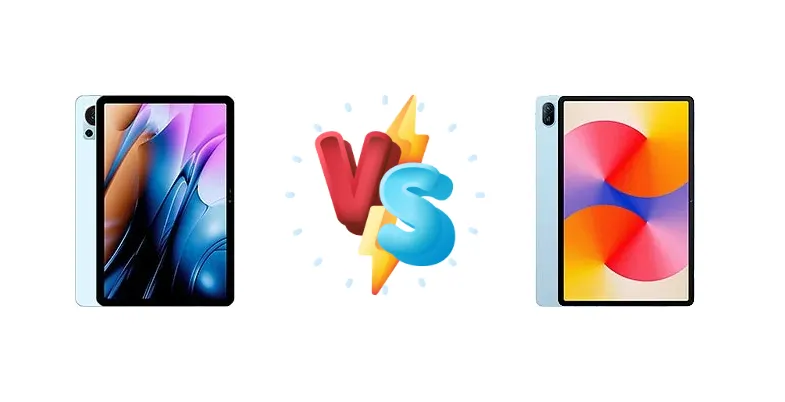
The tablet market offers a wide range of options, but finding the right balance between price and performance can be challenging. We're pitting the Doogee T30S, a value-focused tablet powered by a Unisoc chipset, against the Huawei MatePad SE 11, known for its faster charging capabilities. This comparison will help you determine which tablet best suits your needs and budget.
🏆 Quick Verdict
For the average user prioritizing faster charging and potentially broader software compatibility, the Huawei MatePad SE 11 is the better choice. While the Doogee T30S offers a compelling price point, its significantly slower 10W charging and less powerful Unisoc T606 chipset hold it back in overall usability.
| Network |
|---|
| 2G bands | GSM 850 / 900 / 1800 / 1900 | N/A |
| 3G bands | HSDPA 850 / 900 / 1900 / 2100 | N/A |
| 4G bands | 1, 3, 5, 7, 8, 20, 28, 34, 38, 39, 40, 41 | N/A |
| EDGE | - | No |
| GPRS | - | No |
| Speed | HSPA, LTE | - |
| Technology | GSM / HSPA / LTE | No cellular connectivity |
| Launch |
|---|
| Announced | 2024, February | 2024, June 09 |
| Status | Available. Released 2024, February | Available. Released 2024, June |
| Body |
|---|
| Build | - | Glass front, aluminum frame, aluminum back |
| Dimensions | 257 x 168.7 x 7.6 mm (10.12 x 6.64 x 0.30 in) | 252.3 x 163.8 x 6.9 mm (9.93 x 6.45 x 0.27 in) |
| SIM | Nano-SIM + Nano-SIM | No |
| Weight | 506 g (1.12 lb) | 475 g (1.05 lb) |
| Display |
|---|
| Resolution | 1200 x 1920 pixels, 16:10 ratio (~206 ppi density) | 1200 x 1920 pixels, 16:10 ratio (~206 ppi density) |
| Size | 11.0 inches, 350.9 cm2 (~80.9% screen-to-body ratio) | 11.0 inches, 350.9 cm2 (~84.9% screen-to-body ratio) |
| Type | IPS LCD | IPS LCD, 400 nits |
| Platform |
|---|
| CPU | Octa-core (2x1.6 GHz Cortex-A75 & 6x1.6 GHz Cortex-A55) | - |
| Chipset | Unisoc T606 (12 nm) | - |
| GPU | Mali-G57 MP1 | - |
| OS | Android 13 | HarmonyOS 2.0 |
| Memory |
|---|
| Card slot | microSDXC (uses shared SIM slot) | microSDXC (dedicated slot) |
| Internal | 256GB 6GB RAM | 64GB 4GB RAM, 128GB 4GB RAM, 128GB 6GB RAM, 128GB 8GB RAM, 256GB 8GB RAM |
| Main Camera |
|---|
| Features | LED flash | Panorama |
| Single | 13 MP | 8 MP, f/2.0, AF |
| Video | 1080p@30/60fps | 1080p@30fps |
| Selfie camera |
|---|
| Single | 8 MP | 5 MP, f/2.2 |
| Video | Yes | 720p@30fps |
| Sound |
|---|
| 35mm jack | Yes | Unspecified |
| Loudspeaker | Yes, with stereo speakers (4 speakers) | Yes, with stereo speakers (4 speakers) |
| Comms |
|---|
| Bluetooth | 5.0 | 5.1, A2DP, LE |
| NFC | No | No |
| Positioning | GPS, GLONASS, GALILEO, BDS | No |
| Radio | FM radio | No |
| USB | USB Type-C 2.0, OTG | USB Type-C 2.0, OTG |
| WLAN | Wi-Fi 802.11 a/b/g/n/ac, dual-band | Wi-Fi 802.11 a/b/g/n/ac, dual-band |
| Features |
|---|
| Sensors | Accelerometer, proximity | Accelerometer |
| Battery |
|---|
| Charging | 10W wired | 22.5W wired
5W reverse wired |
| Type | 8580 mAh | 7700 mAh |
| Misc |
|---|
| Colors | Black, Gray, Blue | Nebula Gray, Crystal Blue |
Doogee T30S
- Extremely affordable price point
- Decent performance for basic tasks
- Lightweight and portable
- Slow 10W charging
- Unisoc T606 chipset is less powerful
- Potentially limited software updates
Huawei MatePad SE 11
- Faster 22.5W charging
- Reverse wired charging capability
- Potentially better performance (depending on chipset)
- Likely more expensive than the Doogee T30S
- Huawei AppGallery ecosystem may not suit all users
- Software updates may be limited
Display Comparison
Neither device's display specifications are provided, so a direct comparison is limited. However, given the price point of the Doogee T30S, it likely utilizes an IPS LCD panel. The Huawei MatePad SE 11, being a slightly more premium offering, may also use IPS LCD, but potentially with better color calibration and viewing angles. The absence of details like resolution, peak brightness, and color gamut makes a definitive assessment impossible, but users should expect typical budget tablet display performance from both.
Camera Comparison
Neither device is positioned as a photography powerhouse, and detailed camera specifications are absent. It's safe to assume both tablets feature basic camera setups suitable for casual snapshots and video calls. Without knowing sensor sizes, lens apertures, or image processing capabilities, a meaningful comparison is impossible. Users shouldn't expect flagship-level image quality from either device.
Performance
The core difference lies in the chipsets. The Doogee T30S utilizes the Unisoc T606, a 12nm processor with an octa-core configuration featuring two Cortex-A75 cores for performance and six Cortex-A55 cores for efficiency. This is a budget-oriented chipset designed for basic multitasking and light gaming. The Huawei MatePad SE 11's chipset is not specified, but given its price bracket, it likely features a Kirin 710A or similar. While a direct clock-speed comparison is difficult without knowing the MatePad SE 11's exact processor, Kirin chipsets generally offer better integrated GPU performance and optimized software integration within the Huawei ecosystem. The Unisoc T606's 12nm process node is less efficient than more modern fabrication processes, potentially leading to higher temperatures under sustained load.
Battery Life
The charging capabilities are a significant differentiator. The Doogee T30S is limited to 10W wired charging, which translates to a considerably longer charging time. The Huawei MatePad SE 11, with its 22.5W wired charging, offers a much faster charging experience. Furthermore, the MatePad SE 11 includes 5W reverse wired charging, allowing it to act as a power bank for smaller devices like earbuds or smartphones – a feature absent on the Doogee T30S. While battery capacity isn't specified for either device, the faster charging of the MatePad SE 11 mitigates the impact of a potentially smaller battery.
Buying Guide
Buy the Doogee T30S if you need an extremely affordable tablet for basic tasks like reading ebooks, light web browsing, and occasional video playback, and aren't concerned about charging speed. Buy the Huawei MatePad SE 11 if you prefer a more responsive experience, faster charging to minimize downtime, and potentially access to a wider range of apps through Huawei's AppGallery and GMS compatibility (depending on the model).
Frequently Asked Questions
❓ How long will it take to fully charge the Doogee T30S from 0%?
With only 10W charging, expect a full charge to take several hours, likely between 4-6 hours depending on battery capacity. This is significantly slower than the Huawei MatePad SE 11.
❓ Can the Huawei MatePad SE 11 charge my smartphone?
Yes, the Huawei MatePad SE 11 supports 5W reverse wired charging. While not fast, it can provide a small boost to your smartphone's battery or fully charge accessories like wireless earbuds.
❓ Is the Unisoc T606 chipset capable of running popular games?
The Unisoc T606 can handle less demanding games at lower settings. However, graphically intensive titles will likely experience significant frame rate drops and may not be playable at acceptable levels.
❓ Does the Huawei MatePad SE 11 have Google Play Store access?
This depends on the specific model. Some versions of the Huawei MatePad SE 11 ship without Google Mobile Services (GMS), relying on Huawei's AppGallery. Other versions may have GMS pre-installed. Check the product listing carefully before purchasing.