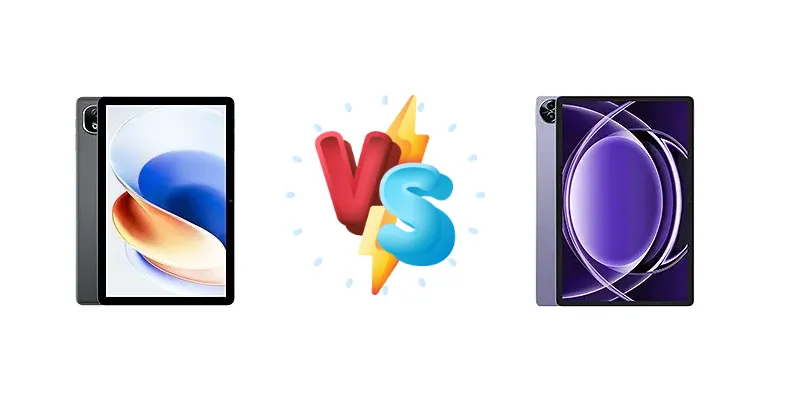
The budget tablet market is fiercely competitive, and the Doogee T30E and Realme Pad 2 Lite are two contenders vying for your attention. While both aim to deliver an affordable tablet experience, they take different approaches to performance and features. This comparison dives deep into their core specifications to determine which tablet offers the best balance of power, usability, and value.
🏆 Quick Verdict
For most users, the Realme Pad 2 Lite emerges as the better choice. Its Mediatek Helio G99 chipset, built on a more efficient 6nm process, provides a noticeable performance advantage over the Doogee T30E’s Unisoc T606. The faster 15W charging also contributes to a more convenient user experience, making it a more compelling all-around package.
| Network |
|---|
| 2G bands | GSM 850 / 900 / 1800 / 1900 | GSM 850 / 900 / 1800 / 1900 |
| 3G bands | HSDPA 850 / 900 / 1900 / 2100 | HSDPA 850 / 900 / 2100 |
| 4G bands | 1, 3, 5, 7, 8, 20, 28, 34, 38, 39, 40, 41 | 1, 3, 5, 7, 8, 20, 28, 38, 40, 41 |
| Speed | HSPA, LTE | HSPA, LTE |
| Technology | GSM / HSPA / LTE | GSM / HSPA / LTE |
| Launch |
|---|
| Announced | 2024, April | 2024, September 13 |
| Status | Available. Released 2024, May | Available. Released 2024, September 26 |
| Body |
|---|
| Dimensions | 258.1 x 169.7 x 8.8 mm (10.16 x 6.68 x 0.35 in) | 258 x 169.5 x 8.3 mm (10.16 x 6.67 x 0.33 in) |
| SIM | Nano-SIM + Nano-SIM | No |
| Weight | 537 g (1.18 lb) | 525 g (1.16 lb) |
| Display |
|---|
| Resolution | 800 x 1280 pixels, 16:10 ratio (~137 ppi density) | 1200 x 1920 pixels, 16:10 ratio (~207 ppi density) |
| Size | 11.0 inches, 350.9 cm2 (~80.1% screen-to-body ratio) | 10.95 inches, 347.7 cm2 (~79.5% screen-to-body ratio) |
| Type | IPS LCD | IPS LCD, 1B colors, 90Hz, 450 nits (peak) |
| Platform |
|---|
| CPU | Octa-core (2x1.6 GHz Cortex-A75 & 6x1.6 GHz Cortex-A55) | Octa-core (2x2.2 GHz Cortex-A76 & 6x2.0 GHz Cortex-A55) |
| Chipset | Unisoc T606 (12 nm) | Mediatek Helio G99 (6 nm) |
| GPU | Mali-G57 MP1 | Mali-G57 MC2 |
| OS | Android 14 | Android 14, Realme UI 5.0 for Pad |
| Memory |
|---|
| Card slot | microSDXC (uses shared SIM slot) | Unspecified |
| Internal | 128GB 4GB RAM | 128GB 4GB RAM, 128GB 8GB RAM |
| Main Camera |
|---|
| Features | LED flash | Panorama |
| Single | 13 MP | 8 MP, f/2.0 |
| Video | 1080p@30/60fps | 1080p@30fps |
| Selfie camera |
|---|
| Features | - | Panorama |
| Single | 5 MP | 5 MP, f/2.2 |
| Video | Yes | 1080p@30fps |
| Sound |
|---|
| 35mm jack | Yes | No |
| Loudspeaker | Yes, with stereo speakers | Yes, with stereo speakers (4 speakers) |
| Comms |
|---|
| Bluetooth | 5.0 | 5.2, A2DP, LE |
| NFC | No | No |
| Positioning | GPS, GLONASS, GALILEO, BDS | GPS, GALILEO, GLONASS, BDS |
| Radio | FM radio | No |
| USB | USB Type-C 2.0, OTG | USB Type-C |
| WLAN | Wi-Fi 802.11 a/b/g/n/ac, dual-band | Wi-Fi 802.11 a/b/g/n/ac, dual-band |
| Features |
|---|
| Sensors | Accelerometer, proximity | Accelerometer |
| Battery |
|---|
| Charging | 10W wired | 15W wired |
| Type | 8000 mAh | 8300 mAh |
| Misc |
|---|
| Colors | Black, Gray | Nebula Purple, Space Grey |
| Models | - | RMP2402 |
| Price | About 120 EUR | About 160 EUR |
Doogee T30E
- Lowest possible price point
- Acceptable for basic tasks
- Durable build quality (typical of Doogee)
- Significantly slower performance
- Slow 10W charging
- Outdated 12nm chipset
Realme Pad 2 Lite
- Faster and more efficient Helio G99 chipset
- Faster 15W charging
- Better multitasking capabilities
- Slightly higher price
- Camera performance likely similar to Doogee
- May not be ideal for intensive gaming
Display Comparison
Neither Doogee nor Realme provided display specs beyond the tablet form factor. Assuming both utilize IPS LCD panels common in this price bracket, the real difference will likely come down to color accuracy and peak brightness. Without specific nit ratings, it’s difficult to declare a clear winner, but the Realme Pad 2 Lite’s brand reputation suggests a slightly more refined display experience. Bezels are expected to be similar on both devices, reflecting their budget positioning.
Camera Comparison
Given the budget nature of both tablets, camera performance is unlikely to be a key differentiator. Both are likely to feature basic camera setups focused on video calls and casual snapshots. Without specific sensor details, it’s safe to assume image quality will be adequate for basic use but not competitive with smartphones. The absence of OIS on either device suggests limited low-light performance. Any 2MP macro or depth sensors included are likely to offer minimal practical benefit.
Performance
The core difference lies in the chipsets. The Realme Pad 2 Lite’s Mediatek Helio G99 (6nm) significantly outperforms the Doogee T30E’s Unisoc T606 (12nm). The 6nm process allows for greater transistor density and improved power efficiency, translating to better sustained performance and less heat generation. The Helio G99’s CPU, with 2x2.2 GHz Cortex-A76 cores, is notably faster than the T606’s 2x1.6 GHz Cortex-A75 cores. This means faster app loading times, smoother multitasking, and a more responsive overall experience on the Realme Pad 2 Lite. While both use 6x Cortex-A55 cores for efficiency, the higher clock speed of the G99’s cores provides a clear advantage.
Battery Life
While battery capacity isn’t specified, the charging wattage provides a tangible difference. The Realme Pad 2 Lite’s 15W wired charging is 50% faster than the Doogee T30E’s 10W charging. This translates to significantly reduced charging times, making the Realme Pad 2 Lite more convenient for users who need to quickly top up their battery. The more efficient Helio G99 chipset may also contribute to slightly better battery life in real-world usage, offsetting any potential capacity differences.
Buying Guide
Buy the Doogee T30E if you prioritize extreme affordability and basic tablet functionality for tasks like reading ebooks or light web browsing. It’s a suitable option for users on a very tight budget who don’t require demanding performance. Buy the Realme Pad 2 Lite if you want a tablet capable of handling more demanding tasks like streaming video, light gaming, and multitasking, and appreciate the benefit of faster charging speeds. It’s ideal for students, casual gamers, and anyone who wants a more responsive and versatile tablet experience.
Frequently Asked Questions
❓ Will the Unisoc T606 in the Doogee T30E struggle with multiple apps open simultaneously?
Yes, the Unisoc T606 is a relatively low-powered chipset. Expect noticeable slowdowns and app reloading when multitasking with more than a few apps. It’s best suited for running one app at a time.
❓ Is the Mediatek Helio G99 in the Realme Pad 2 Lite capable of playing popular mobile games like PUBG or Call of Duty?
The Helio G99 can handle PUBG and Call of Duty, but you’ll likely need to lower the graphics settings to medium or low to achieve a smooth frame rate. It’s not a dedicated gaming chipset, but it offers a playable experience for casual gamers.
❓ How long will it take to fully charge the Doogee T30E from 0% with its 10W charger?
With a 10W charger, expect the Doogee T30E to take approximately 4-5 hours to fully charge from 0%. This is significantly slower than the Realme Pad 2 Lite.
❓ Does the Realme Pad 2 Lite support fast charging standards beyond 15W?
While the Realme Pad 2 Lite supports 15W charging, it doesn't appear to support more advanced fast charging protocols like Power Delivery or Quick Charge. Using a higher wattage charger won't necessarily result in faster charging speeds.