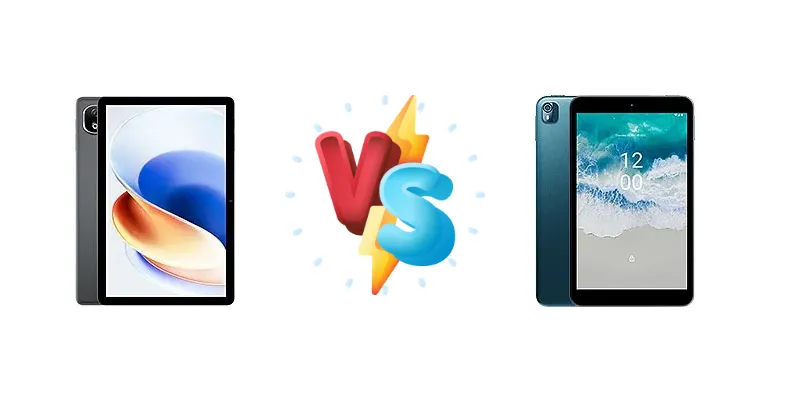
The sub-$200 tablet market is fiercely competitive, with the Doogee T30E and Nokia T10 vying for attention. Both devices center around the Unisoc T606 chipset, making a direct performance comparison crucial. This analysis dives deep into the nuances of each tablet, beyond the shared processor, to determine which offers the best value for everyday users.
🏆 Quick Verdict
For the average user prioritizing a slightly more robust build and potentially better software support, the Nokia T10 emerges as the winner. While both tablets share the same Unisoc T606 chipset and 10W charging, Nokia’s brand reputation and established software update cycle provide a degree of long-term confidence.
| Network |
|---|
| 2G bands | GSM 850 / 900 / 1800 / 1900 | GSM 850 / 900 / 1800 / 1900 |
| 3G bands | HSDPA 850 / 900 / 1900 / 2100 | HSDPA 850 / 900 / 2100 |
| 4G bands | 1, 3, 5, 7, 8, 20, 28, 34, 38, 39, 40, 41 | 1, 3, 5, 7, 8, 20, 28, 38, 40, 41 |
| Speed | HSPA, LTE | HSPA 42.2/5.76 Mbps, LTE Cat4 150/50 Mbps |
| Technology | GSM / HSPA / LTE | GSM / HSPA / LTE |
| Launch |
|---|
| Announced | 2024, April | 2022, July 12 |
| Status | Available. Released 2024, May | Available. Released 2022, August 20 |
| Body |
|---|
| Build | - | Glass front, plastic back, plastic frame |
| Dimensions | 258.1 x 169.7 x 8.8 mm (10.16 x 6.68 x 0.35 in) | 208 x 123.2 x 9 mm (8.19 x 4.85 x 0.35 in) |
| SIM | Nano-SIM + Nano-SIM | Nano-SIM |
| Weight | 537 g (1.18 lb) | 375 g (13.23 oz) |
| | - | Splash resistant |
| Display |
|---|
| Resolution | 800 x 1280 pixels, 16:10 ratio (~137 ppi density) | 800 x 1280 pixels, 16:10 ratio (~189 ppi density) |
| Size | 11.0 inches, 350.9 cm2 (~80.1% screen-to-body ratio) | 8.0 inches, 185.6 cm2 (~72.4% screen-to-body ratio) |
| Type | IPS LCD | IPS LCD, 360 nits (typ), 450 nits (peak) |
| Platform |
|---|
| CPU | Octa-core (2x1.6 GHz Cortex-A75 & 6x1.6 GHz Cortex-A55) | Octa-core (2x1.6 GHz Cortex-A75 & 6x1.6 GHz Cortex-A55) |
| Chipset | Unisoc T606 (12 nm) | Unisoc T606 (12 nm) |
| GPU | Mali-G57 MP1 | Mali-G57 MP1 |
| OS | Android 14 | Android 12, upgradable to Android 13 |
| Memory |
|---|
| Card slot | microSDXC (uses shared SIM slot) | microSDXC |
| Internal | 128GB 4GB RAM | 32GB 3GB RAM, 64GB 4GB RAM |
| Main Camera |
|---|
| Features | LED flash | LED flash |
| Single | 13 MP | 8 MP, 1/4.0", 1.12µm, AF |
| Video | 1080p@30/60fps | 1080p |
| Selfie camera |
|---|
| Single | 5 MP | 2 MP, 1/5.0", 1.65µm |
| Video | Yes | 720p |
| Sound |
|---|
| 3.5mm jack | - | Yes |
| 35mm jack | Yes | Yes |
| Loudspeaker | Yes, with stereo speakers | Yes, with stereo speakers |
| Comms |
|---|
| Bluetooth | 5.0 | 5.0, A2DP, LE |
| NFC | No | No |
| Positioning | GPS, GLONASS, GALILEO, BDS | GPS, GLONASS, GALILEO |
| Radio | FM radio | No |
| USB | USB Type-C 2.0, OTG | USB Type-C 2.0, OTG |
| WLAN | Wi-Fi 802.11 a/b/g/n/ac, dual-band | Wi-Fi 802.11 a/b/g/n/ac, dual-band |
| Features |
|---|
| Sensors | Accelerometer, proximity | Accelerometer, proximity |
| Battery |
|---|
| Charging | 10W wired | 10W wired |
| Type | 8000 mAh | Li-Po 5250 mAh |
| Misc |
|---|
| Colors | Black, Gray | Ocean Blue |
| Models | - | TA-1503, TA-1472, TA-1462, TA-1457 |
| Price | About 120 EUR | About 160 EUR |
| SAR | - | 1.19 W/kg (body) |
| SAR EU | - | 0.27 W/kg (head) 1.57 W/kg (body) |
Doogee T30E
- Potentially lower price point
- Unisoc T606 provides adequate performance for basic tasks
- Suitable for media consumption
- Less established brand reputation
- Potentially limited software support
- Slow 10W charging
Nokia T10
- Established brand with software update commitment
- Potentially better build quality
- Unisoc T606 provides adequate performance for basic tasks
- Slightly higher price point
- Slow 10W charging
- Performance is identical to the Doogee T30E
Display Comparison
Both the Doogee T30E and Nokia T10 utilize unspecified LCD panels, a common trait in this price bracket. Without detailed specifications like peak brightness or color gamut coverage, it’s difficult to definitively declare a winner. However, Nokia’s history suggests a focus on color accuracy, potentially offering a more pleasant viewing experience for photo and video content. The shared resolution likely results in similar pixel densities, meaning display sharpness won’t be a major differentiator. Bezels are expected to be substantial on both devices, reflecting their budget positioning.
Camera Comparison
Camera performance is unlikely to be a key strength for either tablet. Details regarding sensor sizes and lens apertures are unavailable, but given the price point, expectations should be tempered. Both tablets likely feature basic camera setups intended for casual snapshots and video calls. Without further information, it’s impossible to assess image quality differences. The inclusion of a 2MP macro camera on either device is largely a marketing tactic, offering limited practical benefit due to the low resolution and lack of optical image stabilization.
Performance
The core of both tablets is the Unisoc T606 (12 nm) chipset, featuring an octa-core CPU configuration with 2x1.6 GHz Cortex-A75 and 6x1.6 GHz Cortex-A55 cores. This means CPU performance will be virtually identical between the two. The real-world impact of this chipset is suitable for basic tasks like web browsing, video streaming, and light gaming. Neither tablet is expected to handle demanding games or multitasking scenarios with ease. RAM configurations are not specified, but will heavily influence multitasking capabilities; more RAM is always preferable. Thermal management is unlikely to be a significant concern given the low-power nature of the T606.
Battery Life
Battery capacity is not specified for either device. However, given the power efficiency of the Unisoc T606 and the typical usage scenarios for these tablets, both should offer all-day battery life with moderate use. The shared 10W wired charging is a significant limitation. Expect charging times to be lengthy – likely exceeding 3 hours for a full charge. The lack of fast charging is a compromise made to keep the price down, but it impacts the convenience factor.
Buying Guide
Buy the Doogee T30E if you need a tablet primarily for media consumption and light tasks, and are comfortable with a potentially less refined software experience. Its aggressive pricing makes it appealing for those on a strict budget. Buy the Nokia T10 if you prefer a tablet from a more established brand with a commitment to software updates and a potentially more polished user interface, even if it means paying a slight premium.
Frequently Asked Questions
❓ Will the Unisoc T606 struggle with popular games like PUBG Mobile?
Yes, the Unisoc T606 is a budget chipset and will likely struggle to run PUBG Mobile smoothly, even on low settings. Expect frame rate drops and potential lag, especially during intense action sequences. These tablets are better suited for less demanding games.
❓ How long will it take to fully charge either the Doogee T30E or Nokia T10 with the 10W charger?
Given the 10W charging standard, expect a full charge to take approximately 3 to 4 hours, potentially longer if the tablet is being used during charging. This is a significant drawback compared to tablets with fast charging capabilities.
❓ Can I expect regular software updates on the Doogee T30E?
Doogee’s track record for software updates is less consistent than Nokia’s. While Android updates are possible, they are not guaranteed and may be infrequent. The Nokia T10 is more likely to receive timely security patches and potentially even a major Android version update.