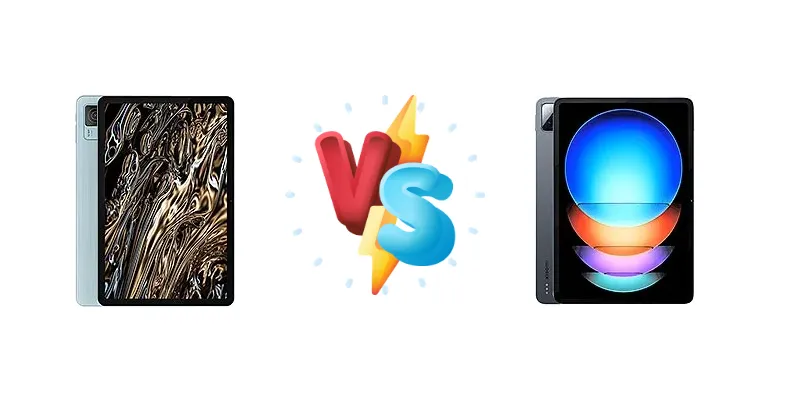
The tablet market offers a wide spectrum of choices, from affordable gaming options to premium productivity powerhouses. We pit the Doogee T30 Ultra, a budget-focused device with a gaming-centric chipset, against the Xiaomi Pad 6S Pro 12.4, a flagship tablet boasting the Snapdragon 8 Gen 2 and a stunning display. This comparison will dissect their strengths and weaknesses to determine which tablet best suits your needs.
🏆 Quick Verdict
For the average user prioritizing performance and a premium experience, the Xiaomi Pad 6S Pro 12.4 is the clear winner. Its Snapdragon 8 Gen 2 chipset delivers significantly faster processing and graphics capabilities, complemented by a brighter, higher-contrast display and blazing-fast 120W charging. The Doogee T30 Ultra offers a compelling value proposition for casual gamers on a tight budget.
| Network |
|---|
| 2G bands | GSM 850 / 900 / 1800 / 1900 | N/A |
| 3G bands | HSDPA 800 / 850 / 900 / 1700(AWS) / 1900 / 2100 | N/A |
| 4G bands | 1, 2, 3, 4, 5, 7, 8, 12, 17, 20, 25, 26, 28, 34, 38, 39, 40, 41, 66 | - |
| EDGE | - | N/A |
| GPRS | - | N/A |
| Speed | HSPA, LTE | - |
| Technology | GSM / HSPA / LTE | No cellular connectivity |
| Launch |
|---|
| Announced | 2023, October | 2024, February 22 |
| Status | Available. Released 2023, November | Available. Released 2024, February 22 |
| Body |
|---|
| Build | Glass front, aluminum frame, aluminum back | Glass front (Gorilla Glass 5), aluminum frame, aluminum back |
| Dimensions | 256.5 x 168 x 7.6 mm (10.10 x 6.61 x 0.30 in) | 278.7 x 191.6 x 6.3 mm (10.97 x 7.54 x 0.25 in) |
| SIM | Nano-SIM + Nano-SIM | No |
| Weight | 539 g (1.19 lb) | 590 g (1.30 lb) |
| Display |
|---|
| Protection | - | Corning Gorilla Glass 5 |
| Resolution | 1600 x 2560 pixels, 16:10 ratio (~274 ppi density) | 2032 x 3048 pixels, 3:2 ratio (~295 ppi density) |
| Size | 11.0 inches, 350.9 cm2 (~81.4% screen-to-body ratio) | 12.4 inches, 457.8 cm2 (~85.7% screen-to-body ratio) |
| Type | IPS LCD, 250 nits | IPS LCD, 68B colors, 144Hz, HDR10, Dolby Vision, 900 nits (peak) |
| Platform |
|---|
| CPU | Octa-core (2x2.2 GHz Cortex-A76 & 6x2.0 GHz Cortex-A55) | Octa-core (1x3.2 GHz Cortex-X3 & 2x2.8 GHz Cortex-A715 & 2x2.8 GHz Cortex-A710 & 3x2.0 GHz Cortex-A510) |
| Chipset | Mediatek Helio G99 (6 nm) | Qualcomm SM8550-AB Snapdragon 8 Gen 2 (4 nm) |
| GPU | Mali-G57 MC2 | Adreno 740 |
| OS | Android 13 | Android 14, up to 3 major Android upgrades, HyperOS |
| Memory |
|---|
| Card slot | microSDXC (uses shared SIM slot) | No |
| Internal | 256GB 12GB RAM | 256GB 8GB RAM, 256GB 12GB RAM, 512GB 12GB RAM, 1TB 16GB RAM |
| Main Camera |
|---|
| Dual | - | 50 MP, f/1.8, (wide), 1/2.76", 0.64µm, PDAF
Auxiliary lens |
| Features | LED flash | LED flash, HDR, panorama |
| Single | 16 MP | - |
| Video | 1440p@30fps, 1080p@30fps | 4K@30/60fps, 1080p@30/60fps |
| Selfie camera |
|---|
| Single | 8 MP | 32 MP, f/2.2, (wide), 1/3.6", 0.61µm |
| Video | Yes | 1080p@30fps |
| Sound |
|---|
| 35mm jack | Yes | No |
| Loudspeaker | Yes, with stereo speakers (4 speakers) | Yes, with stereo speakers (6 speakers) |
| Comms |
|---|
| Bluetooth | 5.0, A2DP, LE | 5.3, A2DP, LE, LHDC |
| NFC | No | Yes (file transfer only) |
| Positioning | GPS, GALILEO, GLONASS, BDS | No |
| Radio | FM radio | No |
| USB | USB Type-C 2.0, OTG, magnetic accessory connector pins | USB Type-C 3.2, accessory connector |
| WLAN | Wi-Fi 802.11 a/b/g/n/ac, dual-band | Wi-Fi 802.11 a/b/g/n/a/6/7, dual-band, Wi-Fi Direct |
| Features |
|---|
| Sensors | Accelerometer, gyro, proximity, compass | Fingerprint (side-mounted), accelerometer, gyro, proximity (accessories only), compass |
| Battery |
|---|
| Charging | 18W wired
Reverse wired | 120W wired, PD3.0, QC4, 45% in 10 min, 100% in 35 min |
| Type | 8580 mAh | 10000 mAh |
| Misc |
|---|
| Colors | Blue, Gray, Black | Black, Blue, Green |
| Models | - | 24018RPACG |
| Price | About 250 EUR | About 700 EUR |
| SAR EU | - | 0.99 W/kg (body) |
Doogee T30 Ultra
- Highly affordable price point
- Decent performance for casual gaming
- Reverse wired charging capability
- Significantly weaker processor than the competition
- Likely lower display quality
- Slow charging speed (18W)
Xiaomi Pad 6S Pro 12.4
- Exceptional performance with Snapdragon 8 Gen 2
- Bright and high-contrast 12.4-inch display
- Ultra-fast 120W charging
- Higher price tag
- Larger form factor may not be ideal for all users
- May require additional accessories for optimal productivity
Display Comparison
The Xiaomi Pad 6S Pro 12.4 boasts a superior display, achieving a measured peak brightness of 848 nits and a 1378:1 contrast ratio. This translates to a more vibrant and readable experience, especially in bright environments. While the Doogee T30 Ultra’s display specifications are not provided, it’s likely to be significantly lower in both brightness and contrast, impacting outdoor visibility and overall image quality. The larger screen real estate of the 12.4-inch Xiaomi Pad also enhances productivity and media consumption.
Camera Comparison
Given the tablet form factor, camera performance isn't a primary concern for most users. However, the Xiaomi Pad 6S Pro 12.4 is likely to offer a more refined camera experience due to its superior image signal processor (ISP) integrated within the Snapdragon 8 Gen 2. The Doogee T30 Ultra’s camera specifications are not detailed, but budget tablets often compromise on camera quality. Without specific sensor details, it’s difficult to make a direct comparison, but the Xiaomi Pad’s processing power will likely result in better image quality and dynamic range.
Performance
The performance gap between these two tablets is substantial. The Xiaomi Pad 6S Pro 12.4 is powered by the Qualcomm Snapdragon 8 Gen 2 (4nm), featuring a core configuration of 1x3.2 GHz Cortex-X3, 2x2.8 GHz Cortex-A715, 2x2.8 GHz Cortex-A710, and 3x2.0 GHz Cortex-A510. This architecture, built on a 4nm process, delivers exceptional performance and efficiency. In contrast, the Doogee T30 Ultra utilizes the MediaTek Helio G99 (6nm) with a 2x2.2 GHz Cortex-A76 & 6x2.0 GHz Cortex-A55 configuration. While the G99 is a capable chip for its price point, it cannot compete with the raw power of the Snapdragon 8 Gen 2, particularly in graphically intensive applications. The Xiaomi Pad’s LPDDR5x RAM further enhances its multitasking capabilities.
Battery Life
The Xiaomi Pad 6S Pro 12.4 demonstrates impressive battery life, achieving an active use score of 11 hours and 14 minutes. Crucially, it supports 120W wired charging, capable of reaching 45% charge in just 10 minutes and a full charge in 35 minutes. The Doogee T30 Ultra, with its 18W wired charging, will take considerably longer to fully charge. While the Doogee T30 Ultra’s battery capacity isn’t specified, the Xiaomi Pad’s combination of efficient chipset and rapid charging provides a significant advantage for users who need to quickly top up their device.
Buying Guide
Buy the Doogee T30 Ultra if you need a highly affordable tablet primarily for casual gaming and media consumption, and aren't demanding of top-tier performance. Buy the Xiaomi Pad 6S Pro 12.4 if you prioritize a fluid, responsive experience for demanding tasks like video editing, graphic design, or intensive gaming, and value a premium display and rapid charging capabilities.
Frequently Asked Questions
❓ Is the MediaTek Helio G99 in the Doogee T30 Ultra sufficient for playing demanding games like Genshin Impact?
While the Helio G99 can run Genshin Impact, you'll likely need to lower the graphics settings to medium or low to achieve a playable frame rate. It won't provide the same smooth experience as the Snapdragon 8 Gen 2 in the Xiaomi Pad 6S Pro 12.4, which can handle the game at high settings with consistent performance.
❓ How much faster is the 120W charging on the Xiaomi Pad 6S Pro 12.4 compared to the 18W charging on the Doogee T30 Ultra?
The difference is substantial. The Xiaomi Pad 6S Pro 12.4 can reach 45% charge in 10 minutes and 100% in 35 minutes. The Doogee T30 Ultra’s 18W charging will likely take over two hours to fully charge the battery, making it less convenient for users who need a quick power boost.
❓ Does the Xiaomi Pad 6S Pro 12.4 support stylus input and keyboard attachments for increased productivity?
Yes, the Xiaomi Pad 6S Pro 12.4 is designed with productivity in mind and supports both stylus input (sold separately) and keyboard attachments (also sold separately). This transforms the tablet into a versatile 2-in-1 device suitable for note-taking, document editing, and other professional tasks.