
Doogee T30 Ultra vs Samsung Galaxy Tab S9 FE: A Detailed Comparison
| Phones Images | |||||
|---|---|---|---|---|---|
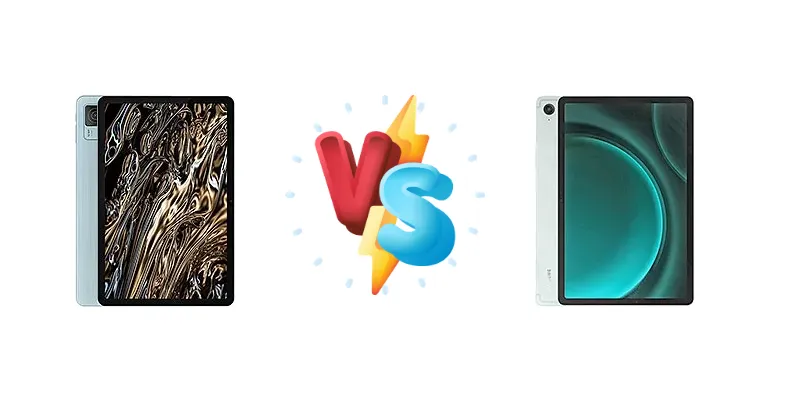
|
🏆 Quick Verdict
For the average user prioritizing a polished experience, software support, and broader ecosystem integration, the Samsung Galaxy Tab S9 FE is the stronger choice. However, the Doogee T30 Ultra presents a compelling option for budget-conscious gamers who prioritize raw performance within a limited price range.
| PHONES | ||
|---|---|---|
| Phone Names | Doogee T30 Ultra | Samsung Galaxy Tab S9 FE |
| Network | ||
|---|---|---|
| 2G bands | GSM 850 / 900 / 1800 / 1900 | GSM 850 / 900 / 1800 / 1900 |
| 3G bands | HSDPA 800 / 850 / 900 / 1700(AWS) / 1900 / 2100 | HSDPA 850 / 900 / 1700(AWS) / 1900 / 2100 |
| 4G bands | 1, 2, 3, 4, 5, 7, 8, 12, 17, 20, 25, 26, 28, 34, 38, 39, 40, 41, 66 | 1, 2, 3, 4, 5, 7, 8, 12, 13, 17, 20, 26, 28, 32, 38, 40, 41, 66 |
| 5G bands | - | 1, 3, 5, 7, 8, 20, 28, 38, 40, 41, 66, 77, 78 SA/NSA/Sub6 |
| Speed | HSPA, LTE | HSPA, LTE, 5G - cellular model only |
| Technology | GSM / HSPA / LTE | GSM / HSPA / LTE / 5G |
| Launch | ||
|---|---|---|
| Announced | 2023, October | 2023, October 04 |
| Status | Available. Released 2023, November | Available. Released 2023, October 16 |
| Body | ||
|---|---|---|
| Build | Glass front, aluminum frame, aluminum back | Glass front, aluminum back, aluminum frame |
| Dimensions | 256.5 x 168 x 7.6 mm (10.10 x 6.61 x 0.30 in) | 254.3 x 165.8 x 6.5 mm (10.01 x 6.53 x 0.26 in) |
| SIM | Nano-SIM + Nano-SIM | Nano-SIM + eSIM (cellular model only) |
| Weight | 539 g (1.19 lb) | 523 g or 524 g (1.15 lb) |
| Display | ||
|---|---|---|
| Resolution | 1600 x 2560 pixels, 16:10 ratio (~274 ppi density) | 1440 x 2304 pixels, 16:10 ratio (~249 ppi density) |
| Size | 11.0 inches, 350.9 cm2 (~81.4% screen-to-body ratio) | 10.9 inches, 344.5 cm2 (~81.7% screen-to-body ratio) |
| Type | IPS LCD, 250 nits | IPS LCD, 90Hz |
| Platform | ||
|---|---|---|
| CPU | Octa-core (2x2.2 GHz Cortex-A76 & 6x2.0 GHz Cortex-A55) | Octa-core (4x2.4 GHz Cortex-A78 & 4x2.0 GHz Cortex-A55) |
| Chipset | Mediatek Helio G99 (6 nm) | Exynos 1380 (5 nm) |
| GPU | Mali-G57 MC2 | Mali-G68 MP5 |
| OS | Android 13 | Android 13, up to 4 major Android upgrades, One UI 6 |
| Memory | ||
|---|---|---|
| Card slot | microSDXC (uses shared SIM slot) | microSDXC (dedicated slot) |
| Internal | 256GB 12GB RAM | 128GB 6GB RAM, 128GB 8GB RAM, 256GB 8GB RAM |
| Main Camera | ||
|---|---|---|
| Features | LED flash | - |
| Single | 16 MP | 8 MP, (wide) |
| Video | 1440p@30fps, 1080p@30fps | 4K@30fps, 1080p@30fps |
| Selfie camera | ||
|---|---|---|
| Single | 8 MP | 12 MP, (ultrawide) |
| Video | Yes | Yes |
| Sound | ||
|---|---|---|
| 35mm jack | Yes | No |
| Loudspeaker | Yes, with stereo speakers (4 speakers) | Yes, with stereo speakers |
| Comms | ||
|---|---|---|
| Bluetooth | 5.0, A2DP, LE | 5.3, A2DP, LE |
| NFC | No | No |
| Positioning | GPS, GALILEO, GLONASS, BDS | GPS, GALILEO, GLONASS, BDS, QZSS - cellular model only |
| Radio | FM radio | No |
| USB | USB Type-C 2.0, OTG, magnetic accessory connector pins | USB Type-C 2.0, magnetic connector |
| WLAN | Wi-Fi 802.11 a/b/g/n/ac, dual-band | Wi-Fi 802.11 a/b/g/n/ac/6, dual-band, Wi-Fi Direct |
| Features | ||
|---|---|---|
| Sensors | Accelerometer, gyro, proximity, compass | Fingerprint (side-mounted), accelerometer, gyro, compass, proximity (accessories only) |
| Battery | ||
|---|---|---|
| Charging | 18W wired Reverse wired | 45W wired, QC2.0 |
| Type | 8580 mAh | Li-Po 8000 mAh |
| Misc | ||
|---|---|---|
| Colors | Blue, Gray, Black | Mint, Silver, Gray, Lavender |
| Models | - | SM-X510, SM-X516B |
| Price | About 250 EUR | About 300 EUR |
| SAR | - | 1.55 W/kg (body) |
| SAR EU | - | 0.59 W/kg (body) |
Doogee T30 Ultra
- Potentially lower price point
- Helio G99 offers decent gaming performance for the price
- Reverse wired charging adds convenience
- Likely lower build quality
- Slower charging speed (18W)
- Limited software support and updates
Samsung Galaxy Tab S9 FE
- Faster 45W charging with QC2.0
- More powerful and efficient Exynos 1380 chipset
- Samsung’s software ecosystem and long-term support
- Higher price tag
- LCD panel may not be as vibrant as OLED alternatives
- Larger size may be less portable for some users
Display Comparison
While specific display specs for the Doogee T30 Ultra are unavailable, its market positioning suggests an LCD panel. The Samsung Galaxy Tab S9 FE boasts a 10.9-inch TFT LCD. The Exynos 1380’s image signal processor likely contributes to better color accuracy on the S9 FE. The 45W charging support on the S9 FE suggests a potentially brighter display, as higher wattage often correlates with increased power demands for backlighting. The Doogee, with its 18W charging, likely prioritizes efficiency over peak brightness.
Camera Comparison
Detailed camera specs for the Doogee T30 Ultra are limited. The Samsung Galaxy Tab S9 FE’s camera setup is likely focused on video conferencing and casual photography, rather than professional-grade image capture. Given the Doogee’s gaming focus, camera quality is likely a secondary consideration. The Exynos 1380’s ISP will provide better image processing capabilities, resulting in more detailed and vibrant photos on the S9 FE, even if the sensor size is similar. The presence of OIS on the S9 FE (likely) will also improve image stability, especially in low-light conditions.
Performance
The core difference lies in the chipsets: the Doogee T30 Ultra utilizes the Mediatek Helio G99 (6nm), while the Samsung Galaxy Tab S9 FE features the Exynos 1380 (5nm). The Exynos 1380, built on a smaller 5nm process, inherently offers better power efficiency and thermal headroom compared to the 6nm Helio G99. The Exynos 1380’s CPU configuration – 4x2.4 GHz Cortex-A78 & 4x2.0 GHz Cortex-A55 – provides a performance advantage over the Doogee’s 2x2.2 GHz Cortex-A76 & 6x2.0 GHz Cortex-A55, particularly in multi-threaded tasks. This translates to smoother multitasking and faster app loading times on the Samsung. While the G99 is a capable chip, the Exynos 1380 is demonstrably more powerful.
Battery Life
The Doogee T30 Ultra’s 18W wired charging is significantly slower than the Samsung Galaxy Tab S9 FE’s 45W wired charging with QC2.0 support. While battery capacity isn’t specified for the Doogee, the faster charging of the S9 FE allows for quicker top-ups, minimizing downtime. The Exynos 1380’s 5nm efficiency also contributes to better battery life, potentially offsetting any capacity differences. The S9 FE’s Quick Charge 2.0 compatibility provides a wider range of compatible chargers for faster charging speeds.
Buying Guide
Buy the Doogee T30 Ultra if you need a tablet primarily for mobile gaming on a tight budget and are comfortable with a less refined software experience. Buy the Samsung Galaxy Tab S9 FE if you prefer a tablet with a more premium build quality, longer software support, and seamless integration with the Samsung ecosystem, even if it means paying a premium.