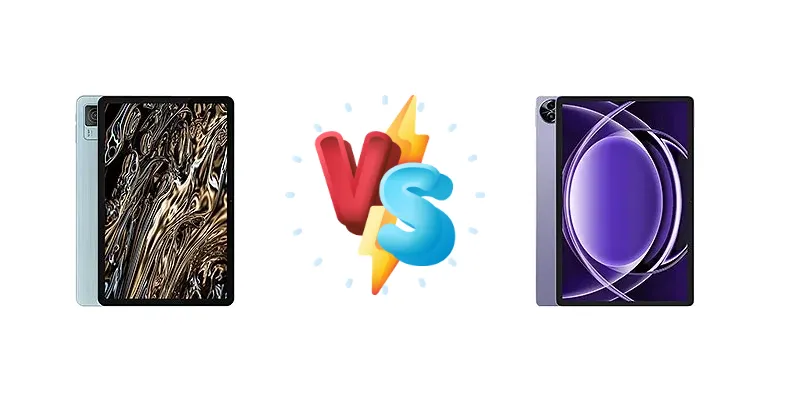
The tablet market is increasingly competitive, with manufacturers offering compelling features at lower price points. Both the Doogee T30 Ultra and the Realme Pad 2 Lite aim to deliver a solid Android tablet experience without breaking the bank. Both devices share the same MediaTek Helio G99 chipset, making the differences lie in the finer details – particularly charging and potential software optimizations. This comparison will dissect those differences to help you choose the right tablet for your needs.
🏆 Quick Verdict
For the average user prioritizing faster charging and potential for reverse wired charging, the Doogee T30 Ultra is the better choice. While the Realme Pad 2 Lite offers a comparable experience, the 18W charging of the T30 Ultra provides a noticeable convenience advantage, especially for those on the go.
| Network |
|---|
| 2G bands | GSM 850 / 900 / 1800 / 1900 | GSM 850 / 900 / 1800 / 1900 |
| 3G bands | HSDPA 800 / 850 / 900 / 1700(AWS) / 1900 / 2100 | HSDPA 850 / 900 / 2100 |
| 4G bands | 1, 2, 3, 4, 5, 7, 8, 12, 17, 20, 25, 26, 28, 34, 38, 39, 40, 41, 66 | 1, 3, 5, 7, 8, 20, 28, 38, 40, 41 |
| Speed | HSPA, LTE | HSPA, LTE |
| Technology | GSM / HSPA / LTE | GSM / HSPA / LTE |
| Launch |
|---|
| Announced | 2023, October | 2024, September 13 |
| Status | Available. Released 2023, November | Available. Released 2024, September 26 |
| Body |
|---|
| Build | Glass front, aluminum frame, aluminum back | - |
| Dimensions | 256.5 x 168 x 7.6 mm (10.10 x 6.61 x 0.30 in) | 258 x 169.5 x 8.3 mm (10.16 x 6.67 x 0.33 in) |
| SIM | Nano-SIM + Nano-SIM | No |
| Weight | 539 g (1.19 lb) | 525 g (1.16 lb) |
| Display |
|---|
| Resolution | 1600 x 2560 pixels, 16:10 ratio (~274 ppi density) | 1200 x 1920 pixels, 16:10 ratio (~207 ppi density) |
| Size | 11.0 inches, 350.9 cm2 (~81.4% screen-to-body ratio) | 10.95 inches, 347.7 cm2 (~79.5% screen-to-body ratio) |
| Type | IPS LCD, 250 nits | IPS LCD, 1B colors, 90Hz, 450 nits (peak) |
| Platform |
|---|
| CPU | Octa-core (2x2.2 GHz Cortex-A76 & 6x2.0 GHz Cortex-A55) | Octa-core (2x2.2 GHz Cortex-A76 & 6x2.0 GHz Cortex-A55) |
| Chipset | Mediatek Helio G99 (6 nm) | Mediatek Helio G99 (6 nm) |
| GPU | Mali-G57 MC2 | Mali-G57 MC2 |
| OS | Android 13 | Android 14, Realme UI 5.0 for Pad |
| Memory |
|---|
| Card slot | microSDXC (uses shared SIM slot) | Unspecified |
| Internal | 256GB 12GB RAM | 128GB 4GB RAM, 128GB 8GB RAM |
| Main Camera |
|---|
| Features | LED flash | Panorama |
| Single | 16 MP | 8 MP, f/2.0 |
| Video | 1440p@30fps, 1080p@30fps | 1080p@30fps |
| Selfie camera |
|---|
| Features | - | Panorama |
| Single | 8 MP | 5 MP, f/2.2 |
| Video | Yes | 1080p@30fps |
| Sound |
|---|
| 35mm jack | Yes | No |
| Loudspeaker | Yes, with stereo speakers (4 speakers) | Yes, with stereo speakers (4 speakers) |
| Comms |
|---|
| Bluetooth | 5.0, A2DP, LE | 5.2, A2DP, LE |
| NFC | No | No |
| Positioning | GPS, GALILEO, GLONASS, BDS | GPS, GALILEO, GLONASS, BDS |
| Radio | FM radio | No |
| USB | USB Type-C 2.0, OTG, magnetic accessory connector pins | USB Type-C |
| WLAN | Wi-Fi 802.11 a/b/g/n/ac, dual-band | Wi-Fi 802.11 a/b/g/n/ac, dual-band |
| Features |
|---|
| Sensors | Accelerometer, gyro, proximity, compass | Accelerometer |
| Battery |
|---|
| Charging | 18W wired
Reverse wired | 15W wired |
| Type | 8580 mAh | 8300 mAh |
| Misc |
|---|
| Colors | Blue, Gray, Black | Nebula Purple, Space Grey |
| Models | - | RMP2402 |
| Price | About 250 EUR | About 160 EUR |
Doogee T30 Ultra
- Faster 18W charging
- Reverse wired charging capability
- Potentially more durable build quality (Doogee's reputation)
- Software experience may be less refined than Realme UI
- Camera performance is unknown
Realme Pad 2 Lite
- Potentially cleaner software experience (Realme UI)
- Competitive price point
- Lightweight design (likely)
- Slower 15W charging
- No reverse wired charging
- Camera performance is unknown
Display Comparison
Both tablets are expected to feature LCD panels, given their price bracket. However, specific details like resolution, peak brightness, and color gamut coverage are not provided. The absence of information regarding refresh rates suggests both likely operate at a standard 60Hz. Bezels are a critical factor in the tablet experience, and without specific measurements, it's difficult to determine which device offers a more immersive viewing experience. Color accuracy will likely be similar, leaning towards acceptable for media consumption rather than professional color work.
Camera Comparison
Camera performance is unlikely to be a key differentiator in this price range. Details regarding sensor sizes and lens apertures are missing. It's safe to assume both tablets will feature a primary camera and potentially a secondary depth or macro sensor. Image processing will play a significant role, and Realme has a history of aggressive image sharpening. The Doogee T30 Ultra’s camera performance will likely be more natural, but without sample images, it’s difficult to assess the quality accurately. Focusing on the primary sensor’s megapixel count is misleading without knowing the sensor size.
Performance
The core of both tablets is the MediaTek Helio G99 (6nm). This chipset features an octa-core CPU configuration with 2x2.2 GHz Cortex-A76 cores and 6x2.0 GHz Cortex-A55 cores. This means both devices will deliver similar performance in everyday tasks like browsing, video streaming, and light gaming. The 6nm process node offers a good balance between performance and power efficiency. RAM configurations are not specified, but the performance will be heavily influenced by the amount of RAM and its speed (LPDDR4X is likely). Thermal management will be crucial; sustained performance will depend on how effectively each tablet dissipates heat, but without specific cooling solutions detailed, it's difficult to predict which will perform better under prolonged load.
Battery Life
Battery capacity is not specified for either device. However, the charging wattage is a key difference: the Doogee T30 Ultra supports 18W wired charging with reverse wired charging, while the Realme Pad 2 Lite is limited to 15W wired charging. This 3W difference translates to a faster 0-100% charge time for the T30 Ultra. The inclusion of reverse wired charging on the T30 Ultra is a significant advantage, allowing it to function as a power bank for other devices. Without knowing the battery capacity, it’s difficult to estimate real-world battery life, but the faster charging of the T30 Ultra will be appreciated by users who frequently need to top up their device.
Buying Guide
Buy the Doogee T30 Ultra if you need a tablet with faster charging capabilities and the flexibility of reverse wired charging to top up other devices. This makes it ideal for travelers or users who rely heavily on their tablet throughout the day. Buy the Realme Pad 2 Lite if you prioritize a slightly cleaner software experience (based on Realme’s UI history) and are less concerned about charging speed, or if you find it at a significantly lower price point.
Frequently Asked Questions
❓ Will the Doogee T30 Ultra’s 18W charging significantly reduce charging time compared to the Realme Pad 2 Lite’s 15W?
While the difference is 3W, it will result in a noticeable reduction in charging time, especially from lower battery percentages. Expect the T30 Ultra to reach full charge approximately 15-20% faster, depending on usage during charging. This is particularly beneficial for users who need a quick top-up before heading out.
❓ Can the Doogee T30 Ultra’s reverse wired charging effectively charge a smartphone?
Yes, the Doogee T30 Ultra can charge a smartphone, but the charging speed will be limited by the tablet’s 18W output and the smartphone’s charging capabilities. It won’t be as fast as a dedicated wall charger, but it’s a convenient option for emergency situations or when a wall outlet isn’t available.
❓ Given both tablets use the Helio G99, will gaming performance be identical?
Not necessarily. While the chipset is the same, sustained gaming performance will depend on the tablet’s thermal management. If one tablet manages heat more effectively, it will maintain higher clock speeds for longer periods, resulting in smoother gameplay. RAM configuration and storage speed also play a role.