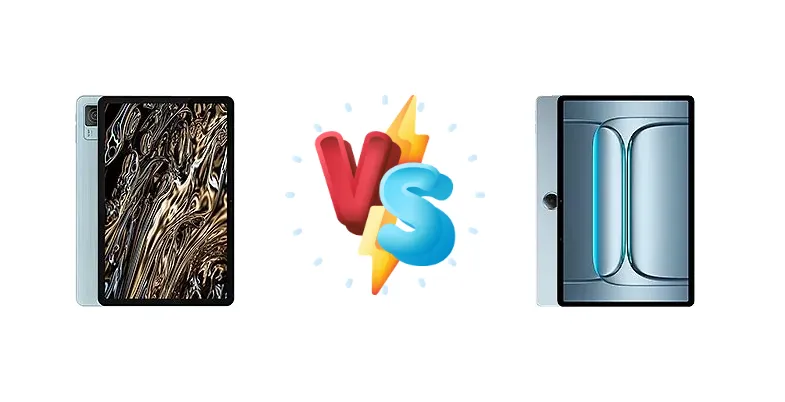
The tablet market is heating up with compelling budget options. We pit the Doogee T30 Ultra, known for its rugged build quality and affordability, against the OnePlus Pad Lite, a streamlined offering from a well-established brand. Both leverage Mediatek’s Helio G-series, but key differences in charging and potential software optimization make this a worthwhile comparison for users seeking a versatile, portable display.
🏆 Quick Verdict
For the average user prioritizing faster charging and a potentially smoother software experience, the OnePlus Pad Lite emerges as the winner. Its 33W charging significantly reduces downtime compared to the Doogee T30 Ultra’s 18W. However, the Doogee offers a compelling value proposition if charging speed isn't a primary concern.
| Network |
|---|
| 2G bands | GSM 850 / 900 / 1800 / 1900 | GSM 850 / 900 / 1800 / 1900 - cellular model only |
| 3G bands | HSDPA 800 / 850 / 900 / 1700(AWS) / 1900 / 2100 | HSDPA 850 / 900 / 2100 - cellular model only |
| 4G bands | 1, 2, 3, 4, 5, 7, 8, 12, 17, 20, 25, 26, 28, 34, 38, 39, 40, 41, 66 | LTE - cellular model only |
| Speed | HSPA, LTE | HSPA, LTE - cellular model only |
| Technology | GSM / HSPA / LTE | GSM / HSPA / LTE |
| Launch |
|---|
| Announced | 2023, October | 2025, July 08 |
| Status | Available. Released 2023, November | Available. Released 2025, August 14 |
| Body |
|---|
| Build | Glass front, aluminum frame, aluminum back | - |
| Dimensions | 256.5 x 168 x 7.6 mm (10.10 x 6.61 x 0.30 in) | 254.9 x 166.5 x 7.4 mm (10.04 x 6.56 x 0.29 in) |
| SIM | Nano-SIM + Nano-SIM | Yes - cellular model only |
| Weight | 539 g (1.19 lb) | 530 g (1.17 lb) |
| Display |
|---|
| Resolution | 1600 x 2560 pixels, 16:10 ratio (~274 ppi density) | 1200 x 1920 pixels, 16:10 ratio (~207 ppi density) |
| Size | 11.0 inches, 350.9 cm2 (~81.4% screen-to-body ratio) | 11.0 inches, 347.5 cm2 (~81.9% screen-to-body ratio) |
| Type | IPS LCD, 250 nits | IPS LCD, 1B colors, 90Hz, 500 nits |
| Platform |
|---|
| CPU | Octa-core (2x2.2 GHz Cortex-A76 & 6x2.0 GHz Cortex-A55) | Octa-core (2x2.2 GHz Cortex-A76 & 6x2.0 GHz Cortex-A55) |
| Chipset | Mediatek Helio G99 (6 nm) | Mediatek Helio G100 (6 nm) |
| GPU | Mali-G57 MC2 | Mali-G57 MC2 |
| OS | Android 13 | Android 15, OxygenOS 15 |
| Memory |
|---|
| Card slot | microSDXC (uses shared SIM slot) | Unspecified |
| Internal | 256GB 12GB RAM | 128GB 6GB RAM, 128GB 8GB RAM |
| Main Camera |
|---|
| Features | LED flash | - |
| Single | 16 MP | 5 MP |
| Video | 1440p@30fps, 1080p@30fps | 1080p@30fps |
| Selfie camera |
|---|
| Single | 8 MP | 5 MP |
| Video | Yes | 1080p@30fps |
| Sound |
|---|
| 35mm jack | Yes | No |
| Loudspeaker | Yes, with stereo speakers (4 speakers) | Yes, with stereo speakers (4 speakers, Hi-Res audio) |
| Comms |
|---|
| Bluetooth | 5.0, A2DP, LE | 5.2, A2DP, LE, aptX HD |
| NFC | No | No |
| Positioning | GPS, GALILEO, GLONASS, BDS | GPS, (cellular model only) - unconfirmed |
| Radio | FM radio | No |
| USB | USB Type-C 2.0, OTG, magnetic accessory connector pins | USB Type-C 2.0 |
| WLAN | Wi-Fi 802.11 a/b/g/n/ac, dual-band | Wi-Fi 802.11 a/b/g/n/ac, dual-band |
| Features |
|---|
| Sensors | Accelerometer, gyro, proximity, compass | Unspecified |
| Battery |
|---|
| Charging | 18W wired
Reverse wired | 33W wired |
| Type | 8580 mAh | Li-Po 9340 mAh |
| Misc |
|---|
| Colors | Blue, Gray, Black | Aero Blue |
| Models | - | OPD2480 |
| Price | About 250 EUR | About 200 EUR |
Doogee T30 Ultra
- Potentially more rugged build quality (Doogee's brand reputation)
- Likely lower price point
- Helio G99 is a proven performer
- Slower 18W charging
- Unspecified battery capacity
- Potentially less refined software experience
OnePlus Pad Lite
- Faster 33W charging
- OnePlus's reputation for software optimization
- Slightly newer Helio G100 chipset
- Likely higher price point
- Unspecified battery capacity
- May lack the ruggedness of the Doogee
Display Comparison
Neither Doogee nor OnePlus provided display specs beyond the chipset. Given the price point, both tablets likely utilize IPS LCD panels. The absence of details like resolution, refresh rate, or peak brightness suggests a focus on cost optimization. Users should expect adequate, but not exceptional, viewing experiences. Bezels are likely to be noticeable on both devices, contributing to their budget status. Color accuracy will likely be standard for this segment, requiring calibration for professional use.
Camera Comparison
Camera details are absent for both devices, making a direct comparison difficult. Given the budget nature of these tablets, expectations should be tempered. It's reasonable to assume both will feature a primary rear camera and a front-facing camera for video calls. The absence of information suggests neither device prioritizes photography. Any additional sensors are likely to be low-resolution depth or macro cameras, offering limited practical value. Image processing will likely be basic, relying on software algorithms to enhance photos.
Performance
Both the Doogee T30 Ultra and OnePlus Pad Lite are powered by octa-core CPUs featuring the same core configuration: 2x2.2 GHz Cortex-A76 and 6x2.0 GHz Cortex-A55. However, the key difference lies in the chipset: the Doogee utilizes the Mediatek Helio G99 (6nm), while the OnePlus employs the Helio G100 (also 6nm). While architecturally similar, the G100 is a slightly newer iteration, potentially offering minor improvements in efficiency and GPU performance. Both devices will handle everyday tasks and light gaming adequately, but demanding titles may require reduced settings. The impact of RAM speed (likely LPDDR4X in both) is minimal given the chipset limitations. Thermal management will be crucial; the 6nm process should help, but sustained loads could lead to throttling.
Battery Life
The battery capacity remains unspecified for both tablets. However, the charging wattage is a significant differentiator. The OnePlus Pad Lite boasts 33W wired charging, enabling significantly faster top-ups compared to the Doogee T30 Ultra’s 18W. This translates to less downtime and greater convenience for users who frequently use their tablets on the go. While a larger battery capacity on the Doogee could partially offset the slower charging, the 33W advantage of the OnePlus is substantial. Expect the OnePlus Pad Lite to achieve a full charge in considerably less time than the Doogee T30 Ultra.
Buying Guide
Buy the Doogee T30 Ultra if you need a durable, no-frills tablet for basic productivity, media consumption, and occasional gaming, and are comfortable with slower charging speeds. Buy the OnePlus Pad Lite if you prioritize faster charging, a potentially cleaner software experience, and are willing to spend slightly more for the convenience of quicker power-ups. Both are excellent choices for students or casual users.
Frequently Asked Questions
❓ Is the Mediatek Helio G100 in the OnePlus Pad Lite noticeably faster than the Helio G99 in the Doogee T30 Ultra for gaming?
While both chipsets share the same CPU core configuration, the Helio G100 is a slightly newer iteration. Expect a marginal performance improvement in GPU-intensive tasks like gaming, but the difference won't be dramatic. Both tablets will likely require reduced graphics settings for smoother gameplay in demanding titles.
❓ How long will it take to fully charge the OnePlus Pad Lite with its 33W charging compared to the Doogee T30 Ultra's 18W?
Without knowing the battery capacity of either tablet, it's difficult to provide precise figures. However, 33W charging is significantly faster than 18W. Expect the OnePlus Pad Lite to charge from 0-100% in approximately 2-2.5 hours, while the Doogee T30 Ultra could take 3-4 hours or longer.
❓ Do either of these tablets support microSD card expansion for additional storage?
This information is not provided in the specifications. However, given the budget nature of these tablets, microSD card support is a likely feature, allowing users to expand storage capacity affordably. Check the product listings for confirmation.