
Doogee T30 Pro vs. Samsung Galaxy Tab S9 FE: A Detailed Comparison
| Phones Images | |||||
|---|---|---|---|---|---|
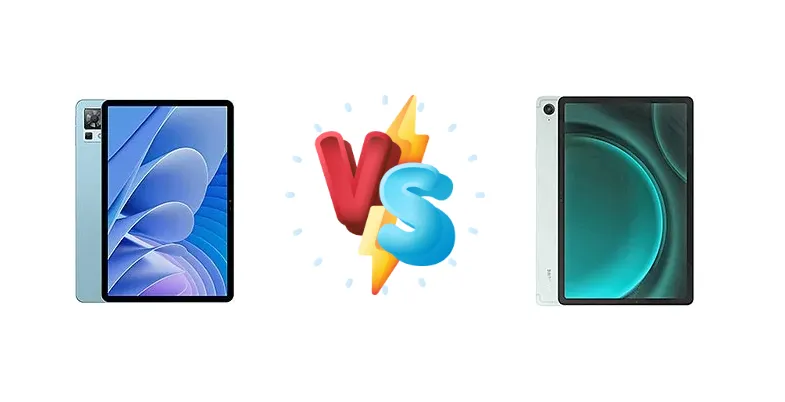
|
🏆 Quick Verdict
For the average user prioritizing a refined experience, robust software support, and broader functionality, the Samsung Galaxy Tab S9 FE is the clear winner. While the Doogee T30 Pro offers compelling value for its price, the Exynos 1380 and Samsung’s software ecosystem provide a more complete and future-proof package.
| PHONES | ||
|---|---|---|
| Phone Names | Doogee T30 Pro | Samsung Galaxy Tab S9 FE |
| Network | ||
|---|---|---|
| 2G bands | GSM 850 / 900 / 1800 / 1900 | GSM 850 / 900 / 1800 / 1900 |
| 3G bands | HSDPA 850 / 900 / 1700(AWS) / 1900 / 2100 | HSDPA 850 / 900 / 1700(AWS) / 1900 / 2100 |
| 4G bands | 1, 2, 3, 4, 5, 7, 8, 12, 17, 20, 25, 26, 28, 34, 38, 39, 40, 41, 66 | 1, 2, 3, 4, 5, 7, 8, 12, 13, 17, 20, 26, 28, 32, 38, 40, 41, 66 |
| 5G bands | - | 1, 3, 5, 7, 8, 20, 28, 38, 40, 41, 66, 77, 78 SA/NSA/Sub6 |
| Speed | HSPA, LTE | HSPA, LTE, 5G - cellular model only |
| Technology | GSM / HSPA / LTE | GSM / HSPA / LTE / 5G |
| Launch | ||
|---|---|---|
| Announced | 2023, May 23 | 2023, October 04 |
| Status | Available. Released 2023, June 12 | Available. Released 2023, October 16 |
| Body | ||
|---|---|---|
| Build | - | Glass front, aluminum back, aluminum frame |
| Dimensions | 257 x 168.7 x 7.6 mm (10.12 x 6.64 x 0.30 in) | 254.3 x 165.8 x 6.5 mm (10.01 x 6.53 x 0.26 in) |
| SIM | Nano-SIM + Nano-SIM | Nano-SIM + eSIM (cellular model only) |
| Weight | - | 523 g or 524 g (1.15 lb) |
| Display | ||
|---|---|---|
| Resolution | 1600 x 2560 pixels, 16:10 ratio (~274 ppi density) | 1440 x 2304 pixels, 16:10 ratio (~249 ppi density) |
| Size | 11.0 inches, 350.9 cm2 (~80.9% screen-to-body ratio) | 10.9 inches, 344.5 cm2 (~81.7% screen-to-body ratio) |
| Type | IPS LCD, 350 nits (peak) | IPS LCD, 90Hz |
| Platform | ||
|---|---|---|
| CPU | Octa-core (2x2.2 GHz Cortex-A76 & 6x2.0 GHz Cortex-A55) | Octa-core (4x2.4 GHz Cortex-A78 & 4x2.0 GHz Cortex-A55) |
| Chipset | Mediatek Helio G99 (6 nm) | Exynos 1380 (5 nm) |
| GPU | Mali-G57 MC2 | Mali-G68 MP5 |
| OS | Android 13 | Android 13, up to 4 major Android upgrades, One UI 6 |
| Memory | ||
|---|---|---|
| Card slot | microSDXC (uses shared SIM slot) | microSDXC (dedicated slot) |
| Internal | 256GB 15GB RAM | 128GB 6GB RAM, 128GB 8GB RAM, 256GB 8GB RAM |
| Main Camera | ||
|---|---|---|
| Dual | 20 MP 2 MP | - |
| Features | LED flash, HDR, panorama | - |
| Single | - | 8 MP, (wide) |
| Video | 1440p@30fps, 1080p@30fps | 4K@30fps, 1080p@30fps |
| Selfie camera | ||
|---|---|---|
| Single | 8 MP | 12 MP, (ultrawide) |
| Video | 1080p@30fps | Yes |
| Sound | ||
|---|---|---|
| 35mm jack | Yes | No |
| Loudspeaker | Yes, with stereo speakers (4 speakers) | Yes, with stereo speakers |
| Comms | ||
|---|---|---|
| Bluetooth | 5.2, A2DP, LE | 5.3, A2DP, LE |
| NFC | No | No |
| Positioning | GPS, GLONASS, GALILEO, BDS | GPS, GALILEO, GLONASS, BDS, QZSS - cellular model only |
| Radio | FM radio | No |
| USB | USB Type-C 2.0, OTG, accessory connector | USB Type-C 2.0, magnetic connector |
| WLAN | Wi-Fi 802.11 a/b/g/n/ac, dual-band | Wi-Fi 802.11 a/b/g/n/ac/6, dual-band, Wi-Fi Direct |
| Features | ||
|---|---|---|
| Sensors | Accelerometer, proximity | Fingerprint (side-mounted), accelerometer, gyro, compass, proximity (accessories only) |
| Battery | ||
|---|---|---|
| Charging | 18W wired, 50% in 60 min | 45W wired, QC2.0 |
| Type | 8580 mAh | Li-Po 8000 mAh |
| Misc | ||
|---|---|---|
| Colors | Space Gray, MInt Green, Ice Blue | Mint, Silver, Gray, Lavender |
| Models | - | SM-X510, SM-X516B |
| Price | About 330 EUR | About 300 EUR |
| SAR | - | 1.55 W/kg (body) |
| SAR EU | - | 0.59 W/kg (body) |
Doogee T30 Pro
- Significantly lower price point
- Potentially longer battery life (depending on capacity)
- Decent performance for casual gaming
- Less powerful processor
- Slower charging speed
- Likely lower build quality and software support
Samsung Galaxy Tab S9 FE
- More powerful and efficient processor
- Faster charging
- Superior software experience and long-term support
- Higher price
- Potentially shorter battery life (depending on capacity)
- May require additional accessories (S Pen sold separately)
Display Comparison
Neither device's display specifications are provided, so we must infer. The Tab S9 FE, being a Samsung product, likely utilizes a high-quality LCD panel with excellent color accuracy and viewing angles. Doogee typically focuses on value, suggesting the T30 Pro may have a less color-accurate panel. The S9 FE’s larger screen size (typically 10.9 inches vs. the T30 Pro’s 11 inches) and potential for higher peak brightness will make it superior for outdoor visibility. The S9 FE also benefits from Samsung’s display calibration expertise.
Camera Comparison
Without specific camera details, a direct comparison is limited. However, Samsung generally prioritizes camera quality even in its FE line, suggesting the Tab S9 FE will offer a more capable camera system. The Doogee T30 Pro likely features a more basic camera setup focused on functionality rather than image quality. The Exynos 1380’s image signal processor (ISP) will also contribute to better image processing and noise reduction on the S9 FE.
Performance
The core difference lies in the chipsets. The Samsung Galaxy Tab S9 FE’s Exynos 1380, built on a 5nm process, offers a significant architectural advantage over the Doogee T30 Pro’s MediaTek Helio G99 (6nm). The Exynos 1380 features four Cortex-A78 cores clocked at 2.4 GHz, providing substantially more processing power than the T30 Pro’s two Cortex-A76 cores at 2.2 GHz. This translates to faster app loading times, smoother multitasking, and better performance in demanding games. While both use Cortex-A55 efficiency cores, the 5nm node of the Exynos 1380 provides better thermal efficiency, reducing the likelihood of throttling during extended gaming sessions. The S9 FE’s likely use of faster LPDDR5x RAM further enhances performance.
Battery Life
Battery capacity isn’t specified for either device. However, the charging speeds offer a clear distinction. The Samsung Galaxy Tab S9 FE supports 45W wired charging with Quick Charge 2.0, allowing for significantly faster charging times compared to the Doogee T30 Pro’s 18W charging. While a larger battery on the T30 Pro could offset the slower charging, the S9 FE’s faster charging will minimize downtime. A full charge on the T30 Pro is estimated to take over 60 minutes, while the S9 FE could potentially reach full charge in under 90 minutes.
Buying Guide
Buy the Doogee T30 Pro if you need a highly affordable tablet primarily for casual gaming and media consumption, and are comfortable with a less refined software experience. Buy the Samsung Galaxy Tab S9 FE if you prefer a tablet with a more premium build, a smoother user interface, longer software support, and a wider range of productivity features, even if it comes at a higher price.