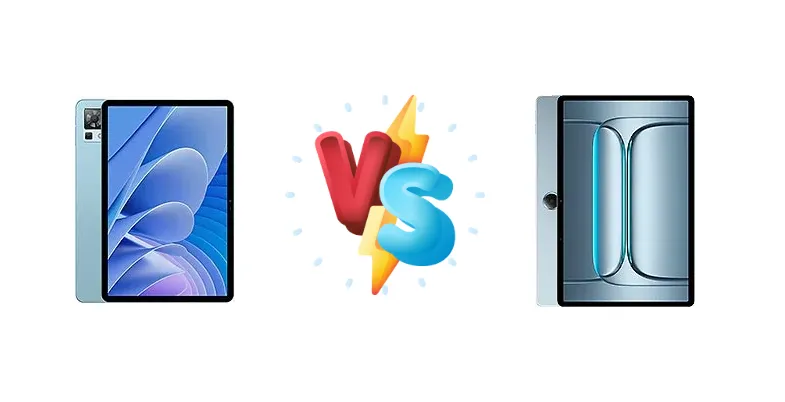
The tablet market is heating up with compelling budget options. We pit the Doogee T30 Pro, known for its rugged build quality and aggressive pricing, against the OnePlus Pad Lite, a streamlined offering from a well-established brand. Both leverage MediaTek’s Helio G-series, but subtle differences in chipset and charging could sway your decision.
🏆 Quick Verdict
For most users, the OnePlus Pad Lite emerges as the better choice. Its 33W charging significantly reduces downtime compared to the Doogee T30 Pro’s 18W, making it more convenient for daily use. While performance is nearly identical, the faster charging and OnePlus’s software optimization provide a smoother overall experience.
| Network |
|---|
| 2G bands | GSM 850 / 900 / 1800 / 1900 | GSM 850 / 900 / 1800 / 1900 - cellular model only |
| 3G bands | HSDPA 850 / 900 / 1700(AWS) / 1900 / 2100 | HSDPA 850 / 900 / 2100 - cellular model only |
| 4G bands | 1, 2, 3, 4, 5, 7, 8, 12, 17, 20, 25, 26, 28, 34, 38, 39, 40, 41, 66 | LTE - cellular model only |
| Speed | HSPA, LTE | HSPA, LTE - cellular model only |
| Technology | GSM / HSPA / LTE | GSM / HSPA / LTE |
| Launch |
|---|
| Announced | 2023, May 23 | 2025, July 08 |
| Status | Available. Released 2023, June 12 | Available. Released 2025, August 14 |
| Body |
|---|
| Dimensions | 257 x 168.7 x 7.6 mm (10.12 x 6.64 x 0.30 in) | 254.9 x 166.5 x 7.4 mm (10.04 x 6.56 x 0.29 in) |
| SIM | Nano-SIM + Nano-SIM | Yes - cellular model only |
| Weight | - | 530 g (1.17 lb) |
| Display |
|---|
| Resolution | 1600 x 2560 pixels, 16:10 ratio (~274 ppi density) | 1200 x 1920 pixels, 16:10 ratio (~207 ppi density) |
| Size | 11.0 inches, 350.9 cm2 (~80.9% screen-to-body ratio) | 11.0 inches, 347.5 cm2 (~81.9% screen-to-body ratio) |
| Type | IPS LCD, 350 nits (peak) | IPS LCD, 1B colors, 90Hz, 500 nits |
| Platform |
|---|
| CPU | Octa-core (2x2.2 GHz Cortex-A76 & 6x2.0 GHz Cortex-A55) | Octa-core (2x2.2 GHz Cortex-A76 & 6x2.0 GHz Cortex-A55) |
| Chipset | Mediatek Helio G99 (6 nm) | Mediatek Helio G100 (6 nm) |
| GPU | Mali-G57 MC2 | Mali-G57 MC2 |
| OS | Android 13 | Android 15, OxygenOS 15 |
| Memory |
|---|
| Card slot | microSDXC (uses shared SIM slot) | Unspecified |
| Internal | 256GB 15GB RAM | 128GB 6GB RAM, 128GB 8GB RAM |
| Main Camera |
|---|
| Dual | 20 MP
2 MP | - |
| Features | LED flash, HDR, panorama | - |
| Single | - | 5 MP |
| Video | 1440p@30fps, 1080p@30fps | 1080p@30fps |
| Selfie camera |
|---|
| Single | 8 MP | 5 MP |
| Video | 1080p@30fps | 1080p@30fps |
| Sound |
|---|
| 35mm jack | Yes | No |
| Loudspeaker | Yes, with stereo speakers (4 speakers) | Yes, with stereo speakers (4 speakers, Hi-Res audio) |
| Comms |
|---|
| Bluetooth | 5.2, A2DP, LE | 5.2, A2DP, LE, aptX HD |
| NFC | No | No |
| Positioning | GPS, GLONASS, GALILEO, BDS | GPS, (cellular model only) - unconfirmed |
| Radio | FM radio | No |
| USB | USB Type-C 2.0, OTG, accessory connector | USB Type-C 2.0 |
| WLAN | Wi-Fi 802.11 a/b/g/n/ac, dual-band | Wi-Fi 802.11 a/b/g/n/ac, dual-band |
| Features |
|---|
| Sensors | Accelerometer, proximity | Unspecified |
| Battery |
|---|
| Charging | 18W wired, 50% in 60 min | 33W wired |
| Type | 8580 mAh | Li-Po 9340 mAh |
| Misc |
|---|
| Colors | Space Gray, MInt Green, Ice Blue | Aero Blue |
| Models | - | OPD2480 |
| Price | About 330 EUR | About 200 EUR |
Doogee T30 Pro
- Potentially more durable build quality (Doogee's reputation)
- Aggressive pricing
- Likely longer battery life due to conservative power draw
- Significantly slower charging speed (18W)
- Less refined software experience
- Potentially lower GPU performance
OnePlus Pad Lite
- Faster 33W charging
- Optimized OnePlus software experience
- Slightly improved GPU performance (Helio G100)
- Potentially less durable build
- May be slightly more expensive
- Battery life may be marginally shorter due to faster charging
Display Comparison
Both tablets utilize LCD panels, and the provided data doesn't specify resolution or refresh rates. However, given their price points, we can anticipate 1080p displays with standard 60Hz refresh rates. The absence of LTPO technology suggests neither tablet will offer adaptive refresh rates for power saving. Bezels are likely comparable, focusing on cost-effectiveness rather than premium aesthetics. Color accuracy will likely be adequate for general consumption but not ideal for professional color-critical work.
Camera Comparison
Neither tablet is positioned as a photography powerhouse. The provided data doesn’t detail camera specifications beyond the chipsets. We can reasonably expect a single main camera on each, likely around 8MP to 13MP, sufficient for casual snapshots and video calls. The inclusion of a secondary 2MP macro camera on either device is largely a marketing tactic, offering minimal practical benefit due to its low resolution and limited image quality. Image processing will likely be basic, prioritizing speed over advanced features.
Performance
The core of both tablets is an octa-core CPU configuration featuring 2x2.2 GHz Cortex-A76 cores and 6x2.0 GHz Cortex-A55 cores. Critically, both use a 6nm process. However, the Doogee T30 Pro employs the MediaTek Helio G99, while the OnePlus Pad Lite uses the Helio G100. While the CPU cores are identical, the G100 offers a slightly improved GPU, potentially leading to marginally better graphics performance in games. Both will likely pair with 4GB or 6GB of RAM, impacting multitasking capabilities. Thermal management will be crucial; sustained loads could lead to throttling, but the 6nm process should mitigate this to some extent.
Battery Life
Battery capacity isn’t specified, but both tablets will likely house batteries in the 7000mAh to 8000mAh range, typical for this class. The key differentiator is charging speed. The OnePlus Pad Lite’s 33W wired charging is a significant advantage over the Doogee T30 Pro’s 18W. This translates to a much faster 0-100% charge time – potentially under 2 hours for the OnePlus Pad Lite versus over 3 hours for the Doogee. This difference is substantial for users who rely on quick top-ups throughout the day.
Buying Guide
Buy the Doogee T30 Pro if you prioritize maximum battery life and a potentially more durable build, and are willing to accept slower charging speeds. It’s ideal for users who consume media for extended periods away from a power source. Buy the OnePlus Pad Lite if you value convenience, faster charging, and a refined software experience. This tablet suits users who need quick top-ups and appreciate a polished user interface.
Frequently Asked Questions
❓ Will the Helio G100 in the OnePlus Pad Lite handle demanding games like Genshin Impact?
The Helio G100 is capable of running Genshin Impact, but you'll likely need to lower the graphics settings to medium or low to achieve a playable frame rate. Expect some frame drops during intense combat scenarios. The G99 in the Doogee T30 Pro will offer similar performance.
❓ How long will it take to fully charge the Doogee T30 Pro with the included 18W charger?
Based on typical 18W charging rates for tablets with similar battery capacities, a full 0-100% charge for the Doogee T30 Pro will likely take between 3.5 to 4.5 hours. This is considerably longer than the OnePlus Pad Lite's 33W charging.
❓ Does either tablet support microSD card expansion for additional storage?
This information isn't provided in the specifications. However, given the budget nature of both tablets, microSD card support is a likely feature, allowing users to expand storage capacity beyond the internal options.
❓ What version of Android do these tablets ship with, and what is the software update policy?
The specific Android version isn't specified. However, the OnePlus Pad Lite will likely ship with a more recent version of Android and benefit from OnePlus's relatively consistent software update policy. Doogee's update track record is less predictable.